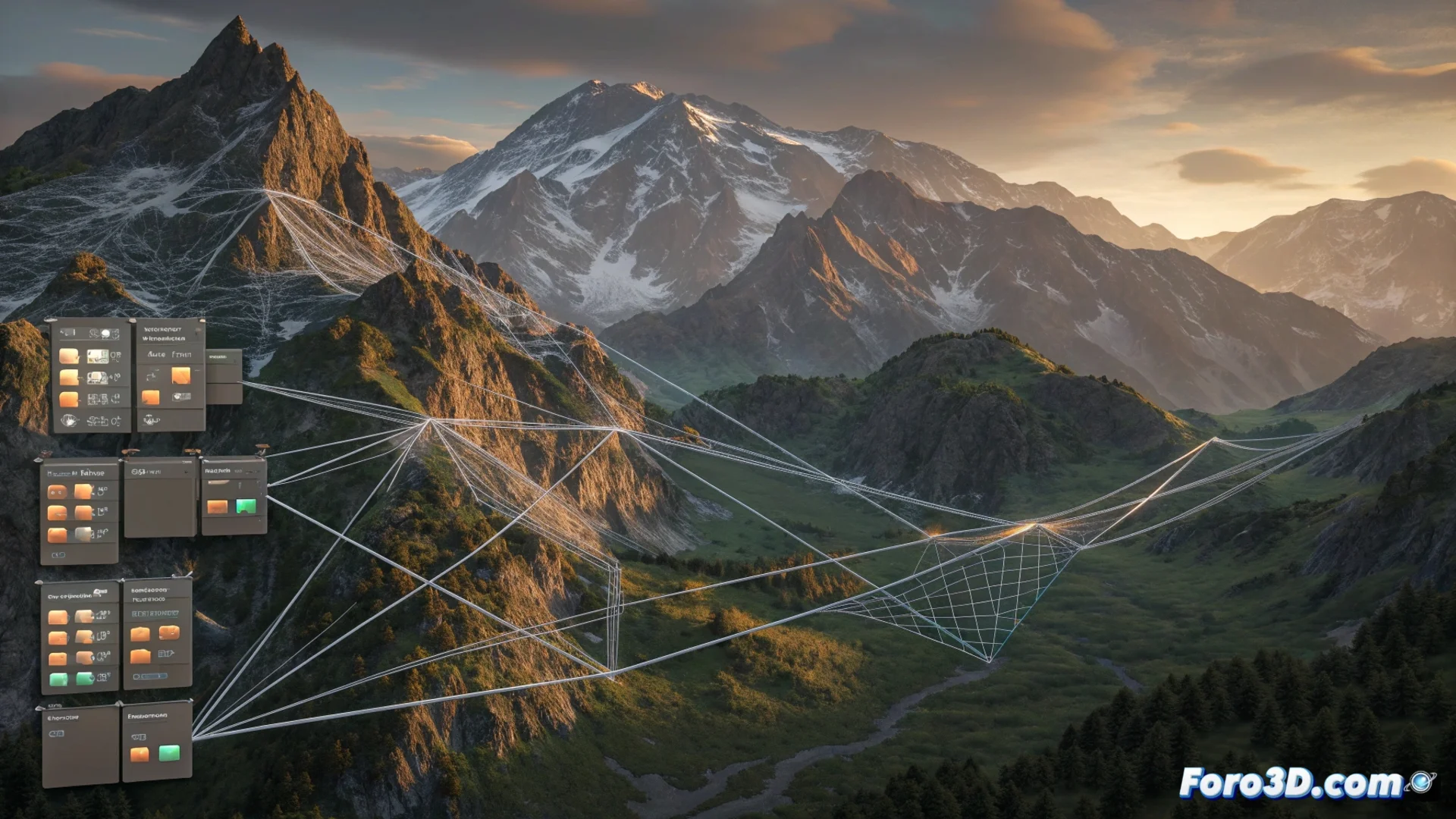
Houdini SOP: the nodal context for modeling and deforming geometries
In the Houdini ecosystem, the SOP (Surface Operator) context forms the core where artists and technicians build and alter geometry. 🛠️ This environment is based on organizing a chain of nodes that process mesh data in a sequential and logical manner, defining a completely procedural workflow.
The architecture of a procedural network
The power of SOP lies in its structure. Geometric data travels from one node to another, being transformed at each stage. An initial node, such as Grid or Box, generates the base shape. Subsequently, operators like Transform, Subdivide, or Mountain deform it, subdivide it, or add detail. The user can insert, delete, or reconfigure these nodes at any time, which redefines the final result without losing previous stages.
Key advantages of the nodal workflow:- Non-destructiveness: You can go back to any point in the chain to adjust values, test alternative configurations, or branch the network to create variants.
- Absolute parametric control: Each node's parameters can be animated or linked to expressions and variables, allowing the creation of complex and dynamic effects governed by rules.
- Automatic updates: A change in an initial parameter propagates intelligently through the entire network, updating the final model in a coherent and predictable way.
This is the space where a cube can dream of becoming a mountain, and with a few nodes, that dream becomes reality without the need to manually sculpt each vertex.
Practical applications of the SOP context
This approach is fundamental for advanced tasks in visual effects and modeling. By relying on editable rules rather than fixed irreversible actions, it becomes the foundation for building scalable and flexible systems.
Essential use cases:- Creating extensive environments: Procedurally generate landscapes, cities, or complex scenes, where a change in the seed or parameters alters the entire ecosystem.
- Simulating dynamic effects: Build the bases for disintegrations, fractures, or deformations that respond to forces and animations.
- Designing custom tools: Develop proprietary modeling systems that automate repetitive tasks and allow quick exploration of design variations.
The essence of procedural modeling
The SOP context encapsulates Houdini's philosophy: building through logic and parameters. It facilitates iteration and experimentation, as geometry transforms according to user-defined rules. This method not only speeds up work but also opens the door to a level of control and complexity unattainable with traditional destructive modeling techniques. 🚀 The ability to edit the history of operations at any time turns the creative process into a continuous dialogue with the geometry.