Houdini Integrates Machine Learning Solvers into Its Simulation Ecosystem
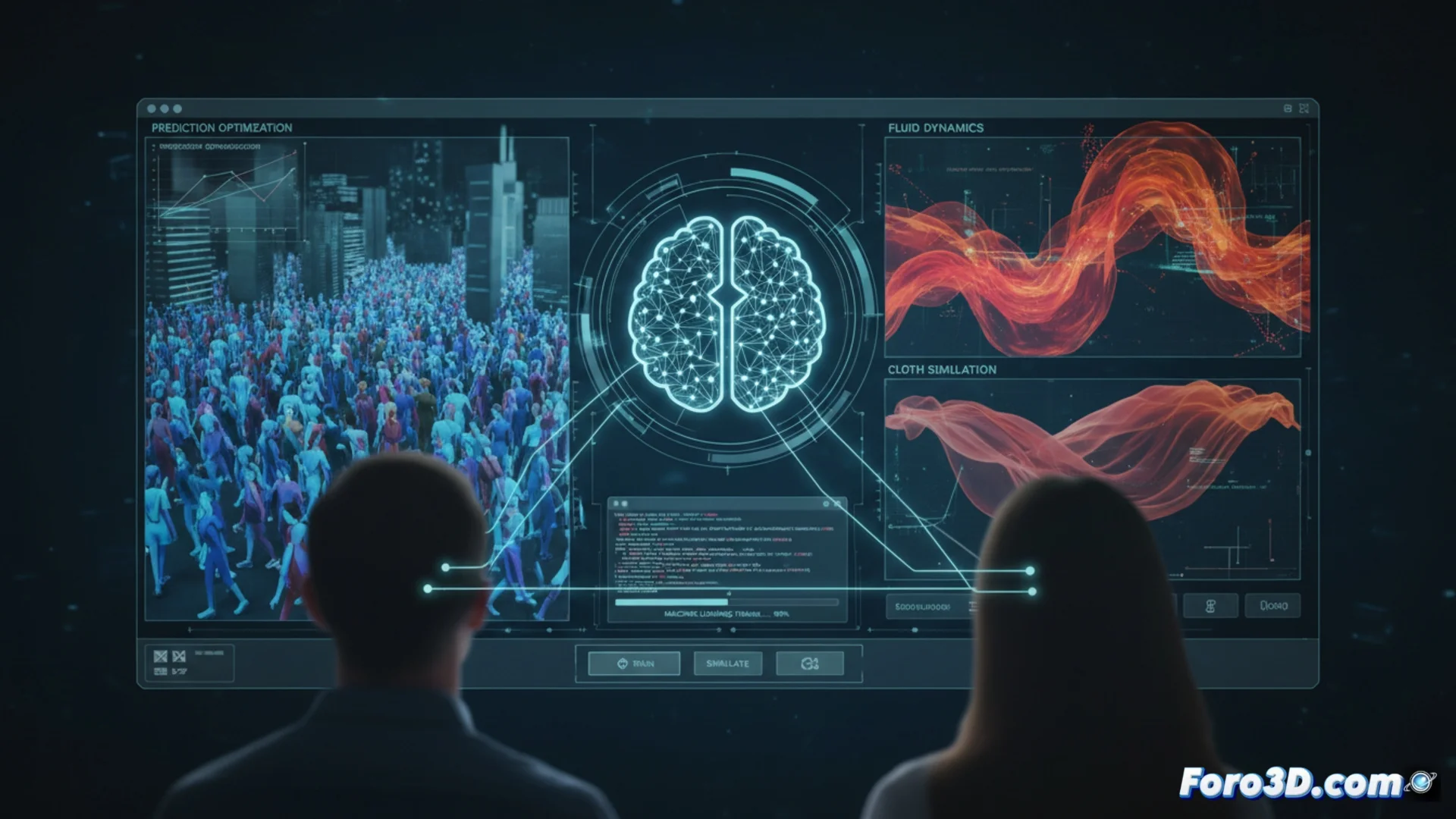
The Houdini software has incorporated machine learning-based tools directly into its simulation core. This integration allows users to train predictive models that can optimize and anticipate complex dynamic behaviors. Artists and technicians can apply this technology to handle crowd simulations, fluid dynamics, or fabrics more efficiently. The system learns from generated data to produce faster or more realistic results. However, fully leveraging these capabilities requires a high technical profile, combining solid mastery of simulation principles with machine learning fundamentals. 🧠
Mechanics of AI Models in a Simulation Environment
The process begins when the user generates a simulation dataset within Houdini. This information is used to train a neural network. Once the model completes its training, it can predict results without needing to calculate each physical step using traditional methods. This dramatically accelerates iterations and opens the door to exploring more creative alternatives. For example, a model can be taught to understand the organic movement of a crowd dodging obstacles. Subsequently, this model generates credible trajectories in fractions of a second, a process that a conventional physical simulation would take much longer. ⚡
Key Advantages of This Approach:- Accelerate Iterations: Trained models predict results, eliminating the need to recalculate the entire simulation from scratch.
- Explore Creative Options: The gained speed allows testing more variants and adjustments in less time.
- Simulate Complex Behaviors: It is possible to efficiently capture the essence of phenomena like fluid flow or fabric movement.
Integrating artificial intelligence into simulations is sometimes perceived as teaching physics to a brilliant assistant who occasionally decides that people can fly. It requires constant supervision.
Use Cases and Workflow Methodology
The most significant applications are found in domains that traditionally require high processing power, such as large-scale fluids or intricate fabric dynamics. The workflow methodology involves first setting up a reference simulation, extracting its most relevant data, and then using that data to train the model. After training, the resulting model is encapsulated in a Houdini node, which can be used like any other solver within the node network. This provides a method for quick previewing or refining simulations in their final stage. The main gain is achieving variations and behavioral details without incurring the usual computational cost. 💻
Main Steps in the Workflow:- Set Up Reference Simulation: Establish a base simulation that generates the necessary learning data.
- Extract and Prepare Data: Isolate key parameters and results from the simulation for training.
- Train and Integrate the Model: The trained model becomes an operable node within the Houdini graph.
Final Considerations for the User
Using machine learning solvers in Houdini represents a significant advancement for optimizing heavy workflows. However, its adoption is not without requirements. The user must possess advanced technical knowledge encompassing both simulation and machine learning fundamentals to be able to truly benefit from the tool. Supervising the process and interpreting the results generated by AI are critical components. In short, this integration brings closer the future of procedural simulation, where AI acts as a powerful copilot that needs clear and expert direction. 🚀