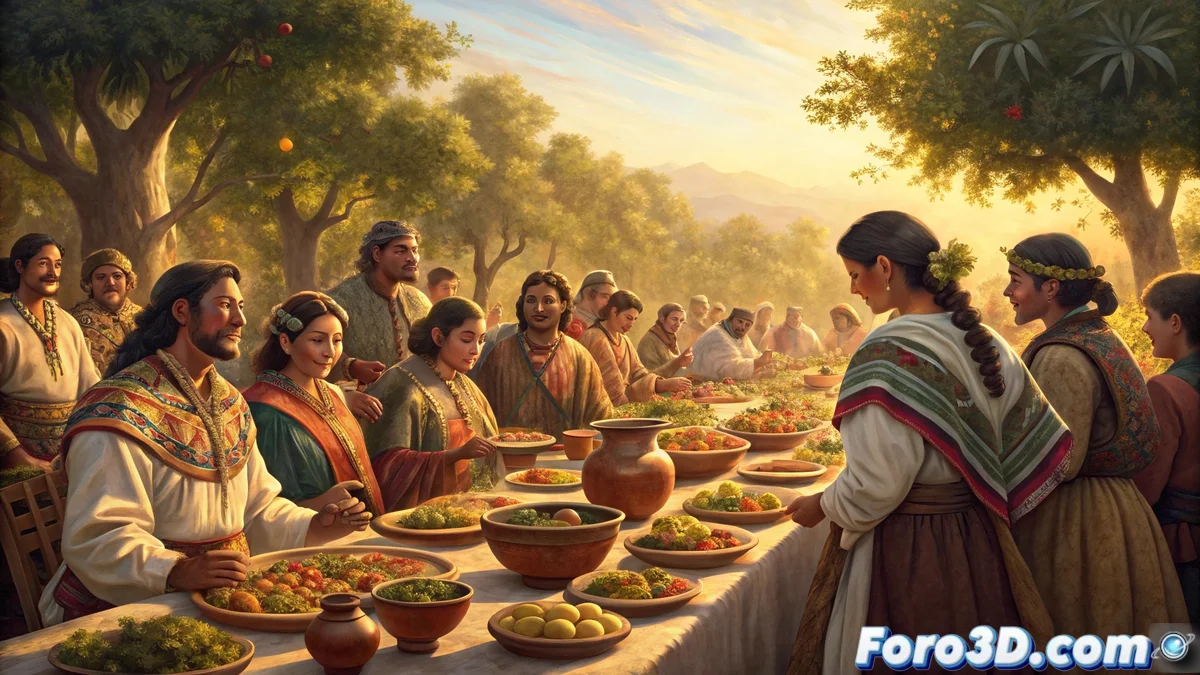
Historical Recreation of the Cultural Encounter in Blender: Technique and Symbolism
The year 1519 marked the beginning of the transformative encounter between Spanish civilization and Mesoamerican peoples, a process that completely redefined the cultural landscape of the continent. Far from being a simple conquest, this historical event involved complex strategic alliances between the newcomers and indigenous groups such as the Tlaxcaltecs and Totonacs, who sought to reconfigure pre-existing power balances. 🏛️
Historical Context and Cultural Significance
The fall of Tenochtitlan in 1521 established the foundations of the Viceroyalty of New Spain, triggering profound political, religious, and social transformations. The implementation of Christianity, Castilian as the administrative language, and the caste system completely reorganized society, while indigenous populations faced a catastrophic demographic collapse due to diseases, conflicts, and forced labor. This period also witnessed the forced arrival of African communities, completing the cultural triangle that would define Latin American identity. 🌎
Key elements of the historical process:- Strategic indigenous alliances that altered the course of the conquest
- Implementation of new political and religious structures under the viceroyalty
- Indigenous demographic catastrophe and forced arrival of African populations
Today, historians agree that this foundational period established permanent cultural ties between previously separated worlds, creating a new mestizo reality that combines indigenous, European, and African elements.
Project Preparation in Blender
To represent this multidimensional historical encounter in Blender, we began by meticulously configuring the scene with metric units and appropriate scales for monumental architectural elements. We established a cinematic 16:9 aspect ratio and configured color management for Filmic Log Encoding Base, essential for handling the high visual contrast between the different cultural textures represented. The main scene was organized as a container for symbolic elements, with thematically categorized collections for pre-Hispanic architecture, colonial components, historical characters, and general environment. 🎬
Initial technical setup:- Metric units and appropriate architectural scale for monumental elements
- 16:9 aspect ratio and Filmic configuration for high contrast handling
- Organization by thematic collections for efficient management of symbolic elements
Modeling and Structuring Process
The symbolic modeling focused on creating a scene that visually represented the cultural fusion through specialized techniques. For pre-Hispanic structures, we used subdivision surface modifiers on base meshes with proportions inspired by traditional Mesoamerican architecture. Spanish constructions employed modular modeling techniques with array modifiers to generate repetitive facades characteristic of the colonial period. Characters were modeled applying precise anatomical proportions, differentiating silhouettes between conquistadors and indigenous warriors through culturally specific armors and attire. ⚔️
Lighting System and Material Development
We configured a tripod lighting system using three main key lights with symbolic meanings: a warm light representing the American sun, a cool light for European influence, and a neutral fill light symbolizing cultural integration. Materials implemented advanced PBR principles with procedural textures for authentic stone and wood surfaces. We developed complex shaders to represent temporal wear on buildings, blending noise texture nodes with color ramps that simulated erosion and the coexistence of different architectural styles. 💡
Technical aspects of lighting and materials:- Tripod system with warm, cool, and neutral lights carrying symbolic meaning
- PBR materials with procedural textures for historical authenticity
- Complex shaders for erosion and temporal wear simulation
Special Effects and Rendering Process
We implemented subtle volumetrics to create an immersive historical atmosphere, using principled volume shaders with controlled density that evoked the passage of time. For the final render, we configured Cycles as the render engine with 2048 samples and OptiX denoiser enabled for maximum quality. We added post-processing in Blender's compositor, applying slight lens distortion and color grading that emphasized cultural duality through contrasting color temperatures. The final result was exported in 4K resolution with PNG compression to preserve the integrity of the represented historical details. 🖼️
Final Reflection on Technique and Meaning
The creation of this historical scene in Blender demonstrates that, just like in real cultural mestizaje, the most unlikely mixtures can produce visually fascinating results, although they require resolving technical conflicts equivalent to historical challenges. Today, when there are no longer conquerors or conquered but rather sister communities, remembering what unites us through artistic representations becomes especially significant. This 3D recreation serves as a bridge between past and present, demonstrating that digital technology can be a powerful vehicle for understanding complex historical processes and celebrating shared cultural heritages. 🌟