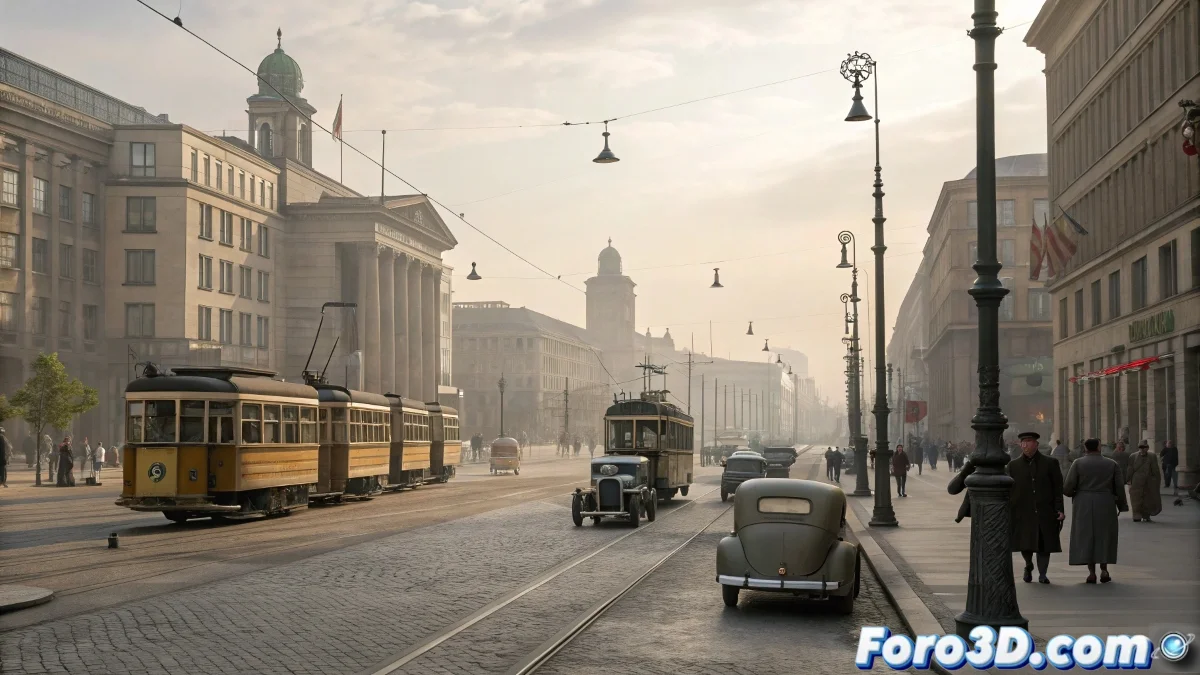
When the Past Comes Alive in Pixels 🎩
Recreating interwar Berlin for Babylon Berlin wasn't just a matter of nostalgia: it needed the precision of a Swiss watch and the clinical eye of a historian. Fortunately, RISE had both... plus an impressive digital arsenal.
The Ingredients of This Time Travel
For this visual time machine, the following were needed:
- Architectural reconstructions so precise that even ghosts would feel at home
- Period vehicles that work better digitally than in reality
- Digital crowds with more personality than some characters
- Atmospheric effects that smell like history (metaphorically)
The result is so authentic that even Marlene Dietrich would sign up to appear. 🚬
Technology in Service of History
"Every digital brick had to tell a story. We weren't just recreating a city, but an entire era in decay"
The 3D projections consumed more resources than a party at the Moka Efti. And that's saying something, as champagne is never in short supply at the club. 🍾
The Art of Making the Vanished Believable
Balancing historical rigor with dramatic needs was like dancing the Charleston on a tightrope. The integration of digital elements with practical sets was so perfect that even the extras doubted what was real.
And that's how you resurrect an era: with pixels instead of mediumship, but with the same respect for detail that a drunk archaeologist would have. Does anyone have a 1929 map? 🗺️
Bonus: Technical Secrets of the Recreation
For those curious about historical-digital processes:
- The buildings used modeling based on historical photos with millimeter precision
- The trams were animated with realistic vintage vehicle physics
- The crowds required AI systems for variations in clothing and movement
- A special pipeline was developed for digital aging of surfaces
All this while maintaining that decadent atmosphere that makes 1930s Berlin seem as vibrant as it is dangerous. Makes you want to stay in the present... or not. 🕰️