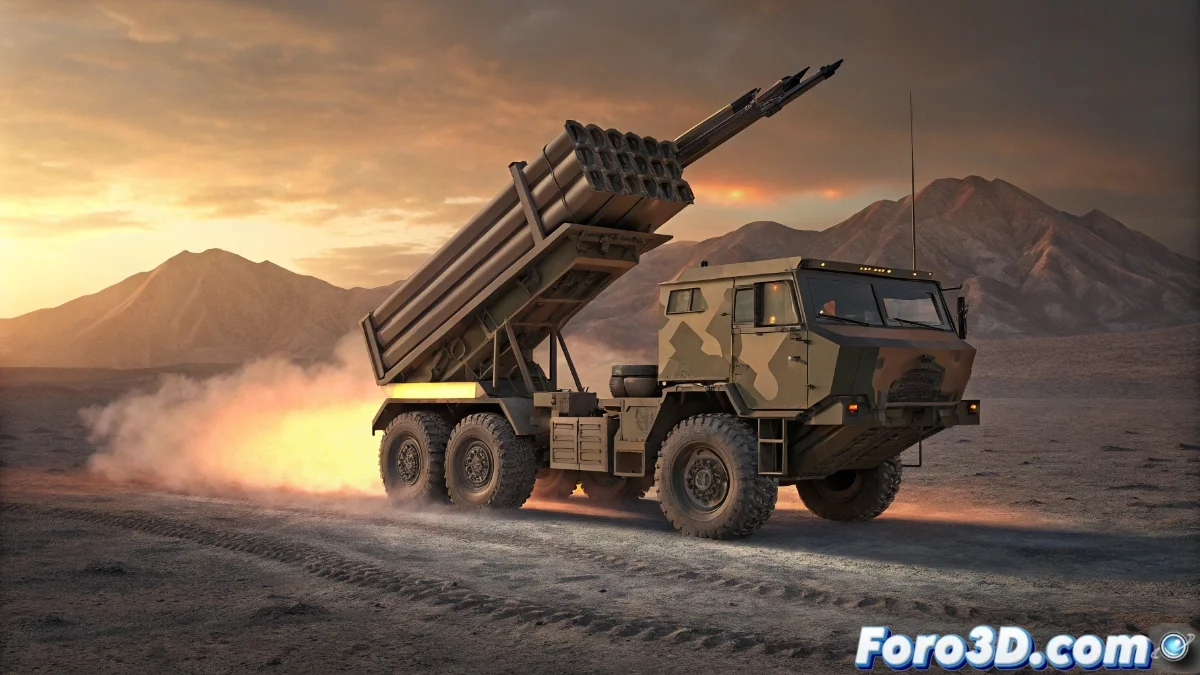
HIMARS: Mobile Artillery System and Its 3D Modeling
The M142 HIMARS is a rocket artillery system mounted on a truck, distinguished by its compact dimensions that facilitate strategic transport in various scenarios. With approximate measurements of 7.3 meters long, 2.4 meters wide, and 3.2 meters high when the container is closed, this 16-ton vehicle offers a highly versatile operational profile for agile deployments. Its design prioritizes mobility and immediate response capability, fundamental qualities in contemporary precision fire systems 🚀.
Weapons Configuration and Modularity
The system uses an interchangeable container that can load six 227 mm GMLRS rockets with ranges between 70 and 150 kilometers, or a tactical ATACMS missile with a range exceeding 300 kilometers. This modularity allows the armament to be adapted according to operational demands, while maintaining the same base platform. Reload time is minimized to just minutes thanks to specialized cranes and quick-swap procedures, optimizing fire continuity in extended missions 💥.
Key Aspects of the Armament:- Modular container for GMLRS rockets or ATACMS missile
- Variable ranges from 70 km up to over 300 km
- Quick reload with specialized crane systems
The versatility of the HIMARS lies in its ability to adapt the armament without changing the platform, essential for immediate tactical responses.
Considerations for 3D Modeling
When recreating the HIMARS in digital environments, it is vital to capture the rectangular structure of the container mounted on the 6×6 chassis, along with the hydraulic stabilizers and visible anchor points. These components not only define its appearance but also reflect its functionality in tactical deployment scenarios. Attention to detail in the mechanical connections and the launcher elevation system will add realism to the model, especially in simulations that demand technical precision 🎯.
Critical Elements for Modeling:- Rectangular container structure on 6×6 chassis
- Hydraulic stabilizers and anchor points
- Elevation system and detailed mechanical connections
Final Reflection on Realism and Simulation
Although in a 3D model reloading can be simulated with a simple click, in reality it requires a complete team and several minutes of intense work. This contrast underscores the importance of integrating functional elements into digital recreations to achieve authenticity in tactical simulation applications. Maintaining fidelity in structural and operational details ensures that the models are not only visually impressive but also technically accurate ✨.