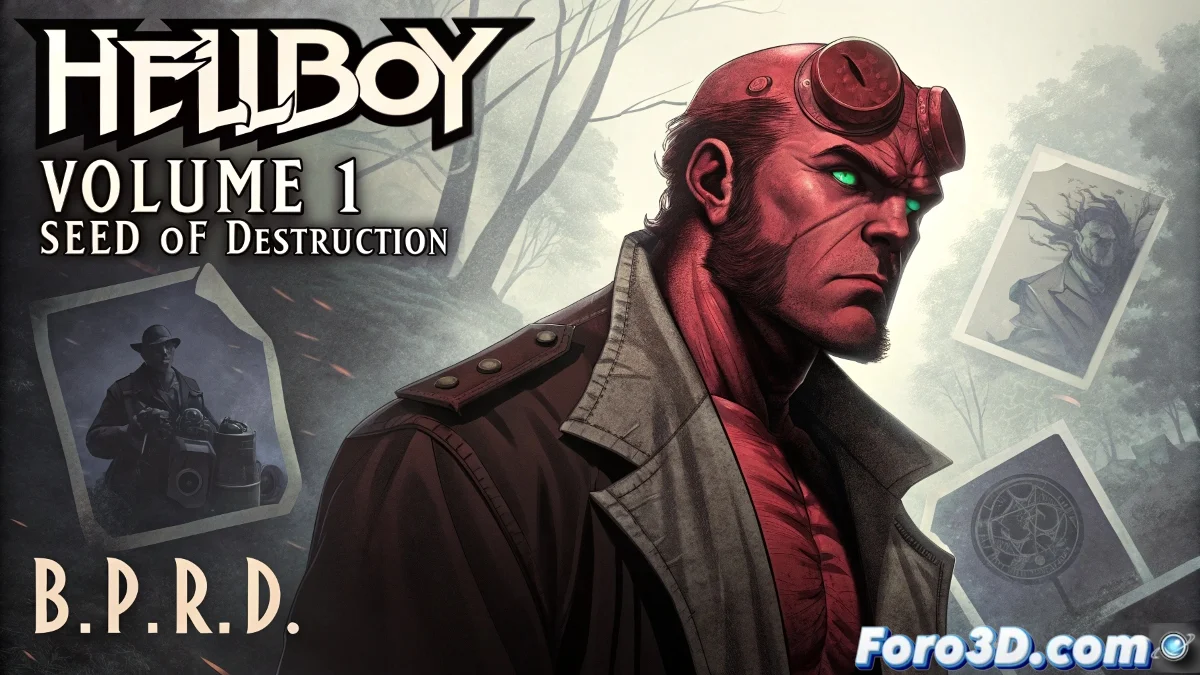
When a demon becomes the hero we needed
In 1994, the comic book world welcomed a character that would challenge all conventions: Hellboy, a demon summoned by the Nazis who ended up fighting on the side of good. Seed of Destruction is not just the beginning of a saga, but the birth of an icon that redefined what it means to be a hero in the modern comic book world. 🔥 Mike Mignola, with his unmistakable art of deep shadows and geometric compositions, created a universe where the supernatural meets pulp, where cosmic horrors coexist with government agents, and where an infernal being with a stone hand can be humanity's best hope.
The origin no one expected but everyone needed
The premise is as brilliant as it is simple: in the final days of World War II, the Nazis attempt an occult ritual to change the course of the conflict. What they achieve, however, is bringing a demonic infant into the world who will end up being raised by Professor Bruttenholm and become the star agent of the B.P.R.D. 🎯 This duality between infernal origin and human upbringing immediately establishes the character's complexity: Hellboy doesn't fight his nature because he is weak, but because he has chosen what he wants to be. It is free will made into a comic book character.
Foundational elements of the Hellboy universe:- The B.P.R.D. as the umbrella agency for all supernatural adventures
- The Ogdru Jahad as the primordial cosmic threat
- Rasputin as the recurring villain and master of ceremonies of chaos
- The Right Hand of Doom as an object of power and curse
The art that changed everything: when shadows speak
Mignola's style in Seed of Destruction bears no resemblance to anything we had seen before in mainstream comics. His compositions, dominated by large areas of pure black, create an oppressive and gothic atmosphere that becomes another character. 🎨 The figures, almost monumental, seem to emerge from the shadows, while the backgrounds are simplified to the essentials, forcing the reader to focus on what matters. It is an exercise in expressive minimalism that demonstrates that, sometimes, what is not shown is more terrifying than what is shown.
Byrne vs Mignola: the collaboration that defined a voice
Although the script is credited to John Byrne, based on Mignola's story, the creative tension between two different visions is noticeable. Byrne brings a classic narrative structure and functional dialogue, while Mignola already glimpses the unique tone that he would fully develop in later volumes. 📝 This duality makes Seed of Destruction a fascinating work to study: you can see Mignola finding his voice while still operating within the conventions of 90s commercial comics. It is the sound of an artist learning to fly while still having training wheels.
Additional material that enriches the experience:- Original sketches showing the evolution of Hellboy's design
- Mignola's notes revealing his initial creative process
- Short stories that expand the universe from different angles
- Gallery of covers that are works of art in their own right
From comic to cinema: when Del Toro met Mignola
The influence of Seed of Destruction transcended the panels to reach cinema through Guillermo del Toro. The 2004 film perfectly captures the gothic aesthetic and pulp tone of the comic, albeit with the narrative licenses necessary for the cinematic medium. 🎬 The most notable aspect is how Del Toro understood that Hellboy is not a story about a monster who wants to be human, but about a being who accepts what he is while choosing to do good. This deep understanding of the character is what makes the essence remain intact despite the differences.
The legacy: a seed that grew to the sky
Looking back from the current perspective, it's incredible to think that the entire vast Hellboy universe—with its spin-offs, crossovers, and adaptations—was born from this relatively modest volume. Seed of Destruction planted the seeds not only of a character, but of an entire mythology that would continue to expand for decades. 🌱 B.P.R.D., Abe Sapien, Lobster Johnson, and dozens of other characters and concepts find their roots in these initial pages. It is the rare case of a foundational work that not only starts a series, but creates an entire narrative ecosystem.
Hellboy demonstrates that our origins do not define us, but the choices we make despite them
Conclusion: why it remains essential 30 years later
Seed of Destruction maintains its power and relevance because it speaks about universal themes: nature versus nurture, free will versus destiny, beauty in the grotesque. Hellboy is that rare character who can face primordial gods on one page and complain about bureaucratic paperwork on the next. 📖 His combination of cosmic horror, dry humor, and unexpected humanism created a formula that countless creators have tried to emulate, but that only Mignola has managed to execute with this singular mastery. After all, not every day is a modern classic born, and this good-hearted demon deserves every bit of his legendary status. 😄