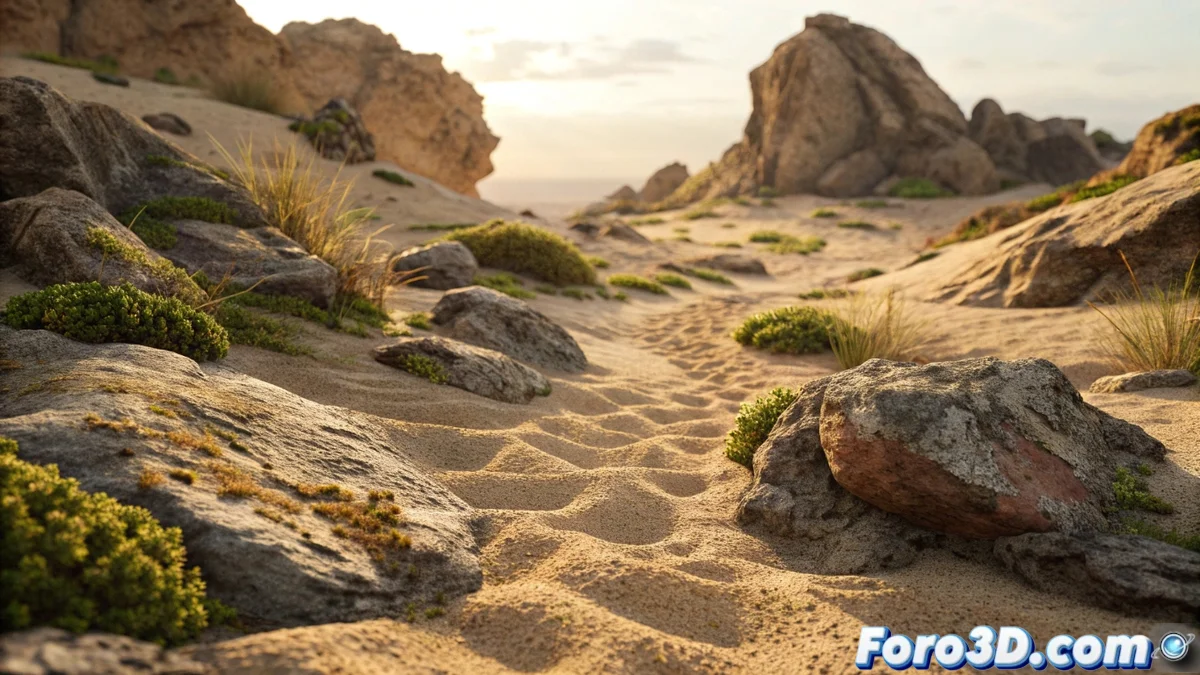
Height Lerp Material Blending: height-based material blending
In virtual environment development, achieving credible transitions between materials is a constant challenge. The Height Lerp Material Blending technique emerges as an advanced solution within engines like Unreal Engine and Unity, displacing the conventional alpha blending that often produces blurry and undefined results. 🎨
The foundation of height-based interpolation
This methodology is based on the use of a height map, typically a grayscale texture, that acts as the master guide for fusion. Unlike a simple transparency mask, this map simulates geometric information. The material's shader evaluates, for each pixel, the values of this map and compares them to an adjustable threshold. The material layer with the highest height value at that specific point will visually prevail, creating the illusion that one material physically protrudes over another.
Key components in the process:- Height Map: Grayscale texture where white represents the "highest" areas and black the "lowest".
- Height Lerp Node: Special function in the material editor that performs linear interpolation (Lerp) between the properties of two materials based on the map.
- Material Layers: Complete sets of textures (albedo, normal, roughness) for each surface to blend, such as grass, dirt, rock, or sand.
The technique is powerful, but it doesn't forgive artistic laziness. A poorly painted height map can completely ruin the illusion of realism.
Advantages and practical use cases
The main advantage is obtaining sharp and organic transition edges, eliminating the unsightly flickering or blurring associated with other techniques. This produces a more physical and believable result, essential for player or viewer immersion. Although its implementation consumes more texture samples (texture samples), the visual benefit justifies its use in critical and close-up elements.
Most common applications:- Complex Terrain Creation: Realistic transitions between different ground types, such as from mud to stone or sand to rock.
- Environmental Effects: Simulate the humidity effect on a coast, where water "wets" the sand progressively with defined edges.
- Detailed Assets: Material blending on architectural objects, vehicles, or props where wear or dirt with volume is required.
Final considerations for implementation
Implementing Height Lerp Blending requires setting up a master material or a Material Function that orchestrates the map reading and interpolation between layers. The quality of the final result largely depends on the painting of the height map, which must coherently reflect the artistic intent. It is a fundamental technique in the arsenal of any technical artist or shader developer seeking to elevate the realism of their scenes beyond basic blends. 🚀