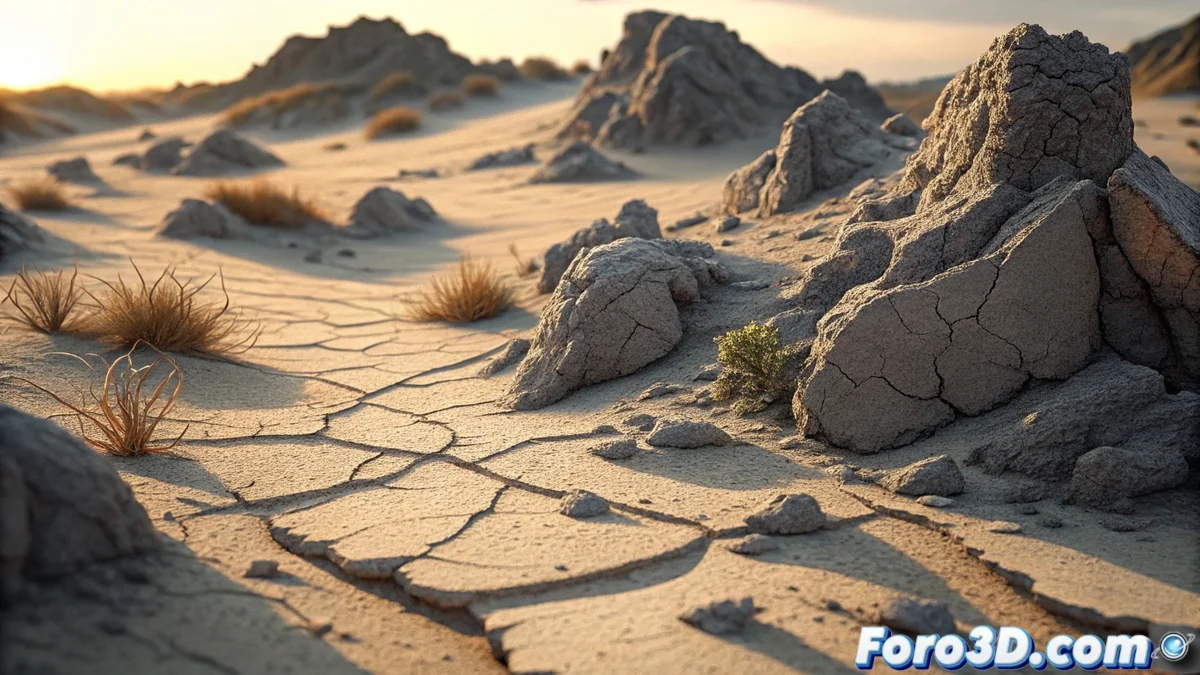
Height Lerp Material Blending: Advanced Blending with Height Maps
In the development of environments for real-time engines like Unreal Engine or Unity, achieving a believable fusion between surface materials is a constant challenge. The Height Lerp Material Blending technique emerges as an advanced solution that abandons conventional alpha blending, famous for generating diffuse and unconvincing edges. At its core, this method employs a height map (heightmap) to physically and visually coherently dictate which material is displayed over another, based on which surface "protrudes" virtually. It is the perfect tool for simulating the interaction between sand and rock on a coast, or the progressive fading of grass into soil on a hillside. 🏔️
The Height Map: The Director of the Transition
The fundamental component of this system is the heightmap, a grayscale texture that acts as an influence plane for shaders. Here, pure white represents maximum elevation and black the lowest. It is crucial to understand that this map does not deform the terrain's geometric mesh; instead, it serves as a data mask that the shader interprets. During rendering, for each fragment or pixel, the shader queries the height value of the two competing material layers. The layer that records the highest value in the map "wins" and becomes visible at that specific point. This decision, typically implemented through a linear interpolation (LERP) function conditioned by these values, generates precise and organic boundaries. The result is that one material appears to erode or cover the other naturally, completely eliminating unsightly semi-transparent patches.
Key Features of the Process:- Influence Mask: The heightmap is not geometry, but a set of data that guides blending at the pixel level.
- Per-Pixel Comparison: The shader evaluates and compares the values of the two height textures for each point on the surface.
- Conditional LERP: The linear interpolation function is activated or deactivated based on which height value is dominant, creating a clean cut.
Height Lerp is the solution for your materials to stop looking like an overlay of acetates and start interacting like solid substances in the real world.
Decisive Advantages Over Traditional Blending
The most evident improvement over alpha channel blending is the elimination of the patchy or diffuse paint appearance. Instead, transitions are achieved that respect the micro-topography of the relief, providing a sense of solidity and realism. By being based on a data map, the transition maintains absolute visual consistency from any camera angle and under any lighting condition, a critical factor in open-world or large-scale projects. Additionally, this technique integrates wonderfully with other material property maps.
Integrated Benefits:- Topographic Realism: Transitions follow a relief pattern, making the blend appear as a physical consequence, not artistic.
- Omnidirectional Visual Consistency: The transition looks correct from all viewpoints, without the transparency issues of alpha blend.
- Synergy with Other Maps: Normal maps, roughness, and ambient occlusion can be blended using the same heightmap logic, unifying the final appearance.
Implementation and Practical Application
Implementing Height Lerp Material Blending requires working in the engine's shader graph. The core logic involves sampling two height textures, comparing their values, and using the result to control interpolation between all material properties (color, normal, roughness). This is ideal for advanced terrain painting systems, where grass should not only change color but appear gradually from the soil, or snow accumulate credibly on rock protrusions. If you've ever seen a texture that seems to melt unnaturally over another, then you understand the need for this technical evolution. Mastering height blending is an essential step to elevate the realism of your materials and terrains