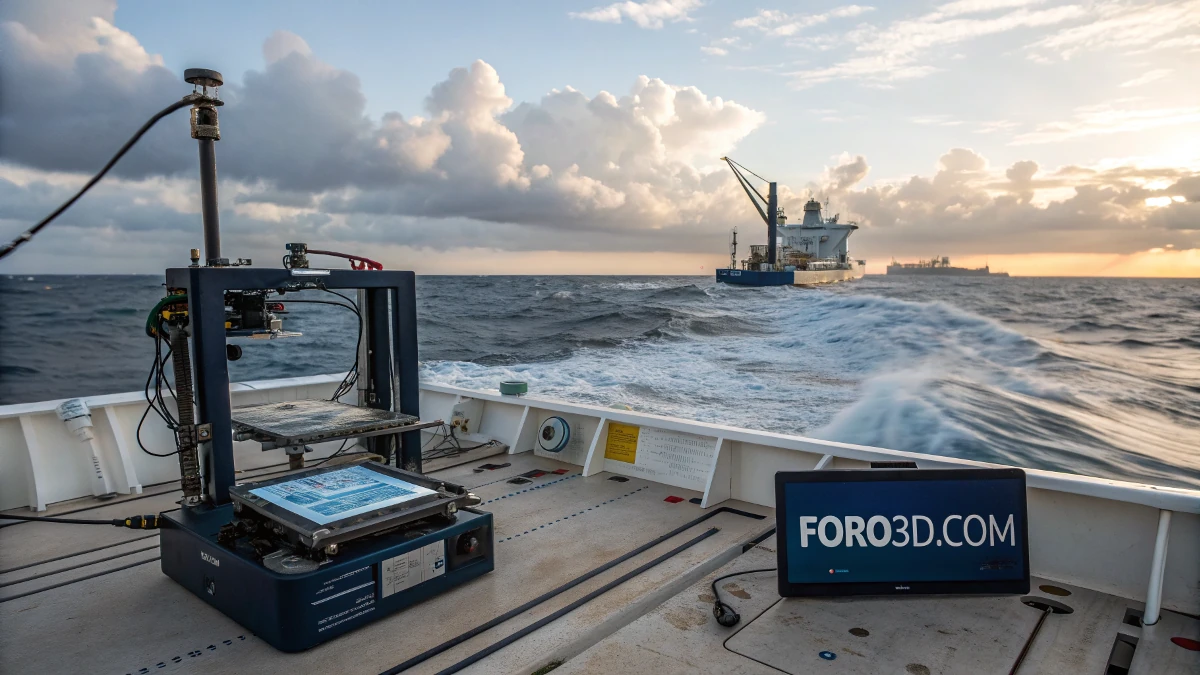
HD Hyundai Heavy Industries has developed an innovative 3D printing technology that enables the manufacturing of metal parts for ships while they are at sea. This technology, recently tested at HD Hyundai Samho facilities in Yeongam, South Jeolla Province, has been designed to simulate sea conditions, ensuring its functionality in offshore environments.
Strategic Collaboration for Technological Advancement
This project has brought together several key entities in the sector, such as 3D printer manufacturer CScam, shipping company HMM, Korean Register, and the Ulsan metropolitan city. The 3D printing system is intended to produce up to 350 different parts, which will be used for ship maintenance, repair, and operations. This technology will significantly reduce the time ships spend diverting to ports to obtain spare parts.
Overcoming Maritime Environment Challenges
To address the challenges arising from maritime conditions, HD Hyundai Heavy Industries has incorporated an auxiliary device that compensates for the typical movements and vibrations of ships. This addition ensures that the quality of the produced parts remains consistent, even in the dynamic and changing conditions experienced at sea.
A Digital Platform for On-Demand Production
The company plans to launch a commercial version of this technology after the project concludes in December. A digital platform system will be responsible for storing part designs, enabling on-demand production. For ships that cannot have 3D printers on board, HD Hyundai plans to install units in strategically located ports along common maritime routes, thus facilitating access to the technology.
Competitiveness and Cost Reduction
During the tests conducted, the competitiveness of additive manufacturing in the shipbuilding industry was highlighted. A representative from HD Hyundai HHI mentioned that collaboration with HD KSOE will allow expanding the range of printable materials and reducing production costs, which could radically transform the way repairs and maintenance of ships at sea are managed.
A Step Toward Ship Autonomy
This advancement not only improves the operational efficiency of ships but also represents a significant step toward autonomy in navigation. By enabling the manufacturing of essential parts while vessels are in transit, dependence on ports is reduced, and sea operation time is optimized, marking a milestone in the evolution of the modern shipbuilding industry.