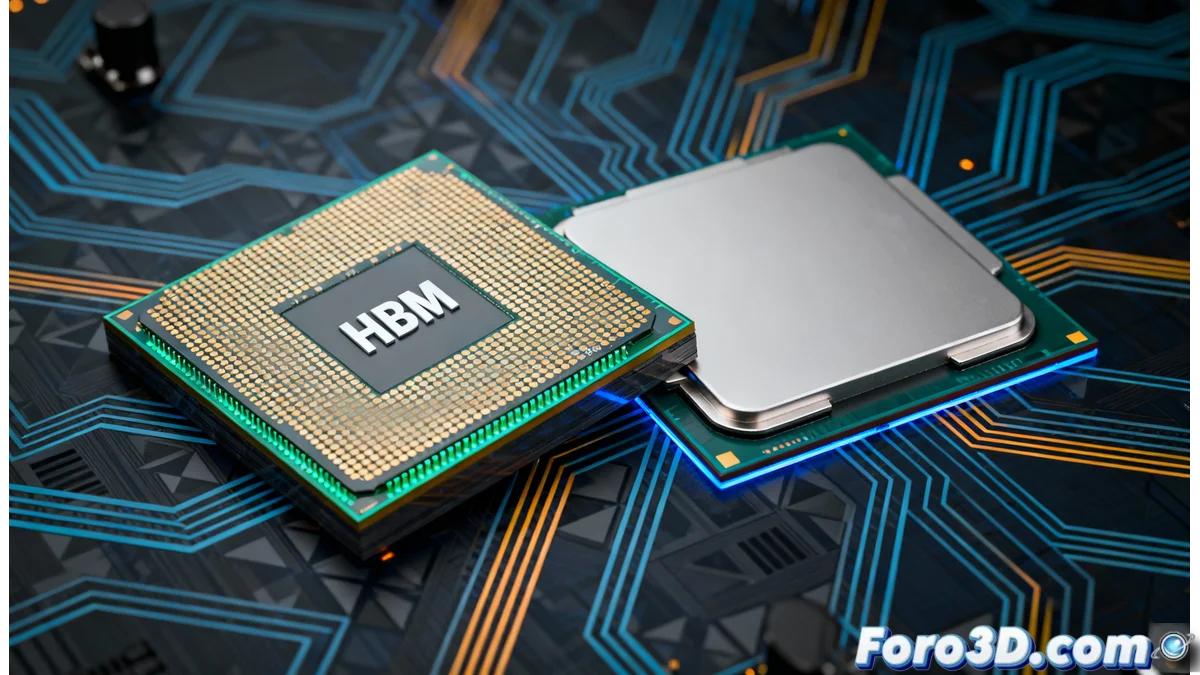
HBM: The 3D Memory Revolution in Modern Computing
In the evolution of contemporary computational architecture, performance has transcended mere processing speed to crucially depend on data access efficiency. HBM memory emerges as a transformative technology that redefines information transfer paradigms through its innovative three-dimensional arrangement. 🚀
Three-Dimensional Architecture and Performance Advantages
The 3D structure of HBM integrates multiple DRAM memory chips arranged vertically and interconnected via Through-Silicon Vias (TSV), microscopic conductors that pierce the different silicon layers. This pioneering configuration generates extraordinarily compact memory modules that achieve bandwidths exceeding 1 TB/s in their most advanced implementations. The connection to the processor is established through a silicon interposer functioning as a high-speed bridge, eliminating the traditional bottlenecks present in conventional circuit boards. 💡
Main features of the HBM architecture:- Vertical stacking of DRAM chips using TSV technology for maximum density
- Direct connection to the processor through silicon interposer eliminating PCB limitations
- Drastic reduction in latency and energy consumption compared to GDDR memory
The physical proximity between memory and processor in HBM creates a computing ecosystem where data flows at unprecedented speeds
Applications in High-Performance Computing and Artificial Intelligence
In the domain of artificial intelligence and machine learning, HBM has established itself as an essential component for specialized accelerators and latest-generation GPUs. Massive matrix operations and the processing of gigantic volumes of information demand a constant flow between memory and processing units, where the exceptional bandwidth of HBM keeps the numerous computing cores fed. Supercomputers and data center servers leverage this technology to drastically reduce training times for complex neural networks, while in professional workstations it exponentially accelerates tasks such as 3D modeling, video editing at extreme resolutions, and scientific visualization. 🔬
Highlighted application areas:- Training of AI models and deep neural networks
- Professional rendering and advanced 3D modeling
- Scientific simulations and real-time big data analysis
Final Considerations on HBM Technology
The inherent scalability of the HBM architecture allows future generations to increase the number of stacked layers, further expanding capacity and transfer speed. However, it is crucial to remember that with great bandwidth comes great responsibility... and electricity bills proportional to the performance obtained. This technology represents a balance between unprecedented computational power and optimized energy efficiency, setting new standards for the next generation of compute-intensive systems. ⚡