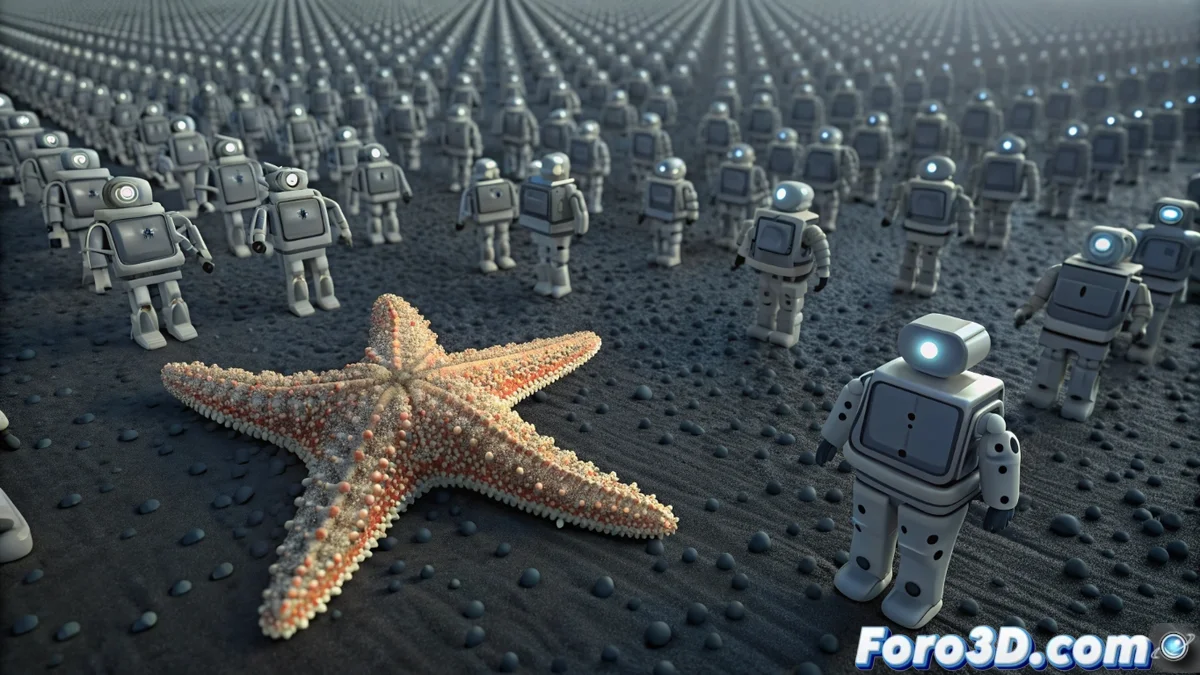
Harvard's Kilobots Investigate How to Organize in Swarms
A collective of more than a thousand tiny robots, known as Kilobots, operates at Harvard University to explore the mechanisms behind swarm organization. These simple and inexpensive units demonstrate that executing basic rules individually can generate sophisticated collective behavior, a phenomenon visible in schools of fish or insect colonies. 🤖
Decentralized Coordination with Minimal Rules
Each Kilobot integrates a microcontroller, a vibration motor for movement, and an infrared communication system. There is no master plan or leader directing. Instead, each robot executes the same basic algorithm that tells it how to interact with immediate neighbors. By propagating data from one to another, the entire group achieves consensus and adopts a target shape, like a star or a key, without any individual perceiving the global picture.
Key Components of a Kilobot:- Microcontroller: processes the basic behavior algorithm.
- Vibration Motor: allows rudimentary movement on surfaces.
- Infrared Communication: exchanges position and status data with nearby robots.
The key lesson: to solve a complex problem, sometimes it's better to distribute the task among a thousand simple but synchronized helpers, rather than relying on a single centralized agent.
A Laboratory to Understand Complex Systems
The main objective is not to build robots for immediate practical tasks, but to use this large-scale swarm as a testbed. Scientists can test theories about how systems self-organize and exhibit resilience. Observing how the group responds to individual failures or obstacles helps decipher the principles governing biological systems and plan future more adaptive robotic swarms.
Research Areas Enabled by Kilobots:- Self-Organization Tests: verify how complex patterns emerge from local interactions.
- Resilience Studies: evaluate how the swarm maintains its function when some robots fail.
- Distributed Algorithm Design: develop simple rules to achieve robust collective behaviors.
Towards Smarter Robotic Swarms
This project underscores the power of distributed collective intelligence. The knowledge generated not only deepens our understanding of nature but also paves the way for designing robot swarms that can operate in unpredictable environments, self-repair, and perform tasks cooperatively without a central authority. The future of robotics may depend on these principles of simplicity and massive cooperation. 🐜