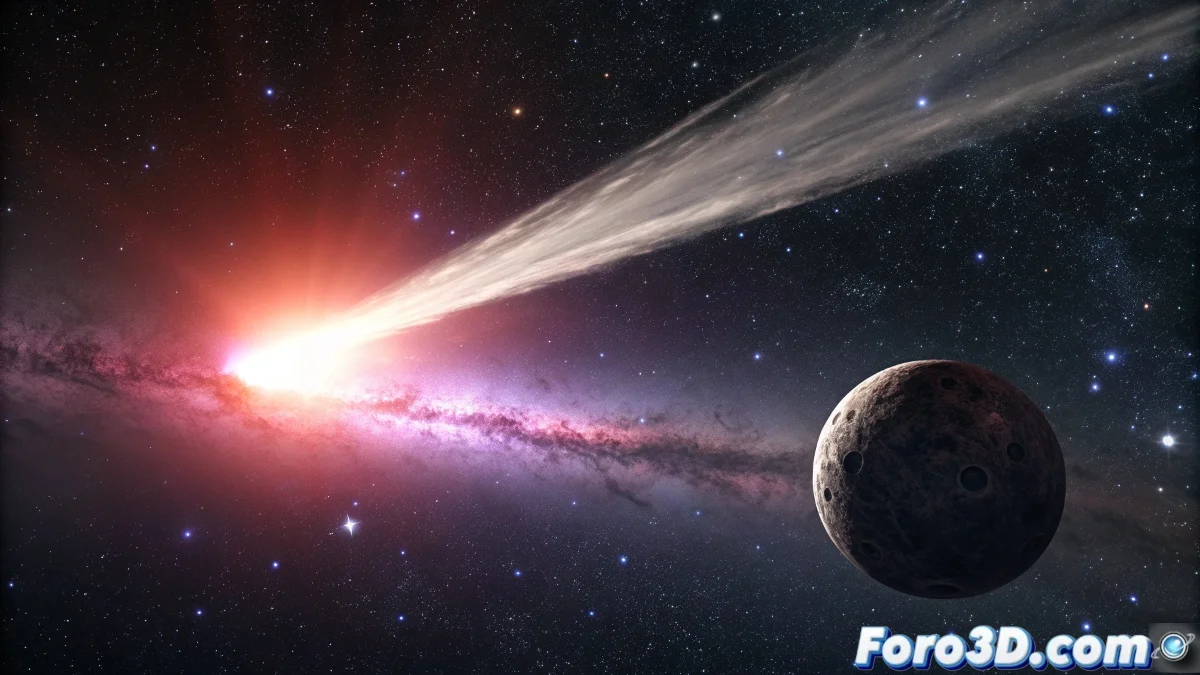
The Interstellar Visitor That Baffles Harvard
Harvard researchers have identified a series of anomalies in the object 3I/ATLAS that challenge conventional explanations. This interstellar body exhibits orbital characteristics and reflectivity properties that do not correspond to known comets or asteroids. Its non-gravitational acceleration and peculiar trajectory have generated intense scientific debate about its possible artificial origin.
What is particularly intriguing is its composition and thermal behavior, which suggests materials not present in natural objects in our solar system. Spectral analyses reveal anomalous patterns that some scientists interpret as possible indications of advanced technology. Although the community maintains healthy skepticism, the evidence warrants serious investigation.
Science advances by questioning the established, not by affirming absolute certainties
Setting Up the Space Scene in Maya
Recreating this cosmic scenario requires approaching it with scientific methodology and professional tools. Autodesk Maya offers the ideal ecosystem for developing precise astronomical visualizations. The first step consists of researching available data on dimensions, trajectory, and physical characteristics of the object.
Setting up the appropriate space environment is fundamental to contextualize the interstellar object. A celestial sphere with mapping of real stars provides the suitable background, while lighting based on nearby stellar systems ensures physical coherence. The correct scale between the object and its space environment is crucial for conveying verisimilitude.
- Collection of scientific data on trajectory and physical properties
- Configuration of astronomical scale unit in Maya's preferences
- Creation of stellar environment using dome light with HDRI
- Establishment of appropriate celestial coordinate system
Modeling the Interstellar Object
Based on available observations, modeling 3I/ATLAS presents unique challenges. Its elongated shape and unusual dimension ratio suggest geometries not found in nature. Starting with basic primitives allows exploring morphological variations before committing to a specific design.
Sculpting techniques are valuable for adding credible surface irregularities, while deformers allow experimenting with unconventional aerodynamic shapes. The balance between scientific precision and narrative needs determines the final level of detail.
- Base modeling with cylinder primitives and nonlinear deformers
- Sculpting of surface details with Mudbox tool
- Application of twist and taper modifiers
- Topology optimization for high-resolution renders
Materials and Shaders for Anomalies
The anomalous reflective properties constitute one of the most intriguing aspects of 3I/ATLAS. Developing shaders that capture this behavior requires a creative approach to Arnold's standard materials. The combination of metallic reflectivity with dielectric properties produces visually interesting results.
Procedural animation of material parameters can simulate the brightness fluctuations reported by observatories. Noise maps control subtle variations in reflectivity, while falloff masks manage transitions between different surface regions.
- Configuration of aiStandard material with high reflectivity
- Procedural animation of roughness parameters
- Application of noise maps for surface variation
- Integration of sub-surface light scattering effects
Scientific Lighting System
Lighting an object in deep space presents unique considerations. The absence of atmosphere means extreme contrast between lit and shadowed areas. Setting up an astronomical three-point lighting requires understanding the physics of space lighting.
The key light represents the nearest star, while fill lights simulate secondary illumination from distant stars and reflected light from possible planets. The rim light helps separate the object from the stellar background, crucial for readable compositions.
Visual Effects for Anomalous Phenomena
Representing the anomalies reported by Harvard requires a subtle yet impactful approach. Particle systems can visualize unusual energy emissions, while controlled emission shaders suggest internal energy sources. Atmospheric distortion effects, although non-existent in vacuum, can indicate exotic energy fields.
nParticles is ideal for creating particle trails that suggest unconventional propulsion. Integration with turbulence fields adds organic dynamism to these effects, while separate render passes allow precise control in compositing.
Orbital Trajectory Animation
The non-Keplerian trajectory of 3I/ATLAS constitutes its most significant anomaly. Animating it properly requires combining standard orbital motion with non-gravitational accelerations. Maya's animation curves allow creating this hybrid behavior through precise tangent manipulation.
Constraints and mathematical expressions help simulate the influence of non-gravitational forces on orbital motion. The camera must follow the trajectory while maintaining dynamic composition that emphasizes deviations from expected behavior.
Render and Post-Production for Scientific Impact
The final render must balance visual drama with scientific rigor. Arnold render settings ensure cinematic quality while maintaining reasonable processing times. Separate render passes for emission, reflection, and special effects provide flexibility in post-production.
The final composition integrates scientific elements such as orbital annotations, distance scales, and astronomical references. These contextual elements transform an attractive image into an effective scientific communication tool.
In the end, perhaps the most intriguing renders are those that remind us how much we still don't know about the cosmos 🌌