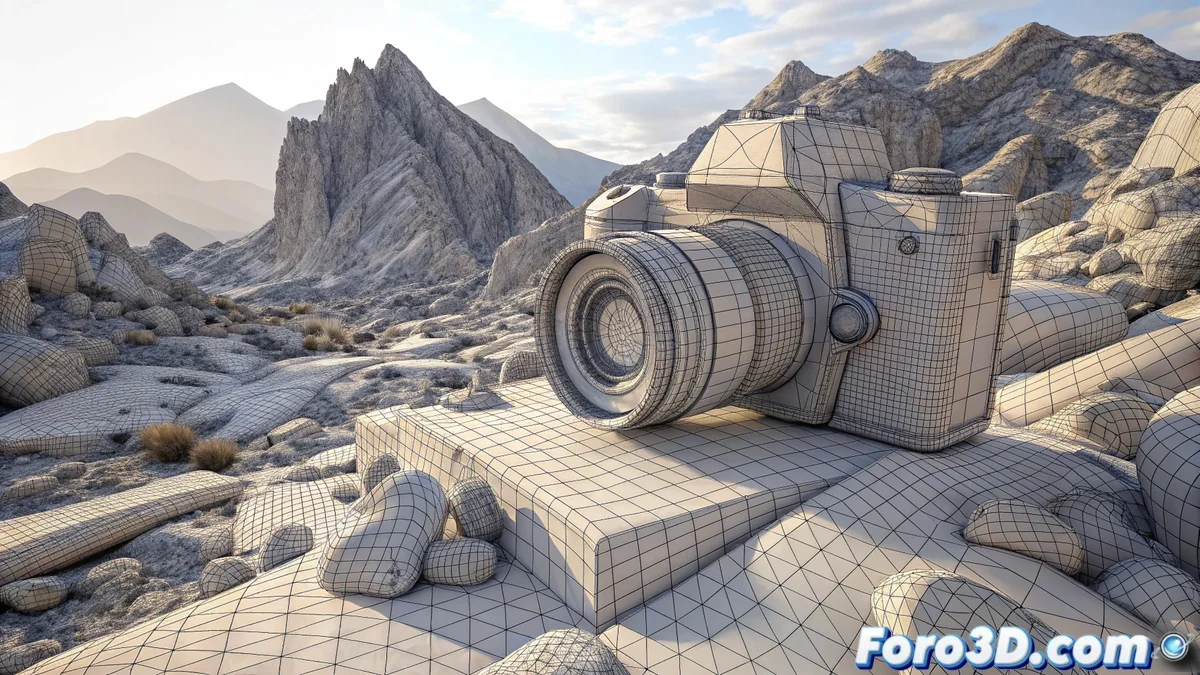
Hardware Tessellation: Subdividing Meshes in Real Time
In the field of computer-generated graphics, hardware tessellation represents a fundamental method for processing geometry dynamically. This technique allows the GPU to take a mesh with few polygons and convert it into one with much higher density right during rendering. The subdivision level is adjusted automatically, often based on the distance to the camera, making system resource management very efficient. 🚀
The three key stages of the tessellation process
To subdivide the geometry, the GPU executes a chain of operations in three well-defined stages, each handled by specialized shaders. This workflow ensures that geometric complexity is generated only when and where needed, without storing all vertices in memory beforehand.
The tessellation pipeline flow:- Hull Shader: This stage receives a control patch (a group of vertices) and is responsible for evaluating how much that patch should be subdivided. It defines the tessellation factors that control the density of the new mesh.
- Tessellator: This is a fixed unit within the GPU that takes the instructions from the Hull Shader and generates the new geometry mesh. It creates the vertices, edges, and triangles within the domain of the original patch.
- Domain Shader: Processes each of the new vertices generated by the Tessellator. This is where a displacement map is typically applied, displacing the final position of each vertex in 3D space to sculpt high-realism surface detail.
Tessellation calculates geometry on the fly, meaning the detail exists only during rendering, freeing system memory from storing massively dense models.
Where and why this technology is used
Hardware tessellation finds its application in areas where a high level of geometric detail is needed without compromising real-time performance. It is a cornerstone in modern game engines and visualization software.
Main applications:- Rendering extensive terrains: Allows a low-resolution landscape to turn into terrain with detailed hills, rocks, and cracks only where the player is looking.
- Creating realistic characters: Used to add fine details to skin, wrinkles in clothing, or scales, starting from a base model that is easy to animate.
- Modeling complex architecture: Buildings and structures can show bricks, moldings, and surface damage thanks to displacement maps applied over the tessellated geometry.
The balance between art and performance
This technique establishes an ideal balance between the artist's work and the power of the graphics card. Developers and modelers can work with low-resolution models that are lightweight, quick to edit, and simple to animate. During runtime, the GPU takes care of converting these models into dense, visually rich versions. A curiosity of this process is that, sometimes, the algorithm can apply extreme detail to an element that will remain out of view (like the sole of a boot), simply because its proximity to the camera dictates it. This underscores the automatic and, at times, ironic nature of distance-based optimization. 🎮