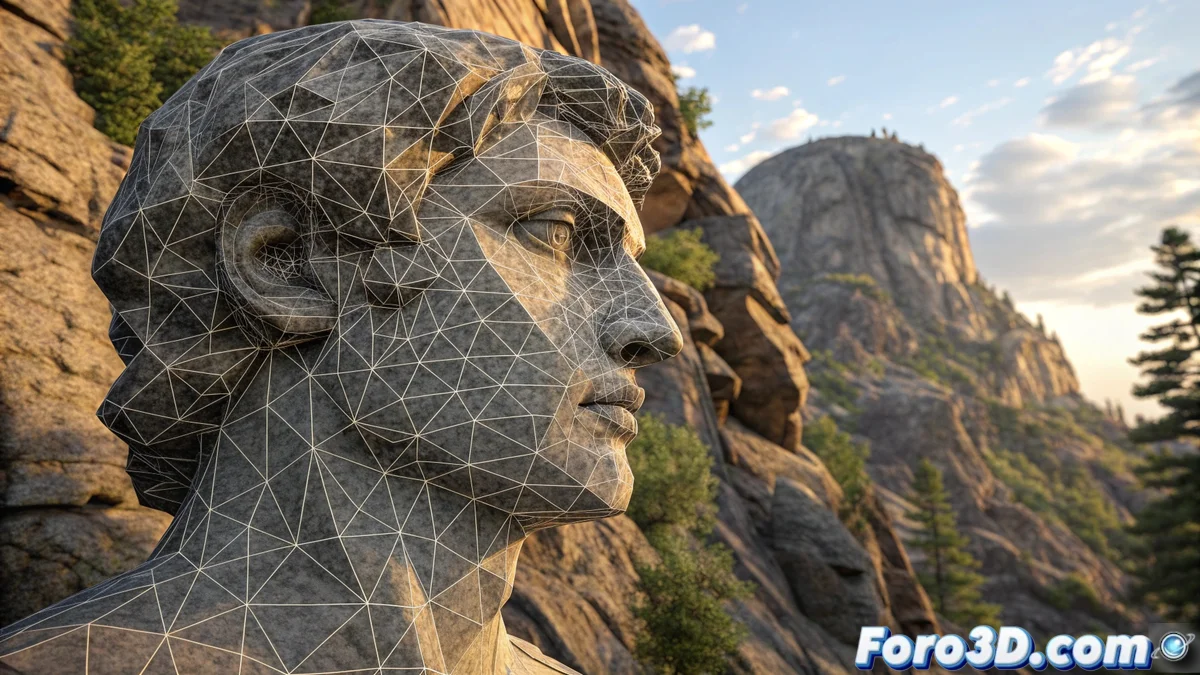
Hardware Tessellation: How to Process Geometry in Real Time
In computer graphics, hardware tessellation is a technique that allows the GPU to generate complex geometry at rendering time. Instead of storing heavy meshes, the graphics processing unit takes a low-resolution base and dynamically subdivides it to produce a model with much more detail. This frees up memory and enhances visual realism. 🚀
The three key stages of the pipeline
The tessellation process is organized into a programmable pipeline with three defined parts. First, the hull shader (or hull shader) receives a control patch and determines how much to subdivide the mesh, calculating the tessellation factors. Then, the tessellator, a fixed stage within the GPU, creates the new mesh by generating points and triangles according to those instructions. Finally, the domain shader (or domain shader) takes these new points and displaces them in space, applying data from a displacement map to sculpt the final shape with high relief.
Workflow components:- Hull Shader: Defines subdivision parameters and prepares the patch for the tessellator.
- Tessellator: Automatically generates the new mesh topology (vertices and triangles).
- Domain Shader: Positions each new vertex in 3D space, applying displacements to create micro-details.
The power of tessellation lies in generating geometric complexity on demand, without saturating the system's memory buses.
Balancing resources and visual detail
This technique is fundamental in video games and 3D visualization where a lot of detail is needed but GPU power must be used intelligently. It allows distant objects to be rendered with little geometry to save resources, while nearby objects acquire a very high level of detail when tessellated. Thus, the GPU manages its workload dynamically, prioritizing details where the user perceives them most.
Practical advantages of implementation:- Efficient memory management: Complex geometry is not stored; it is generated on the fly.
- Dynamic Level of Detail (LOD): Geometric detail adapts to the camera distance.
- Integration with displacement maps: Adds realistic depth and relief to seemingly flat surfaces.
Final considerations and support APIs
To use this capability, developers access it through graphics APIs like DirectX 11 and OpenGL 4.0, which expose the programmable tessellation pipeline. It is crucial to calibrate the tessellation factors: an excessive value can overload the GPU and affect performance. The technique promises almost infinite detail, but its use must be measured to avoid pushing the hardware beyond its limits. ⚙️