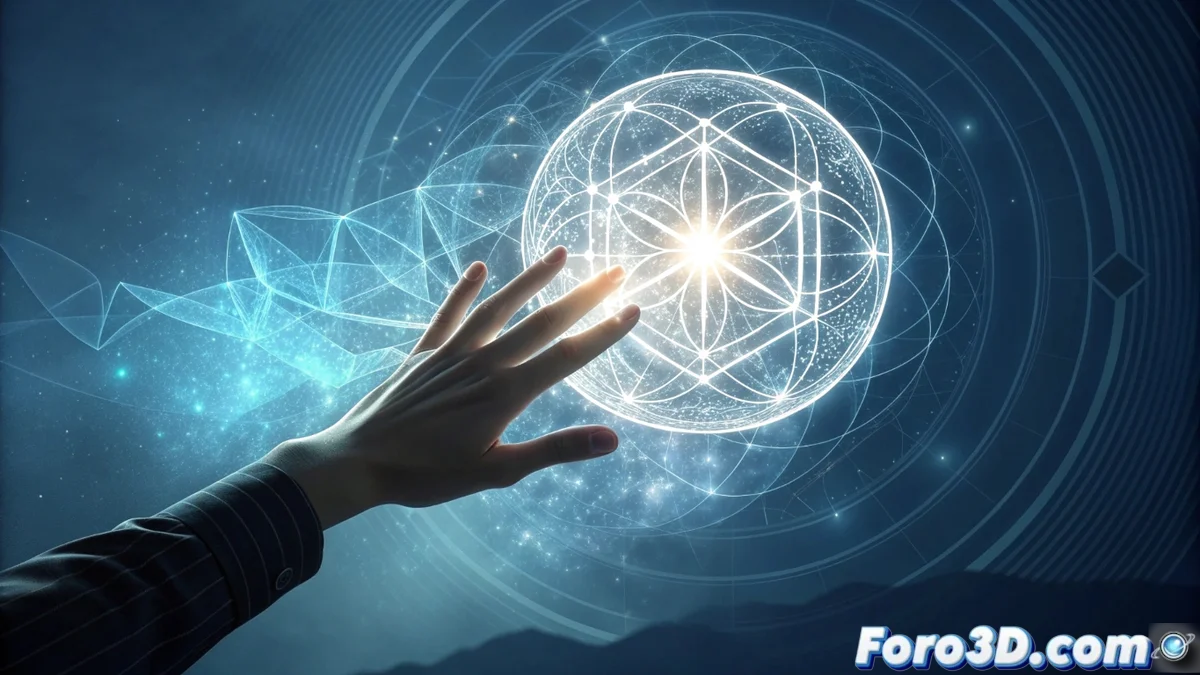
A Haptic System Projects Tactile Shapes in the Air Without Using Gloves
A team of scientists has developed an innovative technology that allows feeling virtual objects in free space. This system integrates a volumetric display to generate 3D images with a haptic force field created by ultrasound, achieving complete interaction without the need for gloves or controllers. 🌀
The Principle of Acoustic Focusing
The technical basis lies in using multiple ultrasound emitters that direct sound waves to converge at a precise point on the skin. The combined pressure at that acoustic focus generates the sensation of touching a surface. By moving this point at high speed, the system can trace contours, curves, and different textures directly in the air.
Key Features of the Technology:- Generates focused pressure points that simulate the texture and contour of virtual models.
- The feedback is powerful enough to mimic anything from a light contact, like a brush, to the firmness of pressing a button.
- Combines holographic visualization with real-time tactile stimulation for a unified experience.
By eliminating the need for wearable devices, the system aims to make haptic interaction with the virtual more natural and intuitive.
Practical Applications in Various Fields
This interface opens new possibilities in sectors where manipulating and evaluating prototypes is crucial. Its contact-free nature makes it especially relevant for environments that require precision and sterility.
Potential Areas of Use:- Telemedicine: A specialist could examine and palpate a 3D model of an organ transmitted from another location.
- Industrial Design: Engineers would manipulate and perceive complex digital prototypes before producing a physical model.
- Scientific Visualization: Offers a novel way to interact with complex three-dimensional data sets.
Challenges and Future Development
The researchers identify two main challenges to improve the system: increasing the resolution of the tactile sensation to achieve more detailed textures and expanding the effective workspace where feedback can be generated. Overcoming these limits will be key for this technology to move from the lab to robust commercial applications. The ultimate goal is to create an interface where the barrier between the digital and the physical completely fades away. ✨