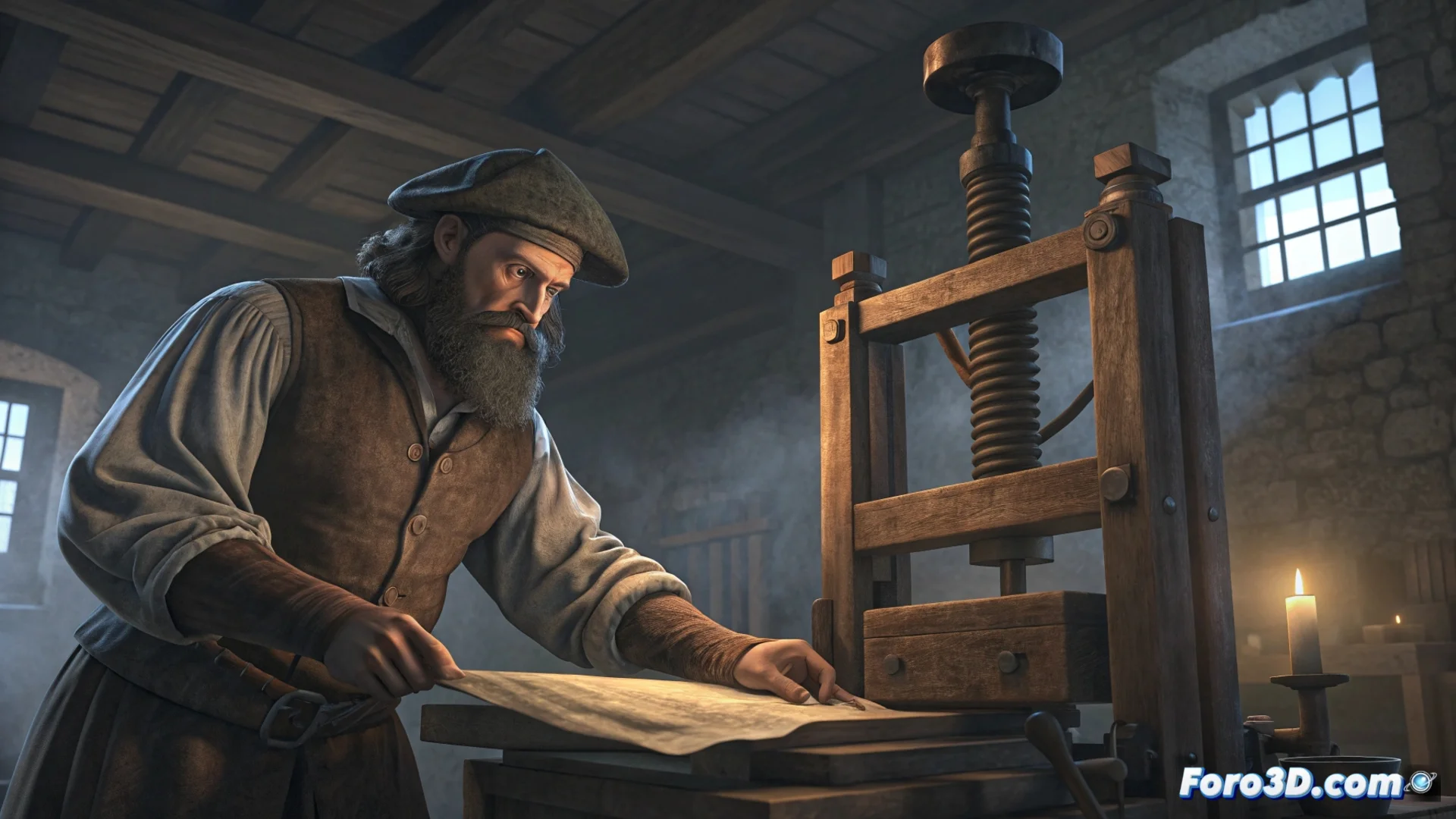
Gutenberg and the Printing Press that Rewrites Memory
In an alternate Mainz, Johannes Gutenberg's workshop does not spread knowledge, but replaces it. His great invention is not books, but neuro-rolls: treated parchments that, upon contact, inoculate nanocircuits that travel to the brain to project prefabricated memories. This revolution does not seek to enlighten, but to permanently colonize the reality perceived by each person. 🧠
The Mechanism of Cognitive Infusion
The devices prevent the user from reading or interpreting. Simple physical contact activates the process. The nanocircuits migrate through the nervous system to the visual cortex, where they rewrite personal life episodes and insert power-validated historical events. Whoever experiences this accepts the implanted memories with absolute conviction, unable to separate them from their genuine experiences.
Features of neuro-rolls:- Direct infusion: Nanocircuits are inoculated through the skin and navigate to the brain without external intervention.
- Memory rewriting: They overwrite personal episodes and add official narratives as if they were one's own memories.
- Indistinguishability: The sensory experience is complete, eliminating the boundary between lived and injected.
Humanity gains a tool to preserve information, but loses forever the ability to remember freely.
The Foundations of a Dystopian State
This twist turns the printing press into the origin of absolute control. Authorities no longer need to destroy dissenting ideas, but to produce and distribute reality itself. The church and nobility finance Gutenberg so that his neuro-rolls consolidate dogmas and lineages. Doubting the official narrative equates to doubting one's own mind, making dissent impossible.
Consequences of perceptual control:- Uniform collective memory: The entire society adopts the same version of events, controlled from a single workshop.
- Disappearance of dissent: Questioning the official truth questions one's own memories, nullifying critical thinking.
- Patronage of power: The technology is funded by elites to perpetuate their dominance and narrative.
Doubt in the Workshop of Truth
In this universe, a Gutenberg apprentice observes his hands with unease. He wonders how many of his childhood memories are authentic and how many come from the first test batches. This moment of introspection symbolizes the definitive loss: the ability to trust one's own experience and to build a free identity from cognitive implants. The printing press, far from liberating, became the ultimate machine for manufacturing consensus. ⚙️