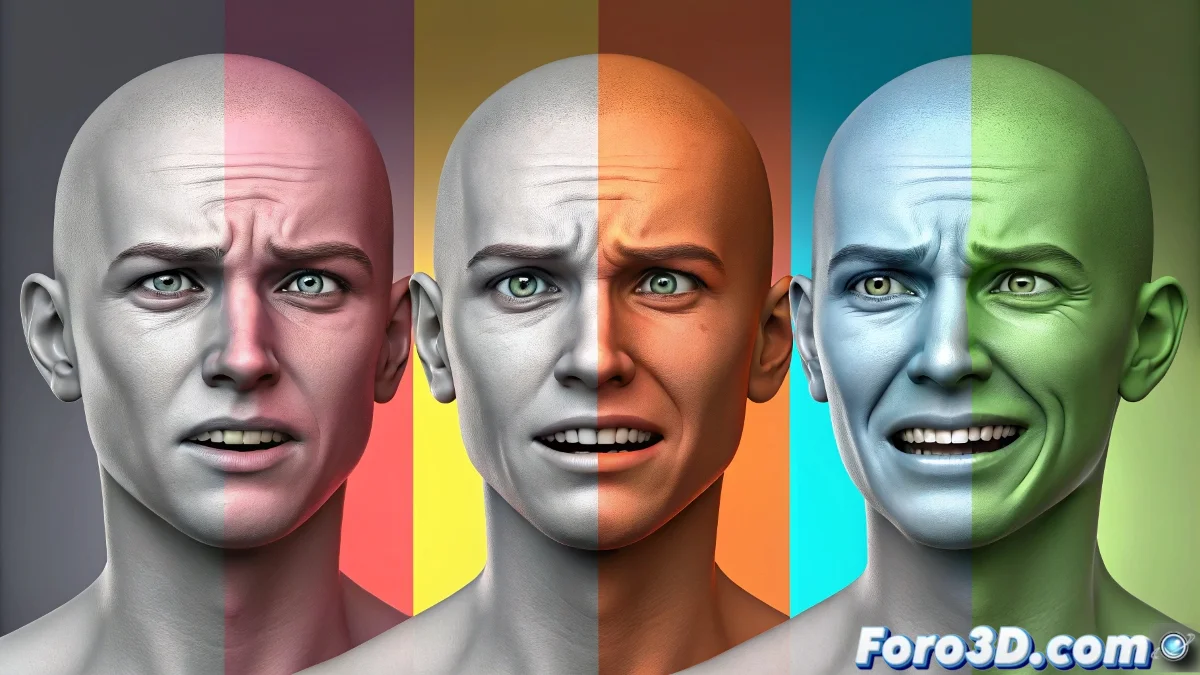
Guide to Facial Expressions in 3D Animation Using Blend Shapes
Blend shapes, also known as morph targets or blend shapes, are an essential technique in 3D animation for creating facial expressions and deformations in 3D models. These allow animators to bring to life a wide range of emotions and articulations, adding depth and realism to characters. And no, you don't need to be a psychology expert to understand emotions! 😊
Basic Facial Expressions
Some of the basic facial expressions that can be achieved with blend shapes include:
- Happiness (Smile)
- Sadness
- Anger
- Surprise
- Fear
- Disgust
Mouth Movements
For lip synchronization and expression, basic mouth movements are fundamental:
- A, E, I, O, U (basic vowels)
- Wide smile
- Pursed mouth
- Mouth open and closed
Eye and Eyebrow Movements
Eye and eyebrow movements also play a crucial role in facial expression:
- Eyebrows up (surprise)
- Eyebrows down (anger or concentration)
- Eyebrows together (worry)
- Blink and wink
Nose, Cheeks, and Jaw Movements
Additionally, nose, cheeks, and jaw movements add more nuances to expressions:
- Wrinkling the nose (disgust or forced smile)
- Cheeks puffed or sunken
- Jaw open, closed, forward or backward
As for how many blend shapes are enough, it depends on the level of detail and realism needed for your project. For a basic project, you could start with around 20 to 30 blend shapes. However, more complex projects may require hundreds to capture all the subtleties of facial expressions. Some shapes can be combined to create more complex expressions, like a wide smile that blends the "I" mouth shape and raised cheeks. So get to work and bring your characters to life! 🎭
With these tips, you can use blend shapes to create facial expressions in 3D animation effectively. And remember, if the expressions don't turn out as expected, you can always blame the morph targets! 😉