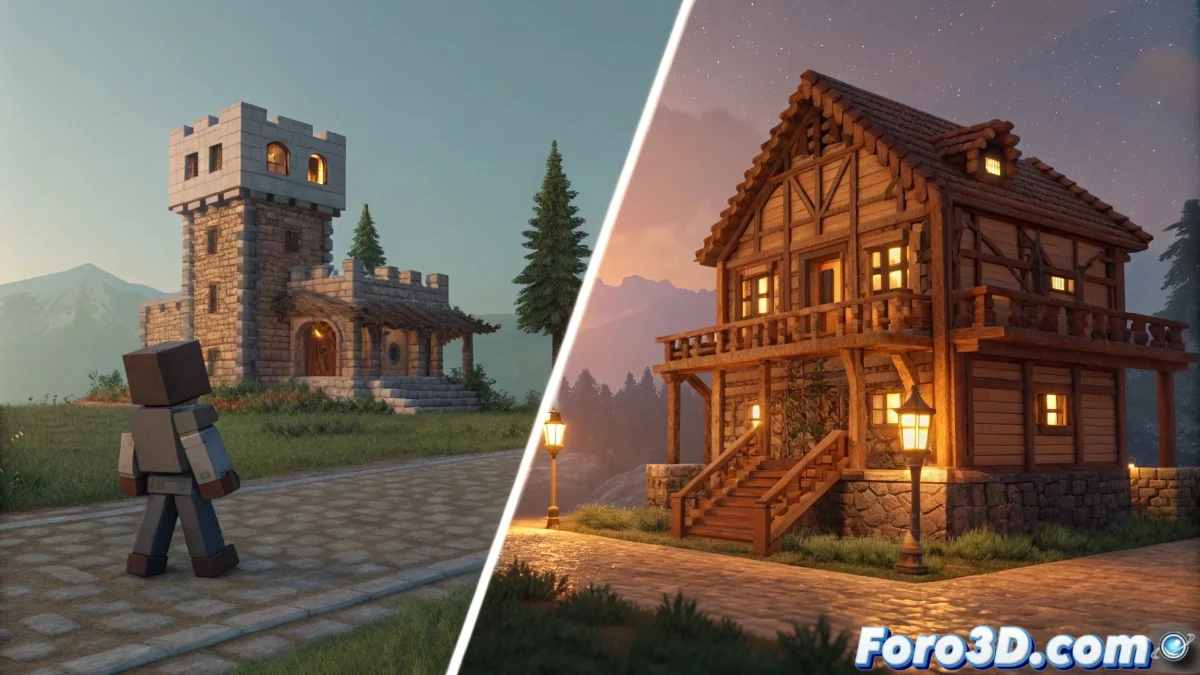
Goxel vs Qubicle: Voxel Modeling Software Comparison
The world of voxel modeling features two standout protagonists that offer completely different work philosophies. Goxel emerges as an open-source and free solution perfect for artists who value flexibility, while Qubicle positions itself as a professional platform with advanced capabilities oriented toward video game development 🎮.
Approaches and Design Philosophies
The essence of each tool reflects distinct target audiences. Goxel prioritizes accessibility and simplicity, making it ideal for rapid prototyping and personal projects. In contrast, Qubicle bets on a comprehensive and specialized ecosystem that meets the demands of professional studios and independent developers.
Main features of each software:- Goxel: Minimalist interface, cross-platform, basic sculpting tools and export to standard formats like OBJ
- Qubicle: Specialized interface, multi-layer management, advanced animation tools and direct integration with graphics engines
- Common points: Both allow three-dimensional creation through voxels but with different approaches and complexity
Choosing between Goxel and Qubicle is like deciding between a simple hammer to hang a picture or a complete toolbox to build a house
Workflows and Export
Differences in user interface directly condition the creative experience. Goxel offers a clean and fast environment that facilitates basic modeling without distractions. Qubicle presents organized and complex panels designed to handle large-scale projects with multiple interconnected components.
Export capabilities:- Goxel: Universal formats (OBJ, PLY) with minimal processing, ideal for static renders
- Qubicle: Optimized export for Unity and Unreal Engine with assets ready for implementation
- Advantages: Each system adapts to different stages of the 3D development pipeline
Tools and Practical Applications
The arsenal of available tools makes the difference in final results. Goxel includes essential functions like brushes, fill, and boolean operations for intuitive modeling. Qubicle incorporates advanced features like automatic mirroring, complex color palettes, and integrated animation systems 🛠️.
Limitations and strengths:- Goxel: Does not support rigging or animation, limited to static models but with great agility
- Qubicle: Requires more learning but offers a complete pipeline from modeling to animation
- Recommendation: The choice directly depends on the project complexity and available resources
Conclusion: Which to Choose Based on Your Needs?
The final decision between Goxel and Qubicle comes down to evaluating specific objectives and available resources. For quick, educational, or low-budget projects, Goxel represents the ideal option. For professional productions that require integration with graphics engines and animation, Qubicle offers the complete ecosystem needed. Both tools demonstrate that voxel modeling continues to evolve with proposals for all creative levels 💡.