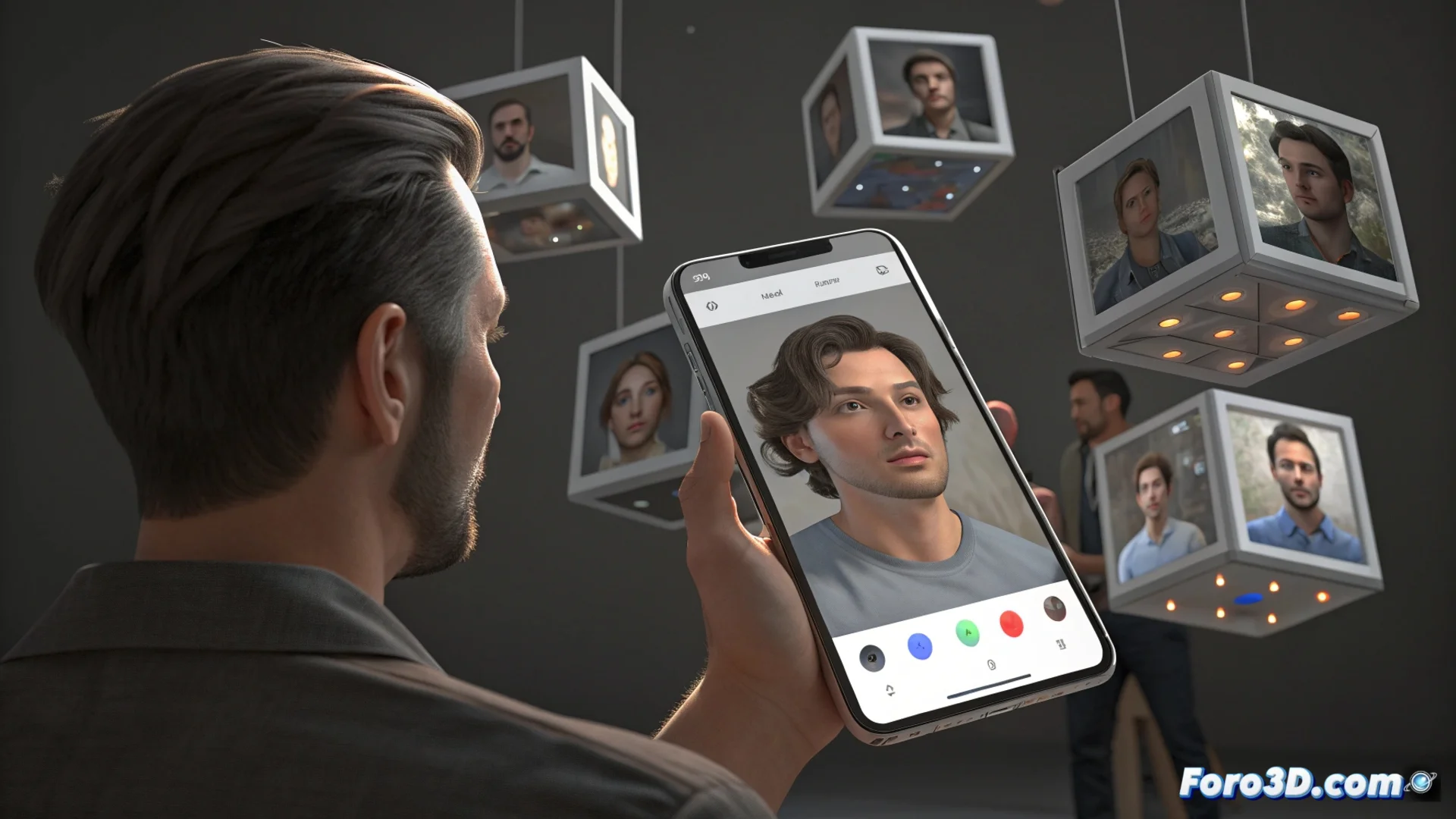
Google Photos Organizes 3D Content with Its Facial Recognition Technology
Google's storage platform extends its powerful facial recognition system beyond flat images. Now, it also processes and organizes photographs and videos with three-dimensional information, automatically identifying the people appearing in them. 🧠
How Does Facial Grouping Work in Volumetric Content?
Google's algorithm analyzes the faces it detects in both 3D photos and videos recorded with this technology. It extracts the facial biometric data from each file and compares it with a private database generated by the user. This method allows creating automatic collections with all the material of an individual, without the owner having to search manually.
Compatible 3D File Formats:- Stereoscopic Photos: Handles formats like MPO (Multi Picture Object) and JPS (JPEG Stereo).
- 3D Videos: Processes content recorded with specialized cameras or smartphones with three-dimensional capabilities.
- Depth Analysis: The system interprets information from multiple perspectives and depth maps to recognize faces from different angles.
Accuracy in identification depends directly on the clarity of the face in the original file and its technical quality.
The User Maintains Control Over Their Data
This functionality is designed with privacy as the central principle. The user can enable or disable face grouping from the app settings. Google stores facial data in an encrypted manner and associates it solely with the personal account, without using it for ad profiling.
Key Aspects of Privacy and Customization:- Manual Management: Option to label or correct erroneous identifications, helping the system learn and improve.
- Private Albums: The automatically generated collections are exclusively accessible to the account owner.
- Secure Storage: Facial biometric information is stored with encryption, separate from other Google services.
A Tool for Modern Files
By integrating facial recognition into the 3D realm, Google Photos updates its utility to handle the type of content produced by current devices, such as certain smartphones and 360° cameras. This evolution shows how artificial intelligence adapts to organize not only our flat photographic past, but also memories captured with volume. The technology acts as a digital archivist that, with the user's permission, meticulously categorizes each familiar face, whether in a traditional photo or an immersive video. 🔍