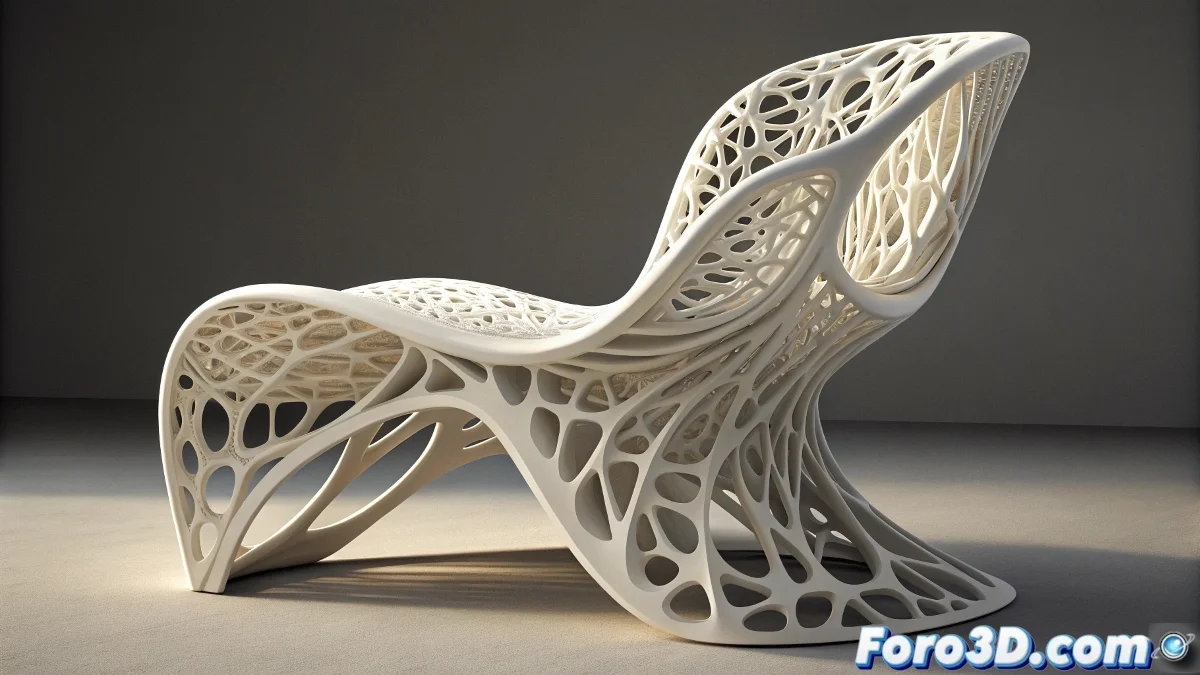
Google DeepMind and Ross Lovegrove: When AI Finds Its Organic Form
Google DeepMind has announced a pioneering collaboration with legendary designer Ross Lovegrove to create the first chair fully generated by artificial intelligence and 3D-printed. This unique project fuses the most advanced generative AI algorithms with Lovegrove's characteristic organic and biomorphic aesthetic, resulting in an object that challenges traditional design and manufacturing categories. The collaboration represents a significant milestone in the evolution of AI-augmented creativity, demonstrating how technology can collaborate rather than replace human artistic vision.
The Synergy Between Algorithm and Creative Intuition
The creative process behind the chair combines DeepMind's computational approach with Lovegrove's organic design philosophy in a constant dialogue between machine and designer. Lovegrove provided initial parameters based on his design principles—structural efficiency, natural ergonomics, and nature-inspired forms—while DeepMind's algorithms generated thousands of iterations that optimized these criteria simultaneously. The result is a piece that retains the essence of Lovegrove's style while incorporating structural solutions that would be difficult to conceive using traditional methods.
The most revolutionary aspect of the process was the AI's ability to explore the design space non-linearly, combining elements from different iterations and testing configurations that a human designer might discard due to established aesthetic biases. Lovegrove acted as curator of the generative output, guiding the process toward aesthetically coherent directions while allowing the AI to discover unexpected possibilities. This hybrid collaboration preserves human artistic intent while amplifying creative exploration through superhuman computational capabilities.
Technical Aspects of the Generative Process:- Multi-objective optimization algorithms for form and function
- Adversarial generation for controlled aesthetic variety
- Real-time physical simulation of structural stress
- Automatic translation to 3D printing instructions
Innovation in Materials and Manufacturing
The chair not only represents an innovation in generative design but also a significant advancement in additive manufacturing techniques. Printed using a combination of biopolymers and advanced ceramic composites, the piece demonstrates how architectural-scale 3D printing can create objects that are both structurally robust and aesthetically refined. The AI-optimized manufacturing process enables material and density gradients that precisely respond to the structural requirements of each design section, eliminating material where not needed and reinforcing high-stress areas.
The resulting design exhibits extraordinary material efficiency, using approximately 40% less material than a conventional chair of similar structural strength. This optimization not only reduces the product's environmental impact but creates a distinctive aesthetic of lightness and transparency where the structure appears to grow organically rather than being built. The integration of internal cavities and patterns not only reduces weight but creates interesting visual and tactile effects that enrich the user experience.
We are witnessing the birth of a new design language—one where natural and artificial intelligence collaborate to create forms that are both computationally efficient and emotionally resonant.
Implications for the Future of Design
This collaboration sets an important precedent for the design industry, demonstrating how AI can be a creative collaborator rather than a mere production tool. The project suggests a future where designers will increasingly work as creative directors of intelligent systems, setting parameters and aesthetic criteria while delegating the exploration of specific solutions to specialized algorithms. This model could democratize aspects of sophisticated design, enabling creators with varying levels of technical skill to access advanced optimization capabilities.
For Google DeepMind, the project represents a significant expansion of its AI technologies' applications beyond traditional domains like gaming or scientific research. It demonstrates how algorithms developed to solve abstract problems can be adapted for concrete creative tasks, opening new commercial and research opportunities. Success in such a subjective domain as furniture design suggests the potential of these technologies in other creative areas like architecture, fashion, and product design.
Key Features of the Final Design:- Monolithic structure printed in a single piece
- Topological optimization for minimum material/maximum strength
- Continuous surfaces without abrupt angles
- Integration of algorithmically generated organic textures
- Ergonomics validated through biomechanical simulations
Impact on the Furniture Industry and Beyond
The Google DeepMind-Ross Lovegrove chair could signal the beginning of a transformation in furniture manufacturing, shifting the industry from mass production to customized and optimized creation. The demonstrated approach enables not only unique designs but adapting products to individual user needs without the traditionally prohibitive costs associated with customization. This could lead to a future where furniture is generated according to users' body measurements, aesthetic preferences, and spatial conditions.
Beyond furniture, the methodology developed in this collaboration has potential applications in diverse sectors from personalized medical implants to optimized aerospace components. The ability to generate complex forms that are simultaneously aesthetically pleasing and structurally efficient could influence how we design everything from prostheses to vehicles. The project serves as a powerful proof-of-concept for the value of integrating generative AI into established creative processes.
The collaboration between Google DeepMind and Ross Lovegrove transcends the creation of a simple object—it establishes a new paradigm for the relationship between humans and machines in creative domains. By demonstrating that AI can amplify rather than replace human aesthetic sensibility, the project offers an optimistic vision of design's future where technology serves as a catalyst for new forms of beauty, efficiency, and personal expression. The resulting chair is not just a functional seat but a tangible symbol of limitless possibilities when natural and artificial intelligences collaborate on equal terms.