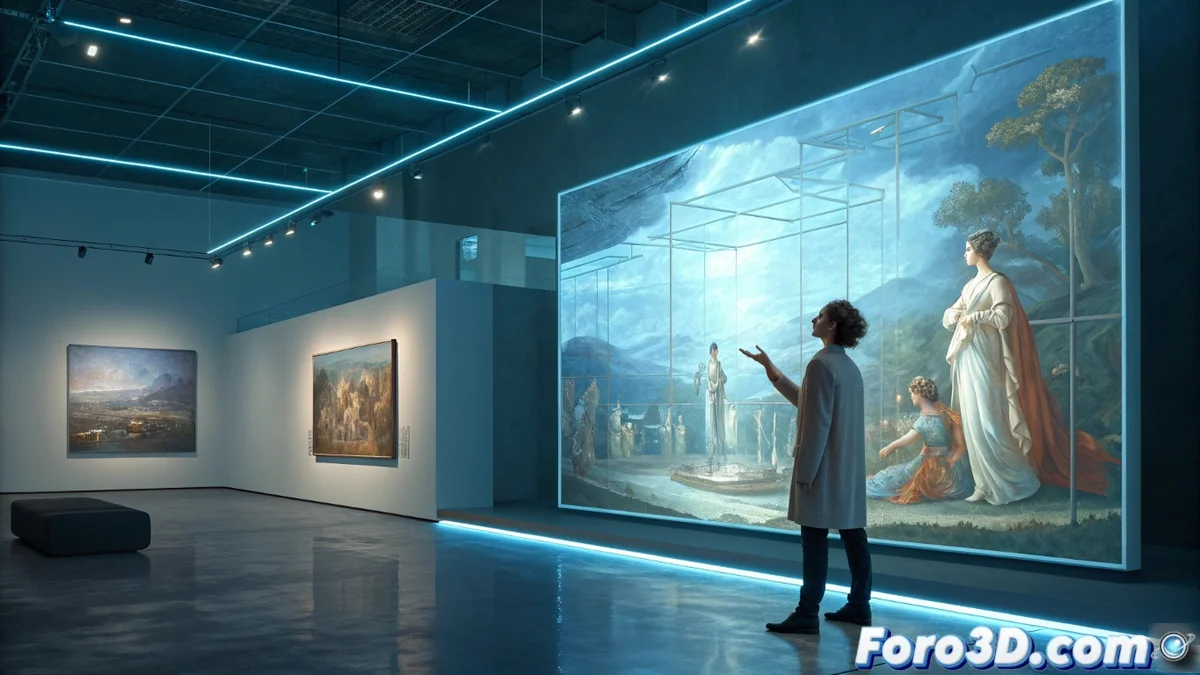
Google Arts & Culture Explores the Intersection Between AI and Cultural Heritage
The Google Arts & Culture platform is driving a revolution in the way we access historical and artistic knowledge. Through its official blog, it has announced the development of new artificial intelligence tools whose fundamental goal is to serve as a digital bridge between the world's vast cultural collections and people. This initiative does not seek to replace the human experience, but to enhance it, making museums, archives, and creative expressions more understandable and appealing to a global and diverse audience. 🎨
AI as a Digital Curator and Research Assistant
The project focuses on two main technological pillars: language models and computer vision. Together, they have the potential to unlock hidden historical narratives and connect data in innovative ways. For example, an AI system could process millions of historical documents—such as letters, decrees, or diaries—to reveal unexpected connections between events or figures, responding to complex queries in natural language. At the same time, image analysis allows scrutinizing works of art with unprecedented precision, identifying brushstrokes, previous restoration techniques, or even proposing digital reconstructions of damaged parts. This empowers curators and historians with a superhuman analytical assistant.
Key capabilities of the new tools:- Deep contextual analysis: Language models can synthesize information from multiple sources to generate rich explanations about the social and political context of a work.
- Influence discovery: Computer vision can track styles, motifs, and techniques across different eras and artists, mapping visual influence networks.
- Predictive digital restoration: Algorithms can suggest how deteriorated areas of a painting or artifact would look, based on the original style and materials.
The goal is to transform the passivity of observation into an active and enriching conversation with culture.
Towards a Fully Personalized Cultural Experience
The long-term vision is even more ambitious: creating interactive and tailored cultural learning experiences. Imagine pointing your mobile device at a sculpture in a museum and, instead of a generic technical sheet, an immersive story about its creation unfolds, its symbolism is broken down, or it is compared to similar works on another continent. AI could design thematic virtual tours tailored to your specific interests—whether the evolution of ceramics, Gothic architecture, or war photography—completely redefining the visit to a gallery or historical site.
Future applications in the museum environment:- Conversational interactive guides: Real-time dialogues with an AI assistant that responds to specific questions about what is being viewed.
- Cross-content recommendations: Connecting an Impressionist painting with a musical piece from the same era or a contemporary philosophical manuscript.
- Historical context recreations: Using AI to generate environments or sounds that immerse the visitor in the moment when a work was created.
A Future of Dialogue Between Humanity and Algorithm
This path led by Google Arts & Culture points to a future where technology not only archives, but also interprets and revitalizes our collective legacy. While humor arises about asking an algorithm the meaning of life in front of a still life, the underlying reality is profound: we are building tools that can make every encounter with art and history more meaningful, personal, and exploratory. Cultural heritage, powered by AI, is about to start a conversation with us. 🤖✨