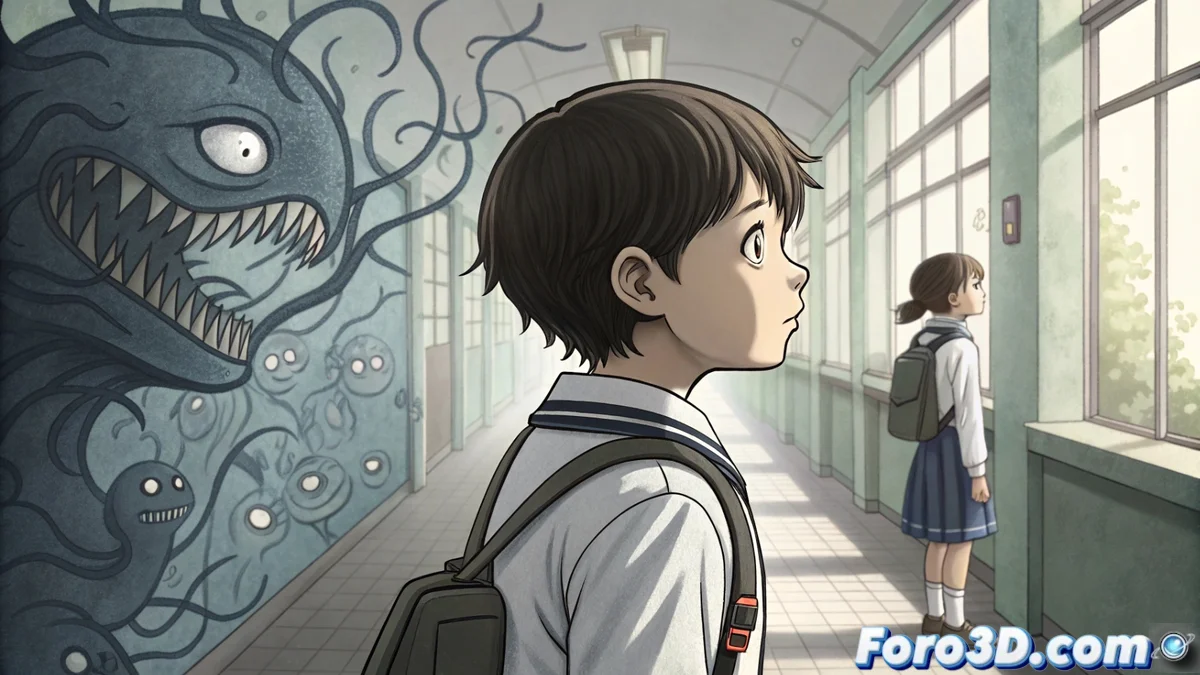
Gogo Monster Explores Childhood and Perception
In Gogo Monster, the creator Taiyo Matsumoto builds a story centered on Yuki, an elementary school boy who perceives an alternative reality populated by beings that only he can detect. This conviction separates him from his peers, who judge him as different. The plot serves as a deep exploration of imagination and the feeling of being alone during early years, employing a surrealist approach to show how a young mind interprets its surroundings. 🎭
A Graphic Style That Defines the Experience
Matsumoto applies a highly characteristic drawing style, with organic lines and forms that flow and transform. This technique generates a unique and dynamic visual energy. The artist deliberately distorts perspectives, allowing the environment to be represented from the protagonist's subjective point of view. This method builds a dreamlike atmosphere where the real and the imagined cease to have clear boundaries.
Key Elements of the Visual Approach:- Loose and Expressive Strokes: They create movement and convey Yuki's emotional intensity.
- Intentional Distortion: Altered perspectives invite the reader to see the world with the same confusion as the child.
- Fusion of Planes: The monsters and the school environment blend, blurring the everyday and the fantastic.
The narrative transcends the purely fantastic to delve into the psychological mechanisms of childhood.
Depth Beyond the Monsters
Although the premise includes fantastic creatures, the comic delves into concrete themes. It examines how a child's mind can invent complex systems to explain what it does not understand or to cope with the feeling of not fitting in. The bond between Yuki and Makoto, the rebellious boy who approaches him, serves as a fragile counterpoint based on curiosity and tentative acceptance.
Central Aspects of the Narrative:- Processing Isolation: The story shows how Yuki uses his imagination to navigate his loneliness.
- An Unexpected Bond: The relationship with Makoto offers a ray of connection in a world that Yuki perceives as hostile or indifferent.
- Deliberate Ambiguity: Matsumoto avoids confirming whether the monsters are real, inviting multiple readings about their nature.
The Irony of the Invisible
A crucial detail is the irony posed by the work: in a story about seeing invisible monsters, what often turns out to be more unsettling is the empty and normalized gaze of the other children. This final reflection underscores how the comic uses the surreal to speak of very real human experiences, such as the fear of being different and the need for someone to try to understand your world. Matsumoto's work not only tells a story but seeks to make the reader perceive the confusion and intensity of childhood. 📖