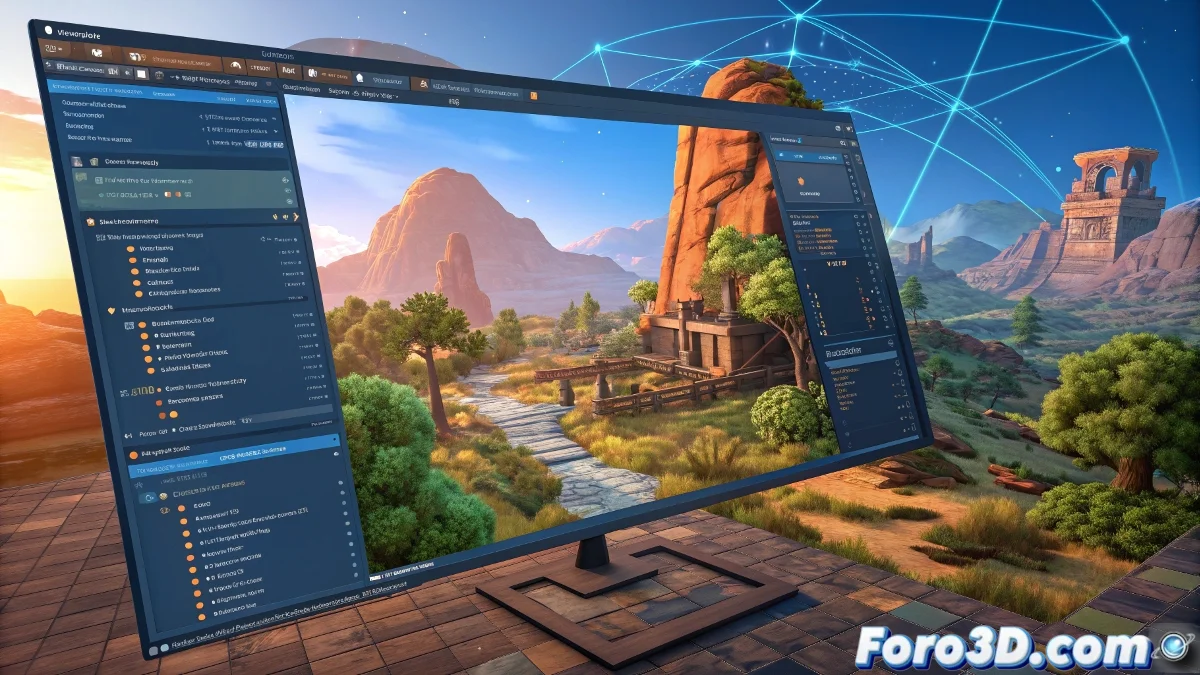
Godot Today: Breaking the Limits of Open Source Development
What began as an alternative engine for small indie projects has evolved into a serious and competitive development platform. Godot Engine in its current state—especially with the 4.x series—has closed the gap with commercial engines, offering capabilities that until recently seemed impossible for an open source solution. Today, Godot is not just a cost-effective alternative; it is a strategic choice with unique advantages that is redefining what can be achieved without million-dollar budgets or restrictive licenses. And the question is no longer "Can Godot make simple games?" but "How far can we really go?" 🚀
Godot 4.2: The Quantum Leap in 3D Capabilities
Version 4.2 represents the turning point where Godot became mature in the 3D space. With the full implementation of the Forward+ and Clustered renderer, Godot now handles complex scenes with millions of polygons and dynamic lights with efficiency that rivals established engines. The real-time global illumination system (SDFGI) enables creating environments with realistic lighting without baking, while the improved Vulkan support ensures optimal performance on modern hardware. But the most impressive part is how these advanced features remain accessible to developers of all levels, without the overwhelming complexity of other solutions. 🎮
Key Technical Advances in Godot 4.2:- Forward+ renderer for better handling of multiple lights
- SDFGI for real-time global illumination
- improved Vulkan support with lower driver overhead
- GPU particle system for complex effects
- integrated profiling and debugging tools
The Development Ecosystem: Beyond Video Games
Godot has transcended its original niche to become a complete interactive application development platform. Its flexible scene and node system is ideal not only for games, but for simulations, data visualizations, educational tools, and virtual reality applications. The native WebAssembly export capability allows running complex projects directly in browsers, while mobile device support has matured to the point where commercially successful games are being published on Google Play and App Store. This versatility is redefining who can be a developer and what they can create. 💻
Godot doesn't compete feature by feature, but completely redefines the philosophy of engine development
Current and Future Limits: The Mobile Frontier
In terms of current practical limits, Godot can handle mid-scale AAA projects with careful optimization. Independent studios are creating games with multi-million dollar budgets, extensive open worlds, and graphics that rival studio productions. Where challenges still exist is at the extremely high AAA level—games with budgets of hundreds of millions that require hyper-optimized asset pipelines and teams of dozens of technical specialists. However, for the 99% of use cases, Godot is more than sufficient, and each update closes this gap further. 🏔️
Demonstrative Projects of Current Capabilities:- open-world games with asset streaming
- virtual and augmented reality experiences
- scientific applications with complex 3D visualization
- professional tools for architecture and design
- multiplayer games with dedicated servers
Community and Development: The Engine That Never Stops
What really drives Godot forward is its vibrant community and transparent development. Unlike commercial engines where decisions are made by an executive committee, Godot evolves through open proposals and community discussion. Users can follow—and contribute to—every new line of code. This model has proven to be exceptionally effective at identifying and solving real problems rather than marketing priorities. The speed at which new features are implemented and bugs are fixed is often faster than in commercial solutions, thanks to this global army of contributors. 🌐
The Immediate Future: Toward Godot 5 and Beyond
Godot's roadmap aims to close the last significant gaps. Active work is being done on better multiplayer development support with rollback networking, AI tools for development integrated directly into the editor, and improvements in the asset pipeline for large teams. But perhaps the most exciting part is how Godot is pioneering new development methods, such as fully VR editors and no-code tools for designers. The future is not just about catching up to commercial engines, but about surpassing them in innovation and accessibility. 🔮
Upcoming Frontiers for Godot:- path-traced rendering for cinematics and preview
- better integration with DCC (Digital Content Creation) tools
- integrated machine learning tools
- native support for emerging new platforms
- real-time collaborative workflows
The question "How far can we go with Godot?" has an answer that constantly expands. Today, Godot can take developers and studios to create experiences that a decade ago required massive investments. Tomorrow, it will probably redefine what we consider possible in interactive software development. What makes Godot unique is not just its technology, but its radical philosophy of creative empowerment: the belief that creation tools should be accessible to everyone, without economic or technical barriers. And in that sense, the real limit is not in the engine, but in our imagination to harness all its potential. ✨