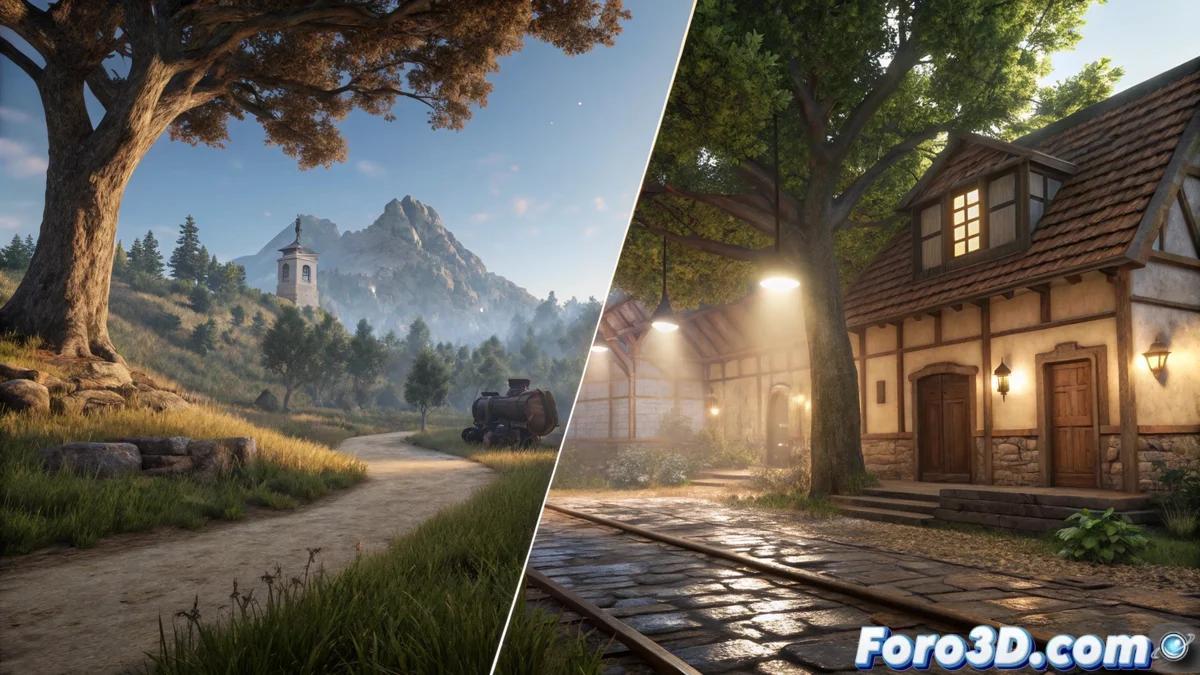
Godot 4 and Unity URP: Two Philosophies for Handling Light
When designing 3D environments, how an engine manages global illumination defines much of its workflow and performance. Godot 4 and Unity with its Universal Render Pipeline (URP) take opposite paths: one prioritizes automation and the other manual control. 🎮
Automation versus Manual Control
The central difference lies in how they process indirect light. Godot 4 implements SDFGI (Signed Distance Field Global Illumination), a system that calculates light bounces instantly without the user needing to prepare data. Unity URP, on the other hand, requires the developer to organize the scene, place Light Probes (light probes), and process Lightmaps (light maps) to capture and apply that illumination. 🔄
Main features of each approach:- Godot 4 SDFGI: Works in real-time for static and dynamic objects, updating the light when they move. Reduces preparation time.
- Unity URP Light Probes: Separates illumination: Lightmaps for static objects and Light Probes for dynamic ones. This allows precise performance optimization.
- Impact on workflow: SDFGI is ideal for rapid prototyping; Unity's method offers stable visual quality but involves more manual steps.
Some developers spend more time processing Lightmaps than designing levels, which sometimes makes them miss the simplicity of turning on a light and having everything work instantly.
Analyzing Performance and Resources
The convenience of SDFGI comes at a cost in complex scenes, where it can consume more GPU resources compared to a precomputed solution like Lightmaps. Unity's system, although demanding initial setup, is usually more efficient on limited hardware once the data is processed. ⚙️
Considerations for choosing:- For dynamic projects: Godot 4's SDFGI is advantageous because the light adapts automatically to changes.
- For projects with static assets: Unity URP's Lightmaps offer high visual quality and optimized performance.
- For teams: Godot speeds up iteration; Unity requires specialization to organize lighting.
Which Philosophy Fits Your Project?
The choice between Godot 4 and Unity URP depends on prioritizing agility or detailed control. If you want to iterate quickly in a changing environment, SDFGI's automation is key. If you need to squeeze maximum performance and have absolute control over every shadow, the workflow with Light Probes and Lightmaps, though more laborious, may be the answer. Both are powerful tools that reflect different visions of how to build virtual worlds. ✨