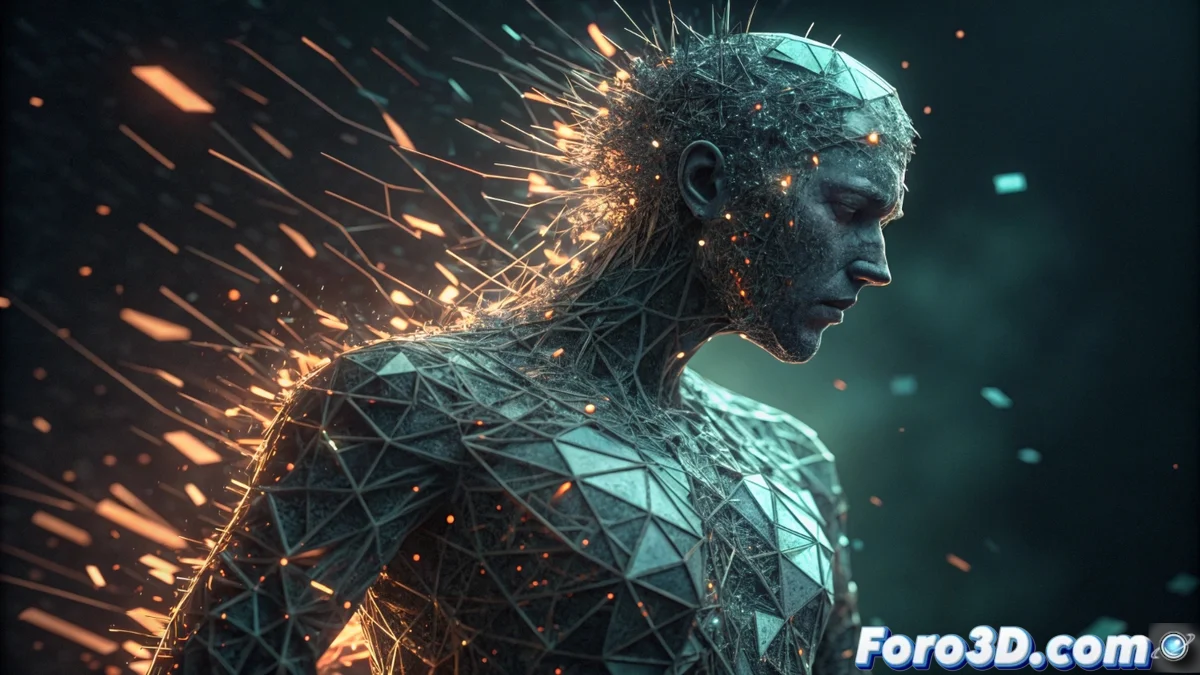
Glitch sculpting: sculpting with errors in 3D modeling
In the most experimental confines of digital art, a practice emerges that turns system failures into creative raw material. Glitch sculpting is a methodology that resides precisely at the intersection between error and intentional creation. It consists of the direct and often destructive manipulation of the raw data of a three-dimensional model, outside the safe environment of any conventional modeling software. The goal is not to refine a form, but to sow chaos in its structure to discover beauty in the unexpected. 🌀
The mesh hacker technique
On a practical level, the artist adopts the role of a data manipulator rather than a traditional sculptor. The process begins by selecting a mesh file, commonly in formats like OBJ (text-readable) or binaries like STL. For the former, a simple code editor is used to manually alter vertex coordinates, disorder lines, or even merge fragments of different geometries. With binary files, the adventure is more abstract: hexadecimal editors are used to modify specific byte values, an act whose geometric consequences are deliberately random. The result of this controlled corruption is a broken topology, full of distortions, overlapping faces, and orphaned vertices that, when reimported into 3D software, reveal organic and unique forms impossible to design by hand.
Key tools and methods:- Text and hexadecimal editors: Software like Notepad++ or HxD to modify the geometry's source code.
- Data corruption: Alter numerical values, delete code sections, or mix files to generate systematic errors.
- Recovery and visualization: Reimport the damaged mesh into programs like Blender or ZBrush to clean, retopologize, or use as a base.
Glitch sculpting challenges the paradigm of absolute control in 3D design, embracing system failure as an unexpected creative collaborator.
Philosophy and applications in digital creation
Beyond its technical nature, this practice embodies a powerful artistic philosophy. It aligns with movements like glitch art, transferring the aesthetics of error from the domain of pixels and video to the three-dimensional space. Philosophically, it questions the pursuit of perfection and control in the digital creative process, proposing instead a collaboration with randomness. In terms of application, the results are not mere curiosities. These corrupted meshes are used as abstract digital sculptures, bases for designing alien-looking organic creatures, or as high-detail geometry for generating complex textures and displacements. They offer an organic starting point that escapes the logic of standard sculpting tools.
Creative uses of glitch meshes:- Base for retopology: Create creatures or organic forms from the resulting chaotic geometry.
- Abstract digital sculpture: Finished artworks that celebrate the aesthetics of error and distortion.
- Detail geometry: Use corrupted meshes as a source for displacement maps or complex procedural textures.
Risks and final considerations
Like any adventure in unstable territory, glitch sculpting is not without risks. The probability that a corrupted file becomes unreadable or causes the unexpected crash of your favorite software is extremely high. Therefore, patience and, above all, maintaining meticulous backups of the original files become the artist's most valuable tools. Ironically, to embrace chaos, one must prepare for it. This technique represents an exciting frontier in 3D art, reminding us that sometimes, broken paths and corrupted data can lead to the most original and inspiring forms. 💥