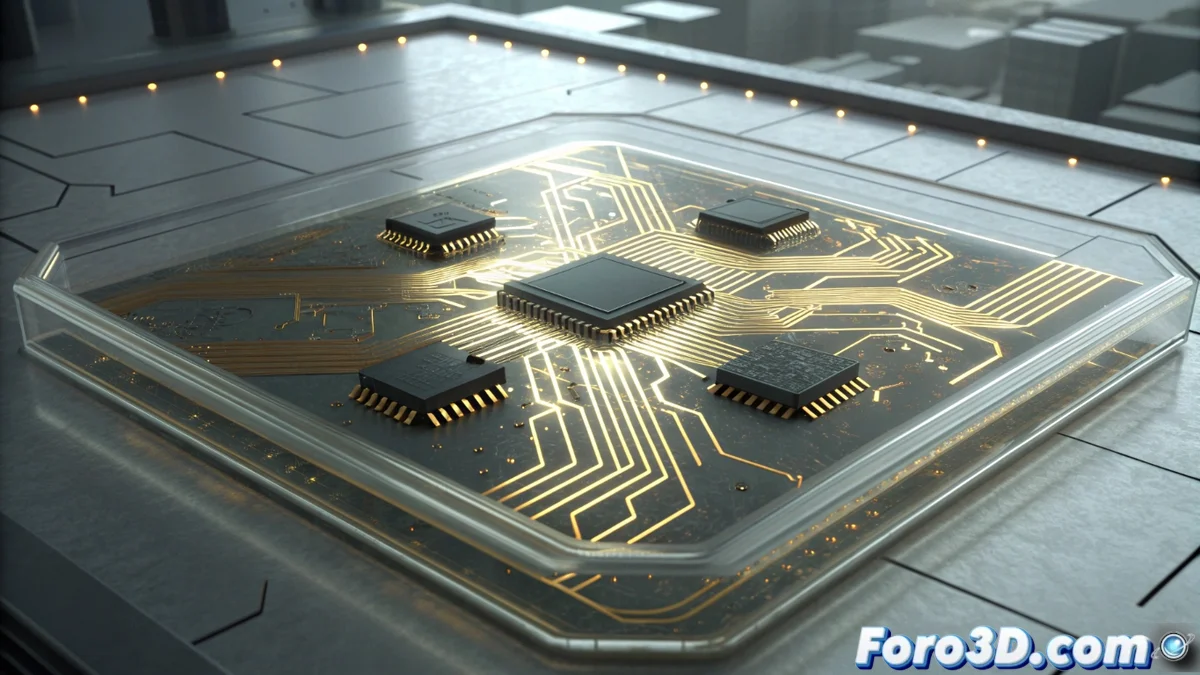
Glass Replaces Organic Substrates for Packaging AI Chips
The race to manufacture more powerful artificial intelligence systems is driving a radical change in base materials. Traditional organic substrates, made of polymers, face an unexpected rival: glass. This ancient material is positioning itself as the foundation for future chips, enabling the connection of an unprecedented number of chiplets in a single package. 🔬
Key Advantages of Glass Substrates
Rigidity and thermal stability are the properties that make glass an ideal candidate. Unlike organic materials, which deform with heat, glass maintains its shape with precision throughout the chip manufacturing process and throughout its lifetime. This feature is crucial for maintaining perfect alignment of thousands of micro-connections.
Direct benefits of this stability:- Allows designing interconnection lines that are finer and placed closer together, dramatically increasing their density.
- Facilitates manufacturing larger packages, overcoming the physical barriers imposed by organic substrates.
- Improves the overall electrical performance of the system by reducing interference and signal losses.
The future of the most advanced chips is not built on sand, but on glass.
Fundamental Enabler for Chiplet Architecture
This advance is not a mere incremental improvement; it is the foundation that makes viable the chiplet-based design strategy. In this architecture, multiple specialized silicon cores (for processing, memory, input/output) are integrated into a single package. The substrate must route a huge amount of signals and power between these blocks.
The role of glass in this ecosystem:- Acts as an ultra-dense interconnection platform that can handle traffic between dozens of chiplets.
- Its ability to support larger packages allows packaging more components, creating more powerful and efficient solutions.
- Companies like Intel are already developing this technology, with plans to implement it by the end of this decade in processors for data centers and AI.
An Ancient Material for Cutting-Edge Technology
The adoption of glass marks a turning point. It directly addresses the industry's need to scale chip packaging beyond current limits. By offering a path to integrate more functions in less space with greater reliability, glass becomes a key technological enabler. Its dominance by humanity for millennia contrasts with its new and precise application to build the computational systems that will define the next era. 💎