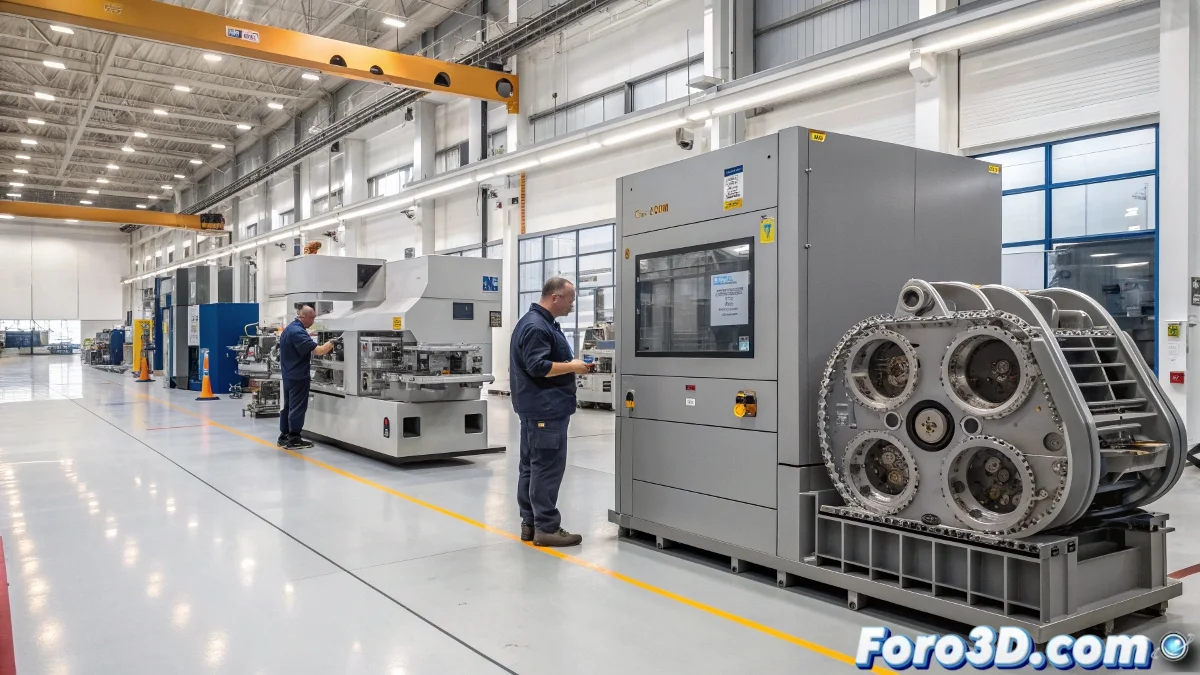
GKN Aerospace Boosts Additive Manufacturing in Connecticut
GKN Aerospace has announced the expansion of its plant in Connecticut to significantly increase the production of engine components manufactured using 3D printing 🚀. This strategic expansion will allow the company to meet the growing demand for complex and lightweight parts for aerospace applications, accelerating the adoption of additive manufacturing in an industry where precision and efficiency are critical. The investment not only increases production capacity but also consolidates GKN's technological leadership in a highly competitive sector. Because in the aerospace world, every gram counts ✈️.
Advantages of 3D Printing in Aerospace Components
Additive manufacturing enables the creation of parts with intricate geometries that would be impossible to produce with traditional methods, optimizing both performance and weight reduction in engines. This technology integrates complex internal structures that improve thermal and mechanical efficiency, while reducing material waste by depositing only what is necessary. For GKN Aerospace, this translates into more durable, lightweight components capable of withstanding the demanding conditions of flight. A combination of innovation and pragmatism that defines the future of the industry 🏗️.
3D printing enables the integration of geometries that would be impossible with traditional methods, improving engine performance and durability.
Impact on the Industry and Sustainability
This expansion not only benefits GKN but also drives the entire aerospace supply chain toward more sustainable and efficient methods. Additive manufacturing significantly reduces the carbon footprint by minimizing material waste and energy compared to subtractive processes. Additionally, it facilitates the iterative design of critical components, enabling rapid prototypes and customization that accelerate innovation. At a time when the industry seeks to reduce emissions and improve efficiency, this commitment to 3D printing sets a path to follow 🌱.
Technical Features of the Expansion
The plant expansion includes several key improvements:
- Large-format 3D printers: Capacity to produce larger and more complex parts.
- Advanced materials: High-strength metal alloys with thermal tolerance.
- Automation: Robotic systems for post-processing and quality control.
- Digital integration: Connected workflows from design to manufacturing.
Preparing for the Future of Aerospace Manufacturing
This investment positions GKN Aerospace at the forefront of the next generation of aerospace manufacturing. The expanded plant will not only increase current production but also serve as a development center for advanced materials and emerging 3D printing techniques. This includes research into composites, lightweight metals, and hybrid manufacturing processes that combine the best of additive and traditional manufacturing. The ultimate goal: more efficient, sustainable engines capable of powering the aviation of the future 🛫.
The Irony of Extreme Lightness
With components so light thanks to 3D printing, soon engineers will need anchors so the parts don't fly away with the slightest breeze... though at least the engines will be so efficient that even the air will have trouble keeping up 😅.