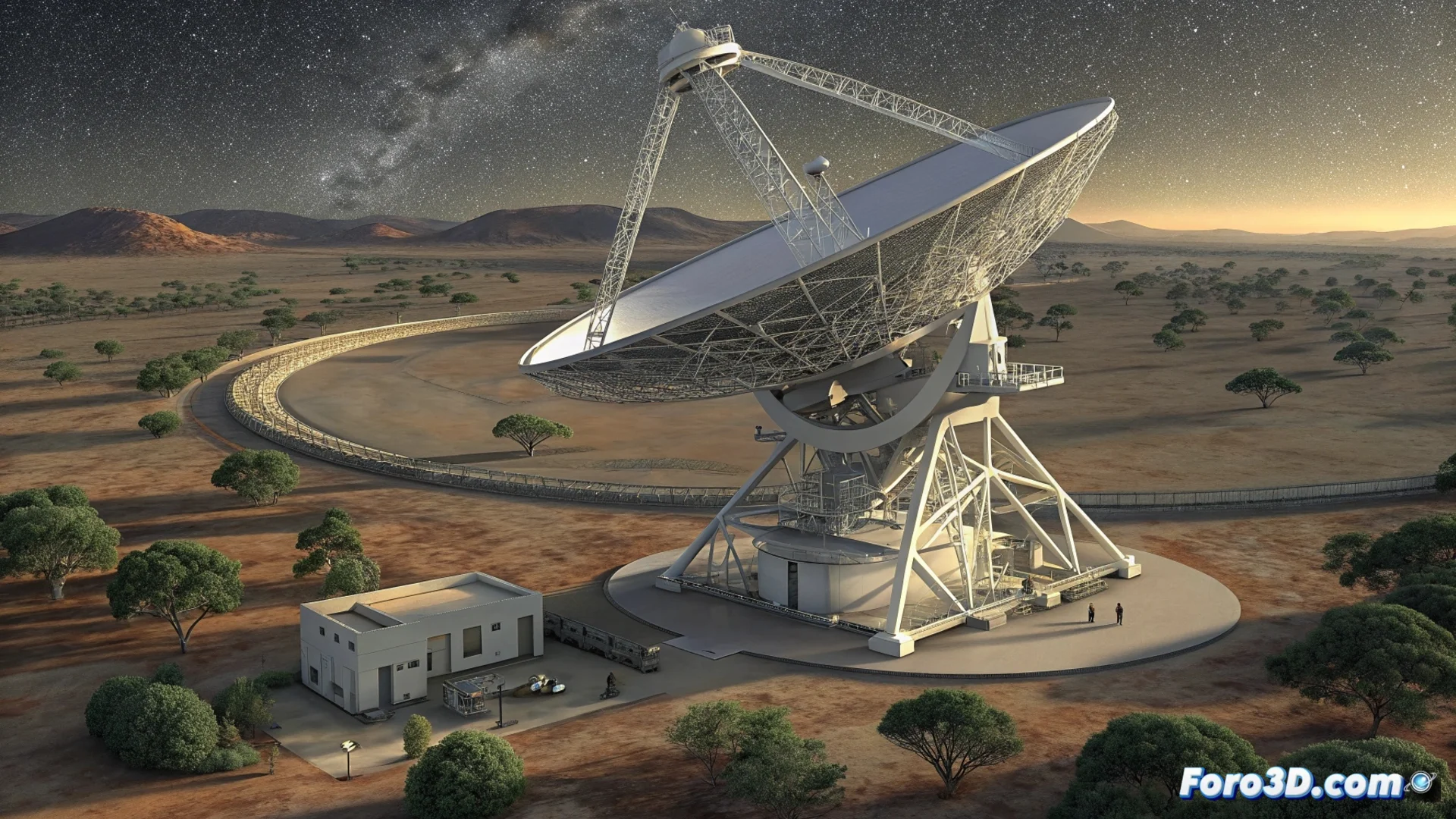
Ghana's Radio Astronomy Observatory Boosts Science in Africa
A 32-meter telecommunications parabolic antenna in Ghana has received a second life as a fully operational radio telescope. This project marks a significant advancement for the continent's scientific capacity, allowing observation of the cosmos from a strategic position near the terrestrial equator. 🌍
From Communications Antenna to Window to the Cosmos
The core of the project was to transform the existing infrastructure. Engineers implemented a new waveguide optics and dual-polarization receivers that operate in the C band. To achieve the necessary precision in observations, a hydrogen maser was installed, which provides an extremely stable time reference, a vital component for participating in very long baseline interferometry (VLBI) techniques.
Key Technical Updates:- Broadband data acquisition system to capture cosmic signals.
- Improved control and pointing infrastructure for precise tracking.
- New systems for real-time signal processing.
Recycling infrastructure ingeniously can open new windows to the universe.
Scientific Results and Operational Validation
With these improvements, the observatory (GRAO) is already generating valuable scientific data. It has been able to detect methanol masers in clouds where stars are born, accurately measure the regular pulses of the Vela neutron star, and combine its observations with those of telescopes on other continents in successful interferometry tests. These achievements validate that the instrument operates with high efficiency and reliability. 🔭
First Notable Observations:- Study of star-forming regions through masers.
- Precise measurement of pulses from distant pulsars.
- Joint detection of signals in international VLBI networks.
A Pillar for Africa's Astronomical Future
The GRAO is consolidating as the first operational node in West Africa for the emerging African VLBI Network. Its role goes beyond research: it is an essential platform for training local astronomers and engineers. This success establishes a crucial foundation for the continent to participate in large-scale global projects, such as the future Square Kilometre Array. Now, scientists in Ghana can scan the sky from their own country, a fundamental step toward democratizing access to radio astronomy. 🚀