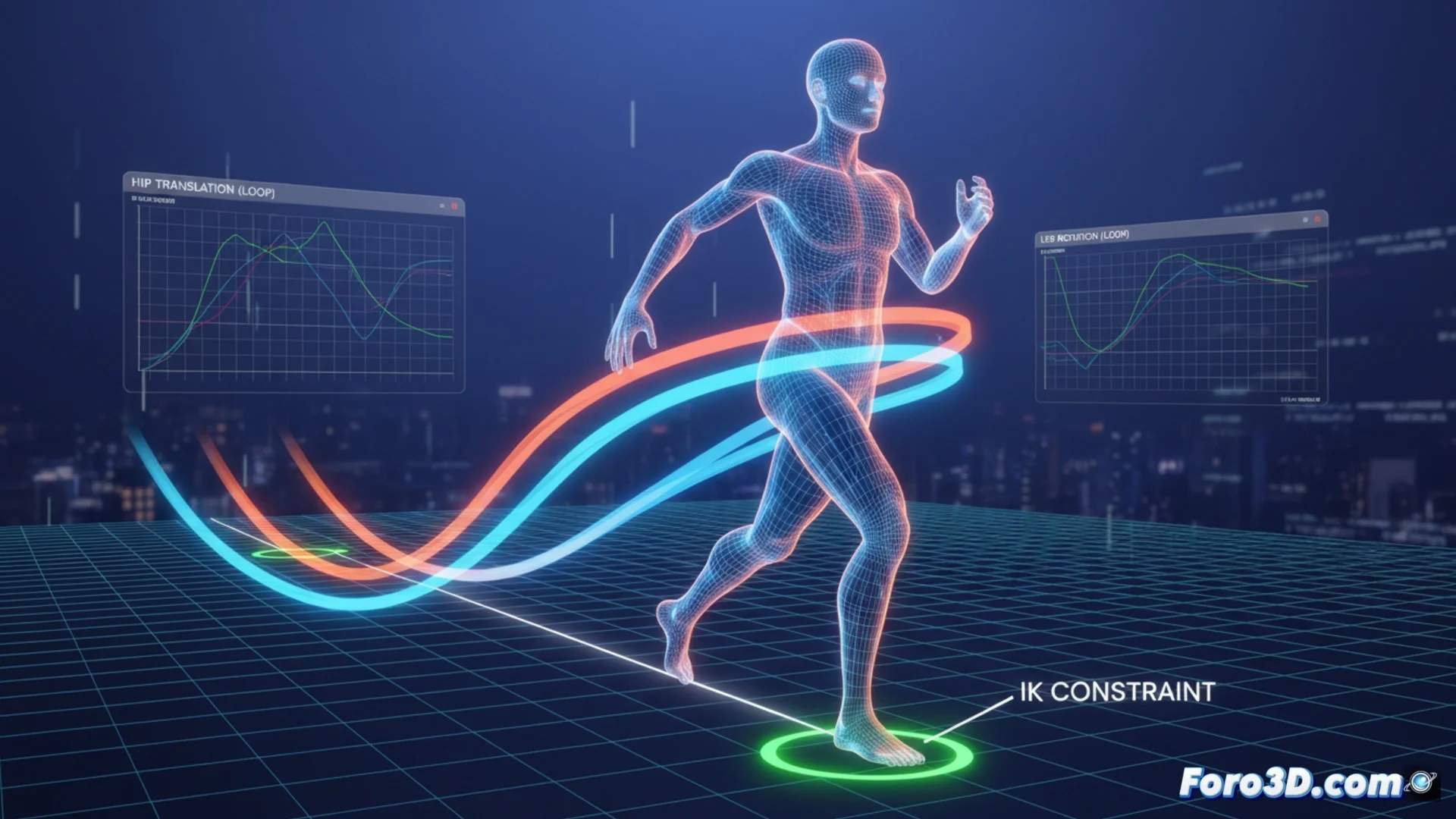
Making a Character Walk Consistently in 3D
Animating a convincing walk cycle is fundamental to bringing a 3D character to life. The goal is to create a loop that repeats seamlessly, generating the illusion of continuous and realistic forward progress. If this cycle is not well calibrated, the result will be a movement that appears to slide or jerk irregularly. 🚶♂️
Anchoring the Movement to World Space
A common mistake is animating the cycle in the model's local space, which makes the feet move but the torso does not progress. The solution is to define the animation in world space. This involves ensuring that the pelvis trajectory has a constant linear displacement. Subsequently, the limbs are animated so that the feet make contact and push off from fixed locations on the ground, creating an authentic traction feel.
Key Steps to Adjust the Cycle:- Establish a uniform and constant displacement for the pelvis in the world axis.
- Position the foot contact points in fixed world coordinates to prevent slipping.
- Synchronize the arm swinging with the leg movement to maintain balance.
The real challenge is not making the character walk, but achieving a natural stop without it seeming to crash into an invisible obstacle.
Smoothing the Movement and Using Automation
For the animation to be fluid, the curves in the graph editor must lack abrupt peaks in the position, rotation, and scale parameters. Employing inverse kinematics (IK) tools helps automatically fix the feet to the ground during the contact phase, simplifying the process. Additionally, systems like root motion, available in many engines, extract the displacement directly from the animation's keyframe, ensuring precise forward speed and eliminating residual slipping.
Recommended Tools and Techniques:- Use inverse kinematics (IK) to anchor the feet to the terrain dynamically.
- Apply root motion systems to transfer the animation movement to the character controller.
- Review and polish the animation curves to ensure smooth transitions between poses.
The Final Challenge: the Natural Stop
Mastering the walk cycle is only half the work. The transition to a complete stop requires a careful transition animation that credibly dissipates the character's momentum. Planning this sequence is as crucial as the main cycle to avoid the final movement being perceived as unnatural or abrupt. 🛑