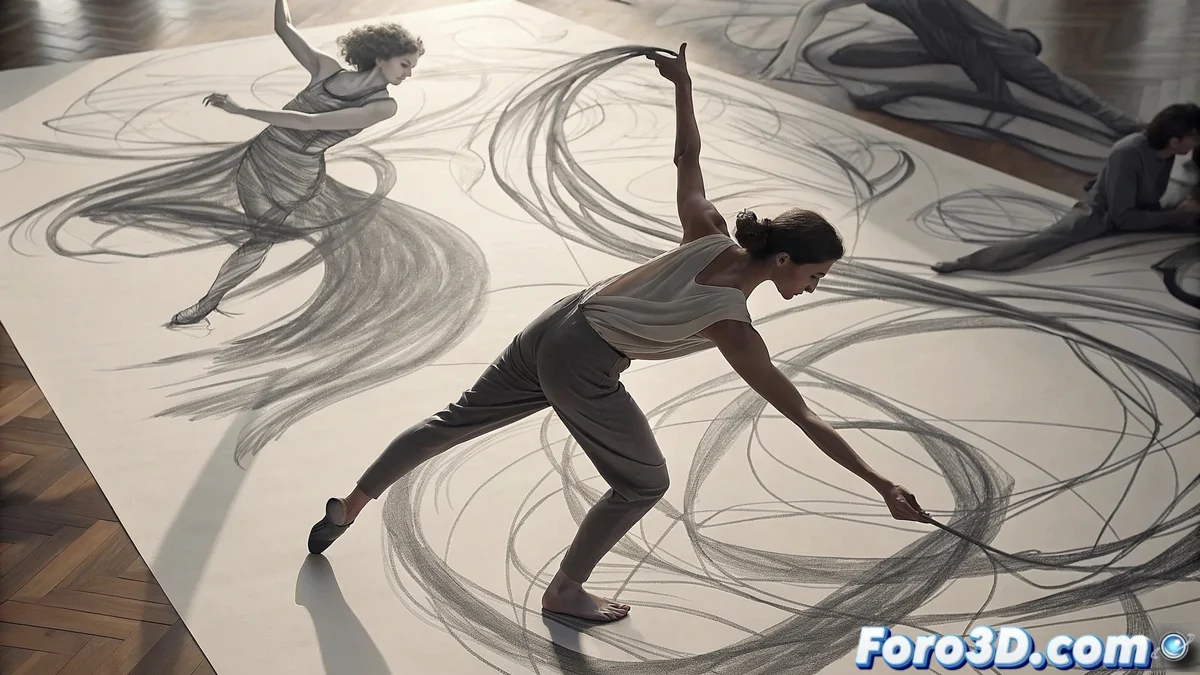
Gesture Drawing: Capturing Movement with Expressive Strokes
Gesture drawing represents a fascinating artistic methodology that focuses on capturing the vital essence of movement through quick, continuous strokes. This practice develops your ability to perceive the overall action rather than focusing on minute details, allowing you to record body dynamics with authenticity and spontaneity. Strokes should emanate from your shoulder and elbow, avoiding excessive use of the wrist, generating organic lines that communicate the intrinsic energy of the observed subject 🎨.
Fundamentals and Essential Preparation
To begin with gesture drawing, you will need materials that favor free and agile strokes. Use soft graphite pencils, charcoal, or broad-tip markers on large-format papers. The secret lies in keeping your hand in perpetual motion, dedicating from 15 seconds to a maximum of 2 minutes per representation. Place references of figures in action - dancers, athletes, animals in motion - and draw without lifting the tool from the surface, following the inherent rhythm of each pose. Your first exercises might show disproportions, but you will gradually cultivate sensitivity to the lines of force that characterize each body position.
Recommended materials to get started:- Soft graphite pencils (4B-8B) for intense and varied strokes
- Traditional charcoal or charcoal sticks for expressive shading
- Broad-tip markers that facilitate continuous and decisive lines
- Large-format paper (A3 or larger) that allows for a wide range of motion
The goal is not to create masterpieces in 30 seconds, but to develop the instinct to capture what really matters before the model disappears.
Evolution of Artistic Fluency
Constant practice of gesture drawing radically transforms your approach to figurative drawing. By focusing on capturing the fundamental impulse of each pose, your compositions acquire increasing vitality and naturalness. This technique teaches you to prioritize the narrative of movement over impeccable finish, producing drawings that exude energy even in states of stillness. Over time, you will perceive how this skill transfers to your more elaborate creations, where figures retain that essential dynamism that makes them convincing and believable. The repetition of brief but intense sessions builds muscle memory for proportions and the natural balance of the body in motion 🖌️.
Benefits of Continuous Training:- Development of manual agility and hand-eye coordination
- Improved understanding of anatomy in motion
- Increased capacity for visual synthesis
- Strengthening of the sense of rhythm and composition
The Philosophy Behind the Technique
Remember that the fundamental goal of gesture drawing is not to produce perfect works in minimal intervals, but to cultivate the instinct to capture what is truly significant before your reference changes or, in the case of static materials, before you lose concentration and seek new sources of inspiration. This discipline teaches you to value essence over form, movement over precision, developing a more intuitive and less critical gaze towards your own creative process ✨.