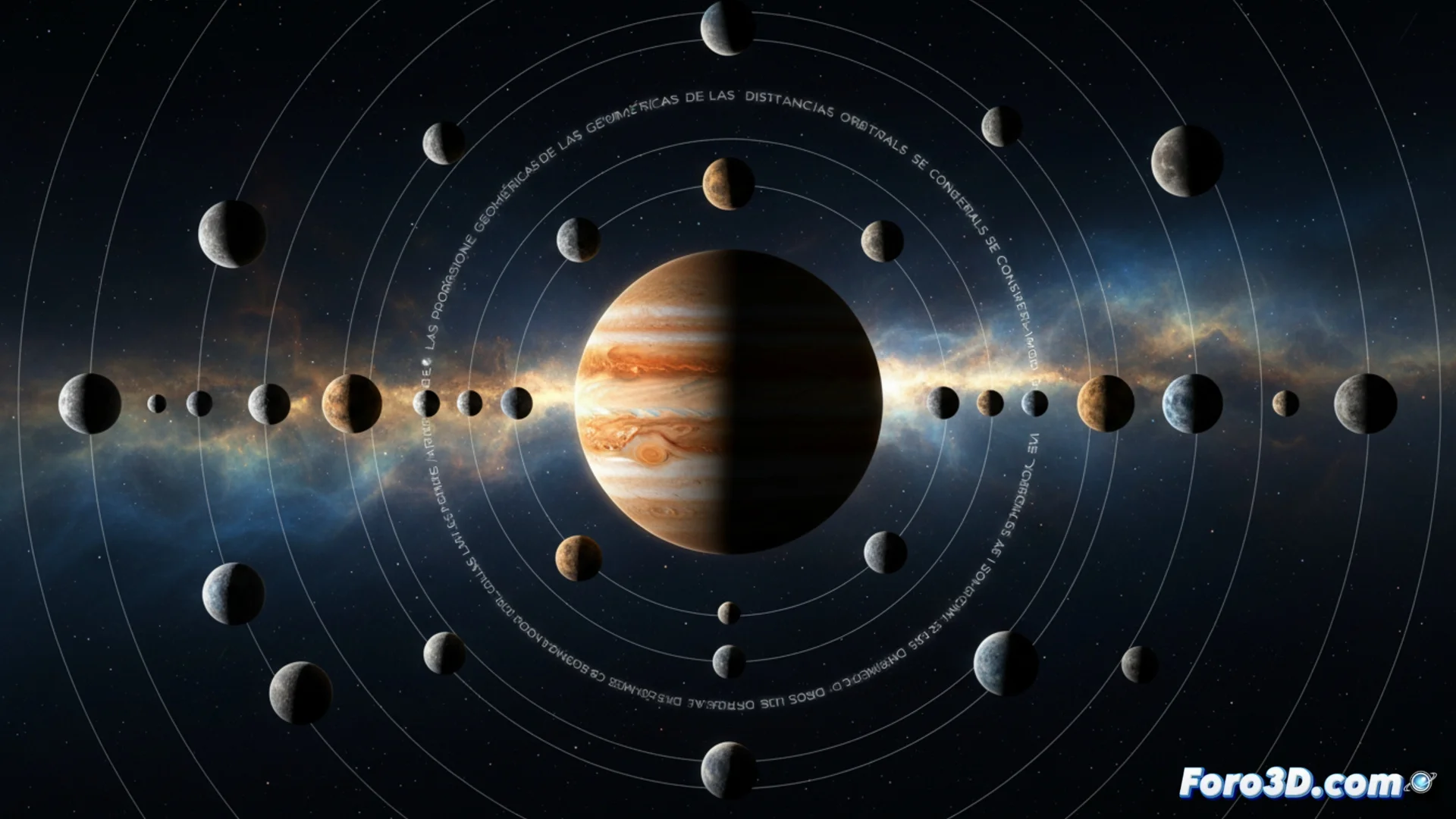
Geometric Progressions in Orbital Distances Are Preserved
It is often overlooked that the distances of the main satellites in the systems of Jupiter, Saturn, and Uranus, as well as in the solar system itself, follow approximate geometric progressions. This research evaluates how two dynamic mechanisms may have modified these proportions throughout the system's history. 🪐
Evaluating the Impact of Dynamic Forces
It analyzes how tides generated by the central body and friction with primordial nebula gas may have altered the mean distance ratios between orbits. A general relationship is established to estimate the initial proportion and is applied to both processes.
Key Findings on Stability:- Geometric progressions in orbital distances are a persistent feature.
- A method was derived to calculate the mean distance ratio in the original configuration.
- This model was applied to the two main dynamic effects considered.
The geometric harmony in the orbital arrangement appears to be a preferred state for these systems.
Central Planet Tides Do Not Change the Proportion
The results demonstrate that the tidal force exerted by the host star or planet does not manage to modify the average distance ratio appreciably on timescales comparable to the age of our planetary system. This secular effect operates too slowly, leaving the fundamental geometric progression practically unaltered since its origin. 🔭
Consequences of This Effect:- The tidal process is ineffective for reorganizing the global mean configuration.
- The basic structure in geometric progression remains from the formation epoch.
- The timescales necessary for a change exceed the age of the Solar System.
Nebula Gas Drag Also Maintains the Structure
Regarding friction caused by primordial nebula gas, the study indicates that the mean distance ratio was probably not substantially altered either. This is subject to specific nebula models and the duration of the effective drag period, but once the gas dissipates, the mean progression is preserved. Resonances between the mean motions of the satellites can help preserve this order.
Conclusion on Geometric Harmony
Although individual orbits may migrate, their tendency to preserve a constant mean ratio suggests that the system prefers a state of geometric harmony. Even when external forces attempt to disrupt the arrangement, the mean configuration based on a geometric progression demonstrates remarkable resilience. 🌌