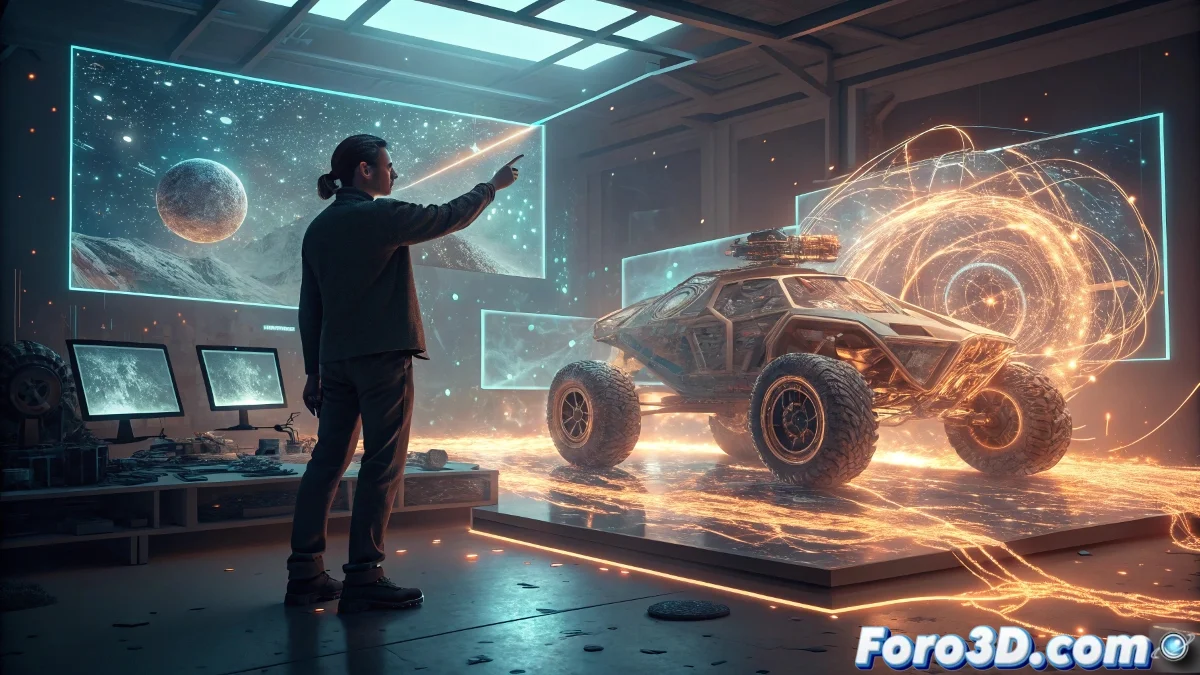
When Words Turn into Three-Dimensional Volumes
Generative AI is radically transforming the 3D modeling landscape by enabling the creation of high-fidelity meshes directly from simple textual descriptions. This technological revolution represents a paradigm shift comparable to the transition from manual technical drawing to computer modeling, but exponentially accelerated. Where specialized work previously required hours or days, systems like OpenAI's Point-E and NVIDIA's Get3D can now generate complete 3D models in minutes starting solely from natural language instructions.
What makes this technology particularly disruptive is its ability to understand abstract concepts and spatial relationships from text. A description like "a modern design chair with curved wooden legs and padded backrest" translates not only into basic geometry, but into material details, aesthetic proportions, and even implicit ergonomic considerations. The AI has learned from millions of existing 3D models how words relate to shapes, creating an intuitive bridge between human language and three-dimensional representation.
Applications Transforming Industries
- Rapid prototyping for industrial design and product development
- Asset generation for video games and film production
- Architectural visualization through conceptual descriptions
- Education and training where students can materialize ideas instantly
The Technical Process Behind the Magic
Generative AI systems for 3D operate through specialized transformer architectures trained on text-image-3D model pairs. When a user enters a description, the system first generates multiple coherent 2D views of the object from different angles, then uses multi-view 3D reconstruction techniques to infer volumetric geometry. The most advanced models jump directly from text to native 3D representations using 3D variational autoencoders and specialized generative adversarial networks.
The best 3D software is the one that understands not only commands, but the intention behind them
The quality of results has improved dramatically in recent months, with systems capable of generating clean topologies, coherent UVs, and even basic applied materials. While early iterations produced mainly voxelized or low-resolution geometry, current ones can generate optimized polygonal meshes ready for use in professional production pipelines. Integration with established software like Blender, Maya, and Unity is making this technology accessible to artists without needing deep AI technical knowledge.
Advantages Over Traditional Methods
- Reduction in modeling times by orders of magnitude
- Democratization of access to professional 3D content creation
- Accelerated creative exploration through instant concept iteration
- Integration with existing workflows as a base for manual refinement
For studios and professionals, the impact is particularly significant in the conceptual and pre-production stages, where the ability to quickly generate and evaluate multiple design variations dramatically accelerates creative decision-making. Where a team could previously explore 3-4 concepts in a week, now it can evaluate dozens in an afternoon, with the added benefit that each variant comes with a fully functional 3D model rather than just 2D sketches.
Those new to this technology will discover that the greatest value lies not in completely replacing 3D artists, but in exponentially amplifying their creative and productive capacity, freeing them from the most repetitive tasks to focus on what really matters: artistic vision and quality refinement 🤖