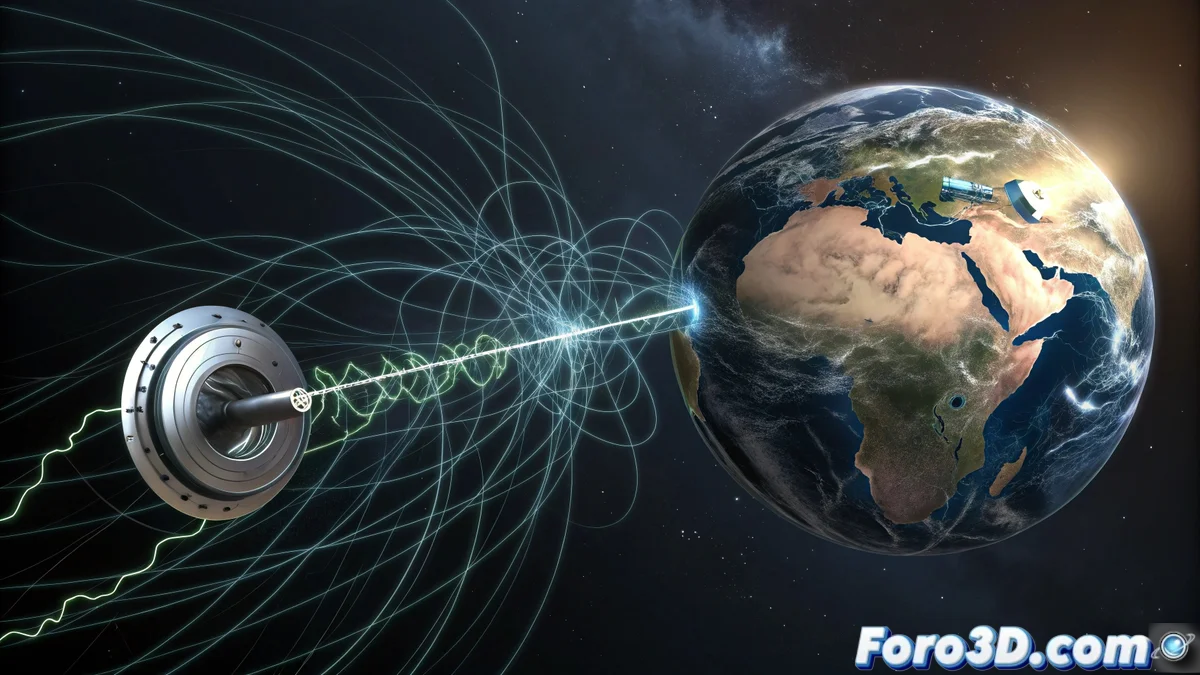
Plugging Earth into the Power Grid? The Idea Spinning Around Us
A group of researchers has proposed a concept that seems straight out of a science fiction novel: generating electricity by harnessing the Earth's constant rotation and its immense magnetic field. 🪐 This idea, which is in a very preliminary phase, raises the possibility of obtaining energy continuously and, in theory, unlimited, without the need for fuels. It involves capturing a fraction of the immense kinetic energy that our planet unleashes every second. The potential is so great that it makes one wonder why we didn't think of it before, although the answer probably lies in the enormous technical challenges.
The Basic Principle: A Planetary Dynamo
The operation is based on electromagnetic induction, the same principle that allows conventional generators to work. When a conductor moves through a magnetic field, an electric current is generated. In this case, the magnetic field is Earth's, and the moving conductor would be a structure designed to interact with it. Imagine an extraordinarily long cable deployed in the atmosphere. The key lies in the scale, as colossal-sized systems would be needed for the generated energy to be significant. It's not magic, it's pure physics, but applied on a massive scale. 😅
This experimental approach transforms the planet's natural dynamics into a potential source of clean energy.
The engineering challenges are formidable. For the system to be viable, room-temperature superconductors or structures capable of withstanding tremendous forces would be needed, something that is currently far beyond our technological capabilities. Additionally, there is debate about whether extracting this energy could, in the long term, have a minuscule effect on Earth's rotation speed. Scientists, however, point out that the amount of energy that could be extracted would be insignificant compared to the total energy of the system.
An Energy Future Hanging by a Very Long Thread
Could this technology complement solar and wind power? In theory, its great advantage is constancy. While the sun sets and the wind dies down, Earth never stops spinning for a second. 🌀 This makes it a potentially stable baseload energy source. However, it is crucial to be realistic. The path from a scientific paper to practical implementation is full of obstacles. The main hurdles to overcome include:
- The scale of the necessary infrastructure, which would require trillions in investments.
- The energy conversion efficiency, which would currently be very low.
- The environmental impact of deploying gigantic structures in the atmosphere or orbit.
Beyond Theory
Despite the challenges, research in this field continues to advance. Scientists are exploring novel materials and theoretical designs that could make the concept viable in the distant future. 💡 The most valuable lesson from this idea is not so much its immediate application, but rather that it reminds us of the amount of untapped energy surrounding us. Scientific creativity knows no bounds, even when engineering limits are very evident. Perhaps, in a century, this will be commonplace, or maybe it will just be a nice thought experiment.
So, for now, it's better to keep paying the electricity bill the traditional way. Earth, for the moment, has no plans to cover that expense. 😉