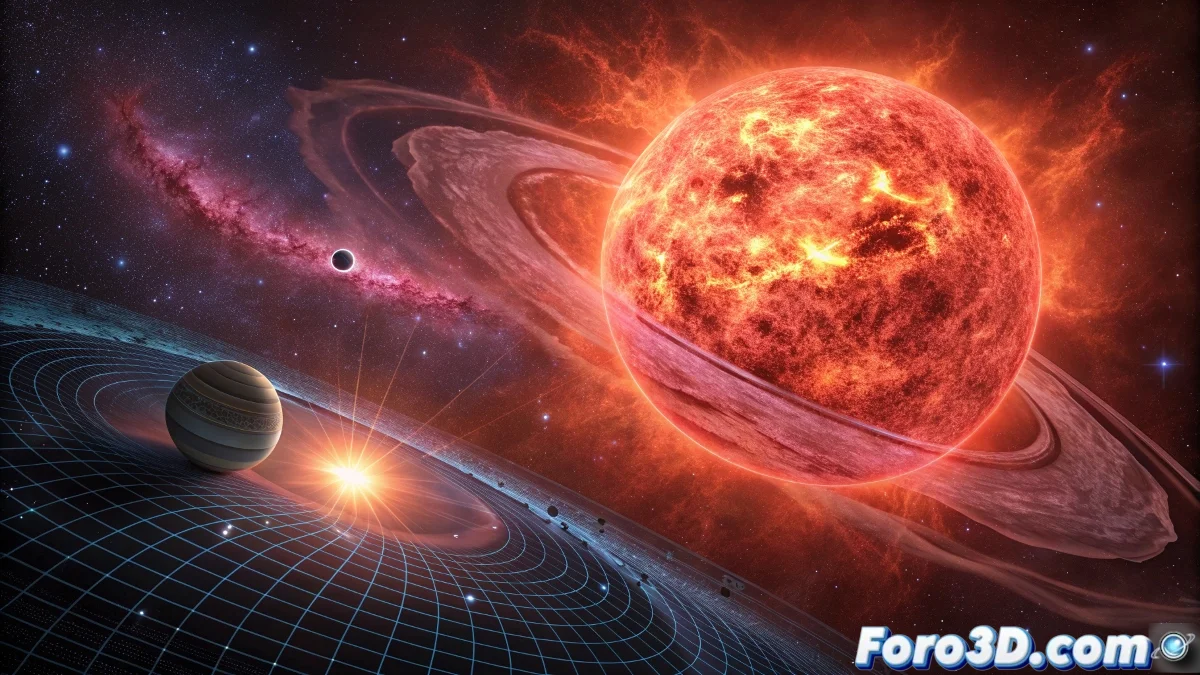
When Einstein Becomes the Guardian of Distant Worlds
General relativity theory, that intellectual monument of Albert Einstein, might be playing a cosmic role that even its creator couldn't have imagined. New research suggests that relativistic effects act as an invisible shield for planets orbiting dying stars, subtly modifying their orbital trajectories to prevent them from being engulfed during the red giant phase. Gravity, which we normally associate with attraction and destruction, reveals itself here as a protective force.
This discovery represents one of those elegant paradoxes that the universe so enjoys: the same force that could destroy a world saves it through quantum nuances. Astrophysicists watch in astonishment as corrections they previously considered insignificant prove crucial for planetary survival in senescent stellar systems. Einstein continues to surprise from beyond. 🌌
Space-time is not just the stage where the cosmic drama unfolds, but a fundamental actor that modifies the script
The Celestial Mechanics of Relativistic Rescue
The planetary salvation process operates through orbital precession induced by space-time curvature. When a star expands into a red giant, its intense gravitational field significantly curves the surrounding space.
- Periapsis precession that moves the point of maximum orbital approach farther away
- Deformation of elliptical trajectories toward more stable orbits
- Orbital resonances that synchronize protective planetary movements
- Conservation of angular momenta modified by relativistic effects
These effects, though minuscule on human scales, accumulate over millions of years to produce sufficient orbital deviations to keep planets outside the stellar destruction radius. Patience is a cosmic virtue.
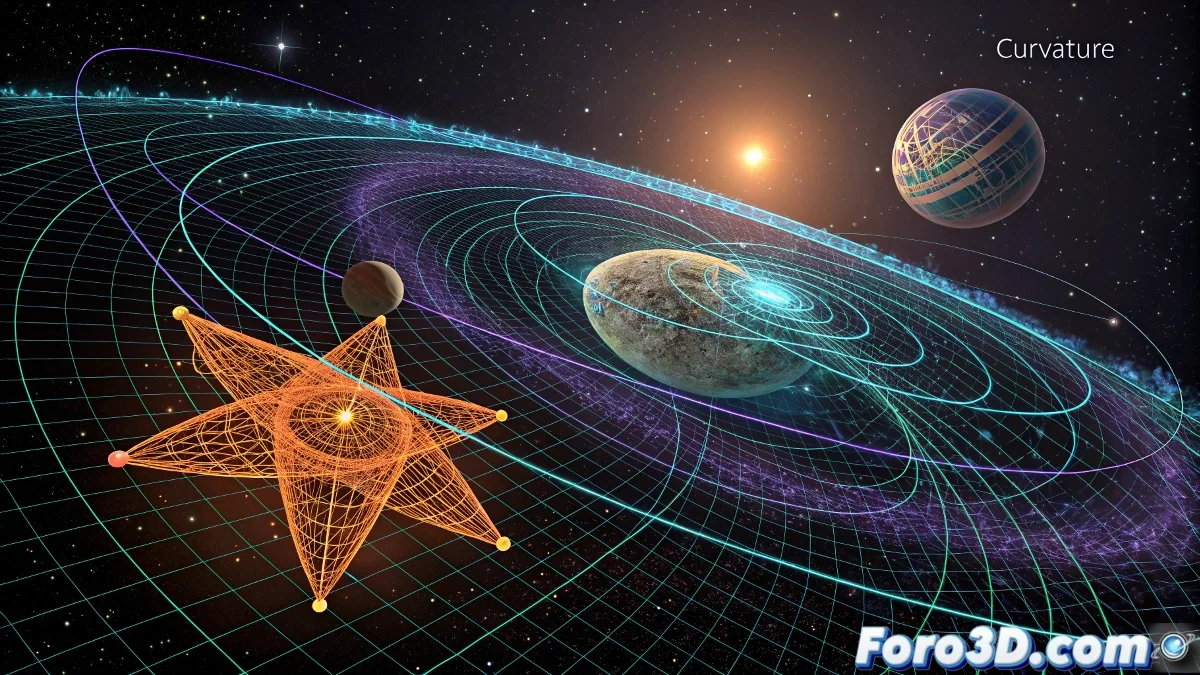
Visualizing the Invisible in Blender
Representing these abstract concepts requires combining scientific precision with visual creativity. Blender offers perfect tools to make the intangible tangible.
- Deformable meshes that visualize space-time curvature
- Particle systems to show matter being dragged toward the star
- Custom shaders that simulate gravitational lensing
- Trajectory animations that show orbital evolution
The key lies in finding the balance between scientific representation and communicative clarity, showing enough detail to be accurate but enough simplicity to be understandable. The art of scientific visualization has never been so challenging.
Implications for the Search for Habitable Worlds
This discovery dramatically expands the temporal window for the development of life in the universe. Planetary systems we previously considered doomed could harbor habitable worlds for much longer periods.
General relativity, which already revolutionized our understanding of the cosmos on large scales, now reveals itself as a possible factor in the persistence of habitable conditions around old stars. The universe demonstrates once again its ingenuity for preserving life where we least expect it. 🪐
And if one day we find life around a red giant, we probably should thank Einstein... though the aliens probably have their own name for the effect 😉