General Electric Revolutionizes Wind Energy with 3D Printing of Concrete Bases
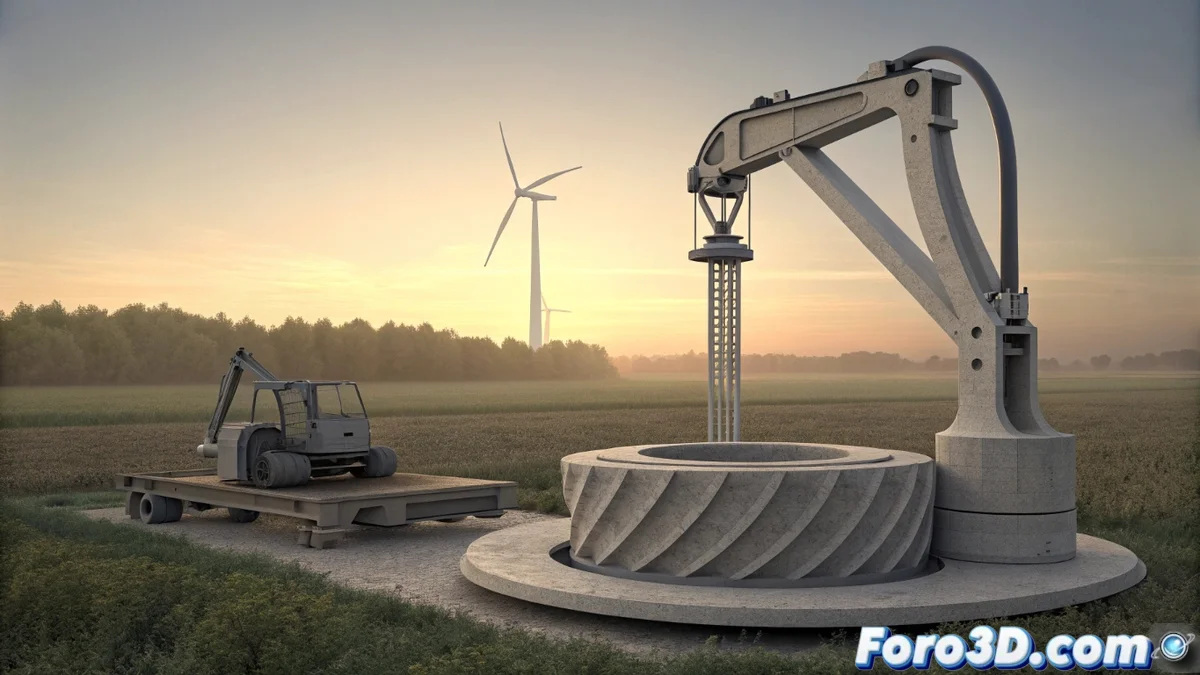
The renewable energy industry is witnessing a transformative breakthrough. General Electric (GE) is leading the charge with a pioneering prototype that applies large-scale additive manufacturing, using 3D concrete printing to create wind turbine blade bases directly at the installation site. This approach eliminates one of the biggest logistical barriers and opens up a world of possibilities for optimized designs and more efficient energy generation. 🚀
Overcoming Transportation and Design Limits
The traditional method of building giant wind turbines faces an obvious bottleneck: transporting monumental components by road. GE's innovation changes the game by manufacturing the tower base in situ. Using concrete as the main material and a robotic extrusion system, it is possible to build wider, more robust support structures and, most importantly, significantly taller ones. Taller towers access stronger and more consistent wind currents, which translates directly into higher electricity production. Additionally, logistical costs, installation timelines, and the project's carbon footprint are drastically reduced.
Key advantages of localized manufacturing:- Greater height and stability: Without road transportation constraints, bases can be designed with optimal geometries to reach greater heights and capture more wind.
- Logistics simplification: The need for special convoys for oversized components is eliminated, streamlining the entire supply chain.
- Terrain adaptability: The technique allows customizing the base design to perfectly adapt to the specific conditions of each site, whether in complex terrains or remote areas.
The future of wind energy lies in printing solutions, literally. This technology could be the turning point to make renewable energy more accessible and efficient.
The Technology Behind the Innovation
This development fits into the growing trend of robotic and 3D printing construction. GE's prototype employs a robotic arm equipped with a high-precision concrete extruder. This system enables exploring complex and organic geometries that would be impossible or extremely costly to achieve with traditional formwork and molds. The goal is to achieve maximum structural strength using the minimum amount of material, a key principle of additive manufacturing.
Potential impact on the energy sector:- Feasibility in remote locations: Makes it possible to install wind farms in areas with limited or non-existent road infrastructure.
- Long-term cost reduction: By optimizing materials and processes, the final cost of generated energy is expected to decrease.
- Generative design: Opens the door to using algorithms to create base designs that are ultra-efficient in terms of material use and aerodynamic performance.
A Promising Horizon with Challenges Ahead
If this prototype scales successfully, it will represent a paradigm shift in wind infrastructure manufacturing. It's not just about building differently, but building better and smarter. Although the technology promises to revolutionize logistics and design, the path to widespread implementation still must navigate permitting processes and industry standard adaptations. However, the message is clear: the fusion of 3D printing and renewable energy is poised to drive the energy transition toward a more sustainable and efficient future. 🌍💨