NVIDIA has unveiled its new line of graphics cards GeForce RTX 50 Series, which include the RTX 5090, RTX 5080, RTX 5070 Ti and RTX 5070. These cards, available starting in February, mark the debut of the Blackwell GPU architecture in desktop graphics cards, positioning themselves as the most powerful options for gaming users and professional artists.
Prices and Availability
The prices of the new graphics cards range between 1,999 € and 549 € (approximately), depending on the model. Below are the prices by model:
- GeForce RTX 5090: 1,999 €
- GeForce RTX 5080: price similar to the RTX 5090
- GeForce RTX 5070 Ti: intermediate price
- GeForce RTX 5070: 549 € (the most affordable option)
The cards will be available between late January and early February, with the GeForce RTX 5090 and 5080 in stores on January 30, and the GeForce RTX 5070 Ti and 5070 starting in February.
Improvements in Specifications
The new RTX 50 series represents a significant improvement over the previous generation RTX 40 cards. These improvements include:
- Better capabilities in three types of essential cores for performance: CUDA (for general GPU computations), Tensor (for artificial intelligence operations) and RT (cores dedicated to real-time ray tracing).
- 4th generation RT cores and 5th generation Tensor cores, which should translate into performance improvements, especially in tasks involving AI and real-time rendering.
Memory
One of the most notable improvements in the GeForce RTX 5090 is its graphics memory capacity, which reaches 32 GB, compared to the 24 GB of the RTX 4090. The GeForce RTX 5070 Ti also sees an increase in its memory, although the 5080 and 5070 versions maintain the same capacity as their predecessors.
GDDR7 Memory and DisplayPort 2.1 Support
The GeForce RTX 50 series is compatible with GDDR7 memory, a more advanced version than the GDDR6X of the RTX 40 series. This improvement contributes to faster and more efficient performance in various applications.
Regarding display connectivity, the new cards feature an HDMI port and three DisplayPort ports, like the RTX 40 cards, but now support DisplayPort 2.1, the latest version of the standard. This will offer higher data transfer rates and a better visual experience. Additionally, the RTX 50 cards are also compatible with DisplayPort 2.1b, which will be released soon.
Greater Energy Efficiency and Compact Design
Despite the performance improvements, the GeForce RTX 50 Series features a more compact design compared to the previous generation, as all cards are dual-slot.
In terms of power consumption, the RTX 50 series presents an increase in Total Graphics Power (TGP), but remains more efficient than its predecessors.
Performance in DCC Applications and Video Editing
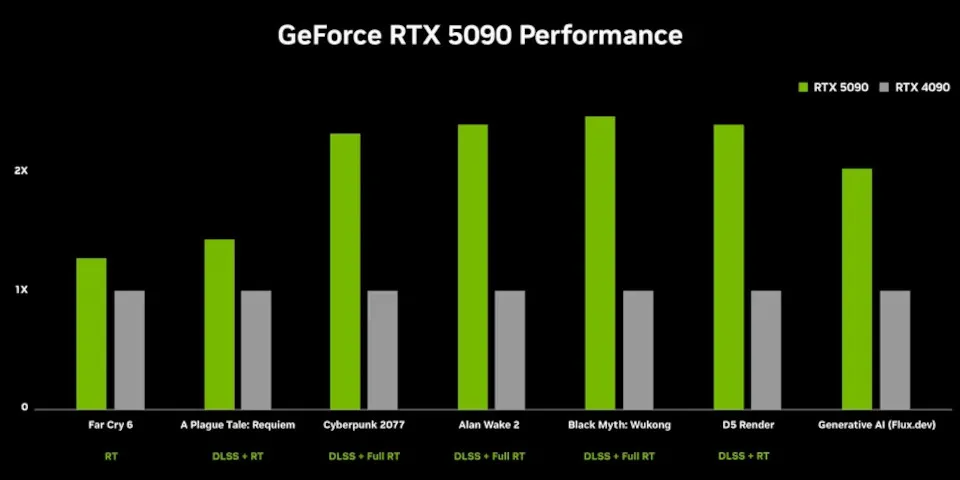
The GeForce RTX 50 cards also offer impressive performance in digital content creation (DCC) applications and video editing software. According to tests conducted with the D5 Render rendering engine, the GeForce RTX 5090 offers more than twice the performance of the RTX 4090.
In applications like DaVinci Resolve, the GeForce RTX 5090 promises to export video 60% faster than the RTX 4090.
"The GeForce RTX 5090 outperforms the RTX 4090 in rendering and video export tasks, showing notable improvements in creative workflows."
NVIDIA also mentions improvements in AI-based creative workflows, although much of its communication focuses on the impact of these cards on generative content creation, such as artificial intelligence in video games and multimedia applications.
Conclusion
NVIDIA's GeForce RTX 50 Series cards mark a milestone in graphics performance, offering powerful improvements in memory, connectivity, and energy efficiency. With prices ranging from the 1,999 € of the GeForce RTX 5090 to the 549 € of the RTX 5070, these cards are designed to satisfy both high-end gamers and design and content creation professionals.
With availability starting at the end of January, these cards promise to change the way creators interact with the most advanced graphics technologies.