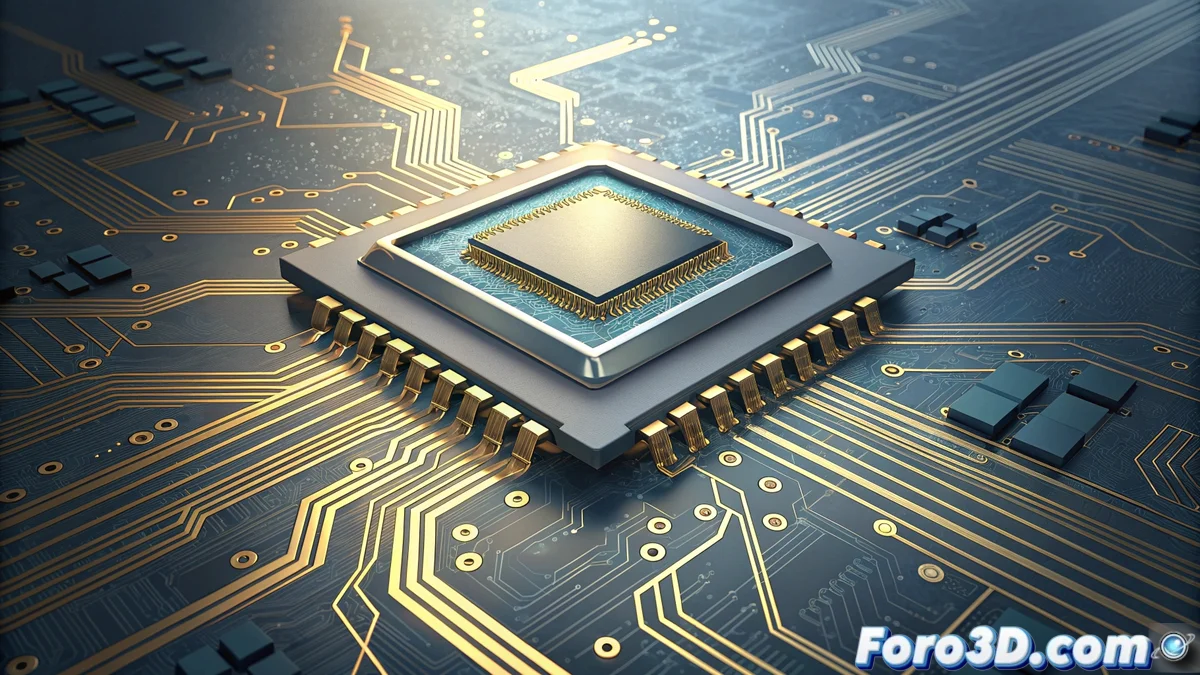
GDDR7: The Next Graphics Memory with PAM3 Signaling
The graphics components sector is advancing toward a new generation with GDDR7. This emerging standard implements PAM3 signaling, a technology that surpasses the transfer limits of its predecessors like GDDR6X. Its main goal is to dramatically expand bandwidth, an indispensable requirement for the most powerful graphics processing units under development. This memory is shaping up as a fundamental element for handling data flows from video games at ultra-high resolutions and the complex artificial intelligence operations that need to move massive information at unprecedented speeds. 🚀
PAM3: The Core of Technological Advancement
Three-level pulse amplitude modulation (PAM3) forms the basis of this leap. Unlike conventional binary schemes that encode a single bit per clock cycle, PAM3 can encode log2(3) bits, translating into superior transfer efficiency. This method allows achieving higher data speeds without excessively increasing the memory module's operating frequency. Preliminary technical specifications indicate speeds that could exceed 32 Gbps per pin, nearly doubling the bandwidth available with current high-end solutions.
Key Features of the Transition to GDDR7:- Implements PAM3 signaling for greater data density per clock cycle.
- Allows per-pin speeds exceeding 32 Gbps, doubling effective performance.
- Reduces the need to excessively increase operating frequencies, optimizing power consumption.
The race for pixels and teraflops is now also fought on the memory bus, where every nanosecond and every gigabyte per second matters more than ever.
The Performance Demands Justifying the Change
The need for this extra bandwidth is evident and immediate. Video games with 8K rendering, the most immersive virtual reality environments, and increasingly complex generative AI models exert enormous pressure on the memory subsystem. A modern GPU processes enormous resolution textures, extremely detailed geometry, and executes thousands of matrix operations simultaneously. GDDR7 is specifically designed to mitigate the bottleneck of transferring this data between memory and the GPU core, making the entire system run more smoothly and efficiently.
Applications That Will Benefit Directly:- 8K Video Games and Virtual Reality: Require moving massive amounts of texture and geometry data in real time.
- Generative Artificial Intelligence: Complex models need to access and process large volumes of information at high speed.
- Professional Simulation and Rendering: Workloads involving manipulating dense 3D scenes and intensive calculations.
A Data-Driven Future
The arrival of GDDR7 marks a turning point in graphics card architecture. It's not just about increasing clock speed, but implementing a smarter and more efficient way to transmit information. PAM3 technology is the catalyst that will allow future GPUs to unleash their full potential, especially in scenarios where bandwidth is the main limiting factor. The evolution of graphics memory runs parallel to that of processing cores, ensuring both advance in a balanced manner to deliver the most powerful visual computing experience. 💻