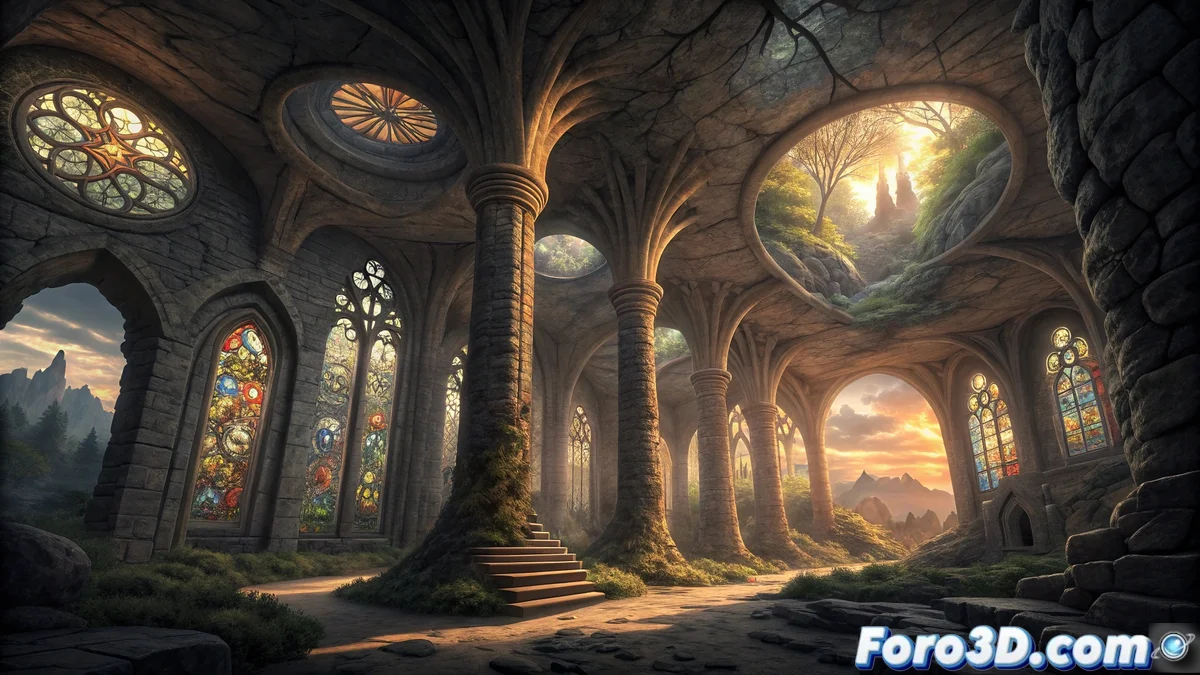
Gaudí's Crypt in the Colonia Güell: Legacy of an Incomplete Genius
At the heart of the Colonia Güell, located on the outskirts of Barcelona, lies an architectural gem that defies convention: the Crypt designed by Antoni Gaudí. This subterranean space was conceived as the foundation for a colossal church that never materialized, transforming into a tangible testament to the revolutionary vision of one of the most influential architects of all time 🌟.
Gaudí's Visionary Architectural Language
Gaudí approached this project with an integrative philosophy that fused architecture and nature in perfect symbiosis. The inclined basalt columns rise from the ground like trunks of a mineral forest, while the hyperbolic vaults create an architectural canopy that anticipates structural solutions he would later perfect in subsequent works. The polychrome stained glass and the characteristic trencadís generate a luminous choreography that transforms the space into a unique sensory experience, demonstrating his mastery of ruled geometry and advanced bioclimatic principles for his time.
Highlighted Structural Innovations:- Inclined basalt columns that distribute loads organically
- Parabolic vaults that optimize structural resistance
- Natural lighting system using strategically positioned stained glass
"Sometimes the foundations can be more interesting than what they were meant to support, especially when those foundations bear the signature of a genius" - Reflection on Gaudí's legacy
The Value of the Unfinished: A Truncated Project
The incomplete nature of the work does not diminish its importance, but rather enhances it by allowing the study of Gaudí's creative process in its pure state. Visitors can observe how the structures emerge from the earth only to be abruptly interrupted, creating an architectural narrative suspended in time. This condition of a "three-dimensional sketch" invites one to imagine the magnitude of the projected church, which would have incorporated unprecedented innovations in 20th-century religious architecture.
Elements that Evidence the Original Project:- Visible foundations intended to support the never-built main nave
- Structures showing the transition between the underground and the elevated building
- Spaces that betray the monumental scale initially conceived
Irony and Enduring Legacy
It is profoundly ironic that what was originally conceived as a simple basement has become the most memorable and studied part of the project, while the main church remains in the limbo of blueprints and models. Gaudí once again demonstrated his ability to transcend conventions, creating a work where the foundations not only support but become the absolute protagonists. Its designation as a UNESCO World Heritage Site certifies that, in architecture, sometimes the incomplete can achieve a perfection that the finished never attains ✨.