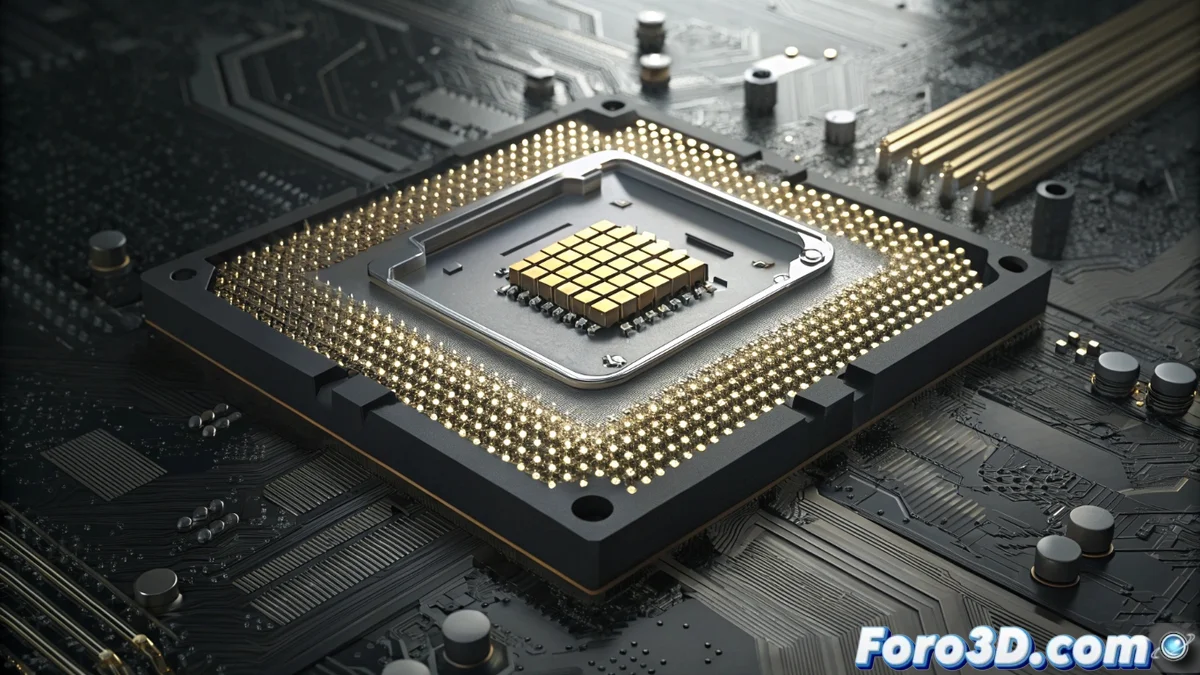
LGA vs PGA: the battle of processor sockets
In the fascinating universe of PC assembly, the moment of placing the CPU into its socket is one of the most critical. Behind this seemingly simple act lie two opposing design philosophies: Land Grid Array (LGA) and Pin Grid Array (PGA). The essential distinction is not merely aesthetic; it lies in where the fragile electrical connectors are located, a decision that directly impacts durability, cost, and user experience. 🧠⚙️
The heart of the difference: where do the pins live?
Imagine the pins as the essential messengers between the computer's brain (the processor) and its nervous system (the motherboard). In the PGA architecture, these fragile, golden messengers reside on the bottom of the CPU. In contrast, in the LGA standard, the situation is reversed: the pins are soldered to the motherboard socket, and the processor presents a flat surface with simple contacts. This role swap is much more than a technical detail; it is a strategy to protect the most valuable component. 💎
Practical implications of each design:- Robustness and handling (LGA): Without pins, the CPU is significantly more resistant to damage from handling. The risk of bending a connector is transferred to the socket, a component that is generally more affordable to replace.
- Density and evolution (LGA): Allows for a higher density of contacts, facilitating support for the power and data demands of modern high-performance processors.
- Cost and tradition (PGA): Usually associated with lower manufacturing costs for the CPU and has been the dominant standard in laptops and popular sockets like AMD's AM4.
AMD's adoption of LGA in its AM5 socket marks a turning point, unifying the trend in the consumer market toward a more robust and high-density design.
Advantages and disadvantages in the real world
The choice between LGA and PGA is not binary; each has its niche. The key advantage of LGA is, without a doubt, safety. For the amateur assembler, installing an Intel Core or an AMD Ryzen 7000 series (AM5) is a less stressful operation, as the expensive component is "shielded." However, this does not make the socket invincible, which requires careful alignment and uniform pressure when lowering the lever. On the other hand, PGA maintains its relevance in environments where cost and compactness are paramount, such as in most laptops. 🛡️ vs 💰
Current landscape of sockets:- LGA dominance: Used by Intel in its desktop sockets (e.g., LGA1700) and by AMD in its AM5 platform for Ryzen. It is the king in high-end and upper mid-range.
- PGA presence: Remains the standard in the vast majority of laptop processors and in the huge installed base of AM4 sockets. Its legacy is extensive.
- Market unification: AMD's migration to LGA with AM5 suggests that this design is consolidating as the future for desktops, prioritizing evolution capacity and user protection.
Conclusion: more than a simple connector
The next time you hold a processor, look at its bottom. If it is a smooth sheet of contacts, you are facing an LGA design and can breathe a little easier during installation. If, on the other hand, you see a forest of small golden pins, handle that PGA with the delicacy of a watchmaker. This "battle" of sockets reflects the constant evolution of hardware, where seemingly small engineering decisions—like moving the pins—have a huge impact on the experience, reliability, and future of our machines. The trend is clear: toward designs that protect the user's investment and allow for greater connection complexity. 🚀