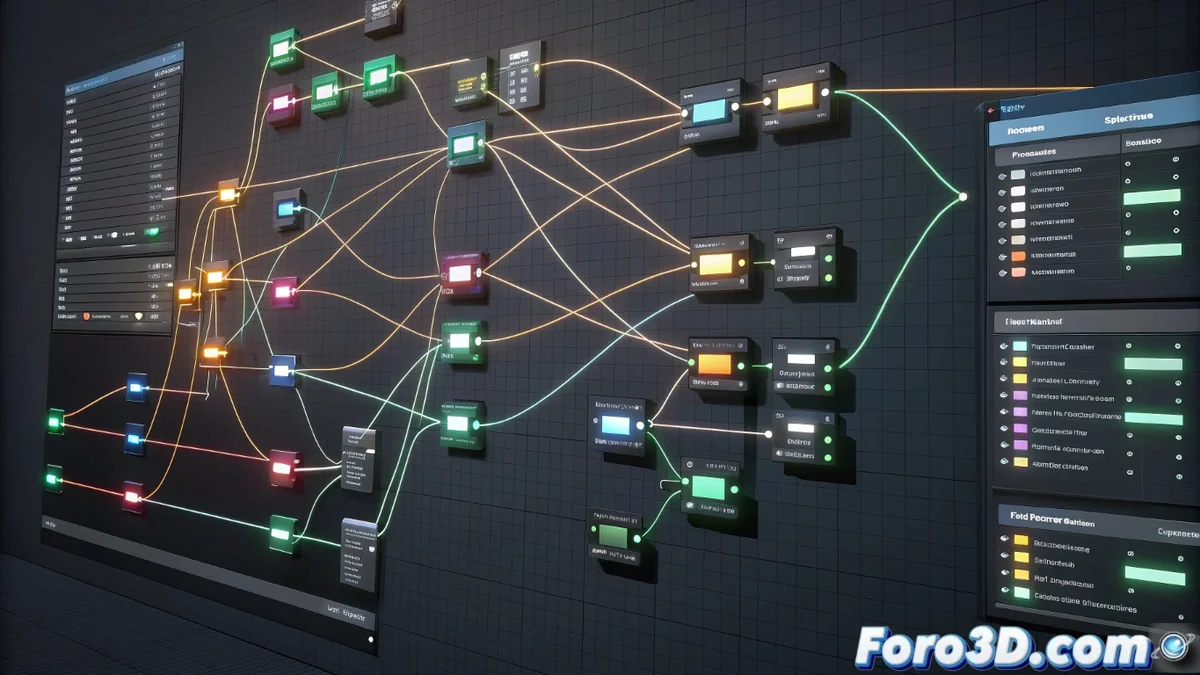
Material Function Instancing in Game Engines
In modern video game development, optimizing the workflow for creating materials is crucial. Material Function Instancing is a methodology adopted by engines like Unreal Engine to structure and streamline this process. Instead of writing shader code manually every time, this system allows encapsulating complex visual behaviors within reusable modular blocks. 🎮
How does this workflow work?
The essence of the system lies in separating responsibilities. A technician or graphics programmer defines the core shader logic once, within a main material function. This function acts as a powerful template that exposes specific controls, such as values for color, roughness, or reflection intensity. Artists and visual designers then instance this master function, creating variations without touching the underlying code. The engine doesn't need to process and compile a completely new shader for each adjustment, which dramatically speeds up testing ideas.
Key benefits of adopting this approach:- Development efficiency: Technical teams build the foundation once, and artists can combine and adjust these functions like visual building blocks, reducing errors and maintaining consistency.
- Optimized performance: The engine executes instances of the same compiled shader, instead of handling hundreds of unique variations. This improves memory usage and runtime speed.
- Accessibility for artists: The workflow becomes more intuitive and agile for non-technical profiles, who can focus on the visual result without relying on constant compilations.
An artist can generate a hundred different material appearances just by modifying colors and textures, while the underlying engine compiles and processes a single base shader.
Applying the system in a real project
In production, the process is straightforward. First, a specialist creates the material function using the engine's node editor. There, the network of mathematical operations and textures that shape the desired visual effect is defined. The parameters that need to be customizable are marked as exposed. Then, a master material is generated that instances this function. From this master, artists derive the final materials for their assets.
Typical steps in implementation:- Define complex visual logic in a reusable function with shader nodes.
- Create a master material that serves as a bridge between the function and the final instances.
- Generate derived materials from the master to assign to 3D models, adjusting the exposed parameters to simulate different surfaces like metal, fabric, or skin.
- Iterate and refine values in real time, as changes do not trigger a full shader recompilation.
Impact on the production cycle
Adopting Material Function Instancing transforms how teams collaborate. It eliminates bottlenecks where the art department waits for each minor modification to compile. Instead, artists can experiment freely, adjusting parameters interactively and seeing results instantly. This not only accelerates content production but also fosters greater creativity and quality control, ensuring all project assets share a solid and unified technical foundation. 🚀