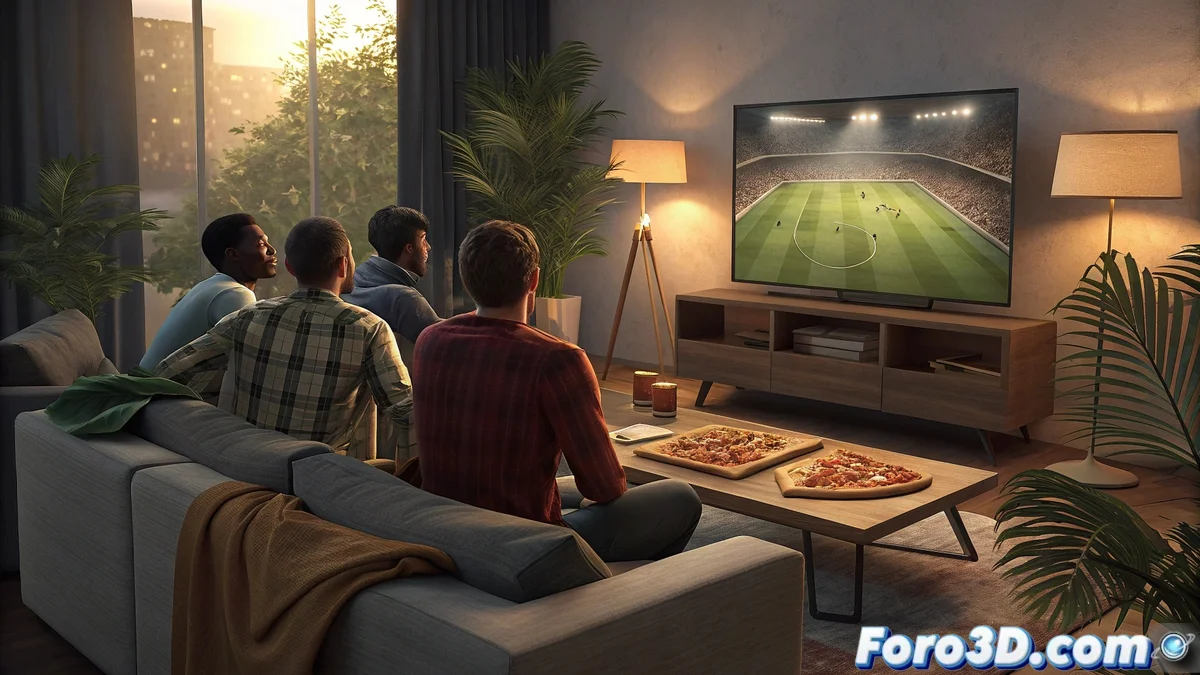
From the Stadium to the Living Room: The Architectural Evolution of Watching Football at Home
The architectural transformation of domestic spaces to accommodate football gatherings represents a fascinating sociological study that has redefined how we design our homes. From the first television broadcasts to today's immersive experiences, each generation has adapted their homes to turn sports viewing into a unique social ritual 🏠⚽.
The Revolution of Domestic Space
When television burst into Spanish homes, it not only changed entertainment habits but completely reconfigured the layout of living rooms. Architects began designing more flexible spaces where the television became the main focal point, displacing fireplaces and other traditional elements. This evolution has created a new paradigm where interior design prioritizes collective visibility and group comfort over more formal arrangements.
Key Elements in the Evolution:- Transition from closed living rooms to open spaces that integrate kitchen, dining, and living areas
- Incorporation of modular furniture that adapts to different group sizes
- Development of acoustic solutions to enhance the sound experience without disturbing neighbors
Watching football at home has created an emotional architecture where spaces are designed not only to live in, but to share collective passions.
Advanced Configuration in ArchiCAD for Sports Spaces
Creating an optimized environment for watching matches requires a precise technical approach in ArchiCAD. Start by setting up a new project with metric units and establish specific organizational layers: main-structure, fixed-furniture, sports-lighting, and decorative-elements. Precision in these initial configurations will determine the quality of the final result 🎯.
Detailed Step-by-Step Configuration:- Start new document with ArchiCAD 26 Template and set units to millimeters
- Create specific layers: Structural-Walls (thickness 200mm), Fixed-Furniture, LED-Lighting, Wall-Decoration
- Set floor height in Options > Story Settings to 2.70m for standard Spanish ceiling
- Use Wall Tool with parameters: Composite Wall type, thickness 150mm, height 2700mm
- For open distribution, draw walls at 45° angles using Special Snap Points for perfect connections
Optimization of Viewing and Acoustics
The furniture arrangement must follow specific ergonomic principles to maximize the visual experience. In ArchiCAD, use the Object Tool with the GDL library to insert sectional sofas configured in a semicircular arrangement. Adjust seat height to 450mm from the floor and optimal viewing distance calculated as 2.5 times the simulated screen diagonal 📺.
Advanced Modeling Techniques:- For screens: use Object Tool > TV Screens > select 65" LED model with 50mm thickness
- Configure screen materials with Surface Settings: Reflectivity 0.15, Transparency 0.05, Roughness 0.1
- For pizzas: create custom objects with Morph Tool and apply HD textures from Image Material
- Optimize acoustics with Wall Tool > Composite Structure adding 30mm acoustic layer
Professional Lighting for Sports Environments
Strategic lighting is crucial to create atmospheres that enhance the experience without compromising screen visibility. In ArchiCAD, configure a hybrid system using Window Tool for natural light and Light Tool for directional artificial lighting. Set luminous intensity parameters between 800-1200 lux for peripheral areas while keeping the screen area below 300 lux 💡.
Advanced Rendering Configuration:- Activate CineRender Engine from Document > Creative Imaging > Render Settings
- Set quality: Physical Sky Model, Resolution 3840x2160, Anti-aliasing High (16 samples)
- Adjust camera: Position Height 1600mm, Target Point center of screen, Field of View 60°
- For special effects: activate Depth of Field with F-stop 2.8 and Focus Distance towards main group
The Architectural Legacy of Football Gatherings
These spaces have evolved into social design laboratories where architecture responds to specific human behaviors. The integration of home technology, adaptive acoustics, and spatial flexibility demonstrates how everyday rituals can influence lasting architectural trends. Beyond the sports outcome, these configurations have created a cultural heritage that will continue to evolve with each new generation of fans 🏆.