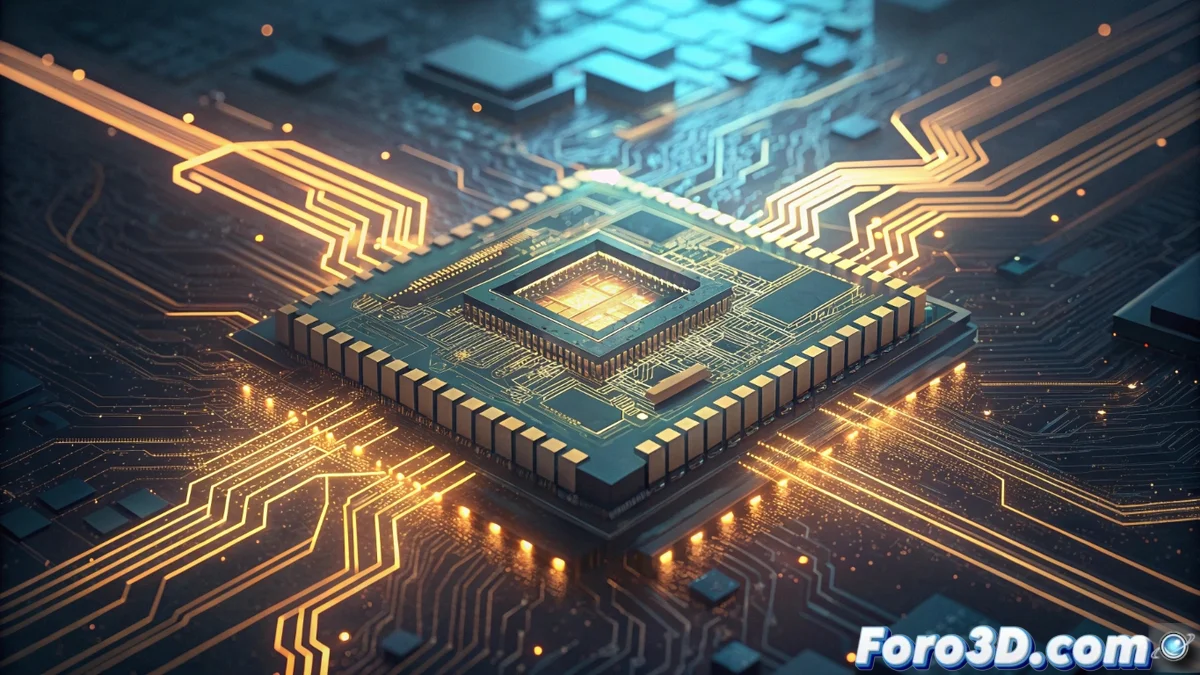
Foveros and the 3D Stacking Revolution in Semiconductors
The race for miniaturization in the semiconductor industry has taken a radical turn, leaving behind the obsession with reducing nanometers in a single plane to literally ascend. Foveros, Intel's innovative three-dimensional packaging technology, leads this movement by enabling the construction of processors in height, vertically stacking silicon blocks with diverse functions. This method surpasses the traditional concept, integrating CPU cores, GPU units, and specialized accelerators into a single sophisticated package. 🏗️
Why build upward? The advantages of the Z-axis
3D logic stacking, distinctive of Foveros, is not just about saving space. Its main benefit is drastically shortening communication paths between different functional modules. By interconnecting them via Through-Silicon Vias (TSV) of extreme density, the physical distance—and therefore latency and energy consumption for moving data—is reduced exponentially. This creates colossal bandwidth and unprecedented efficiency, enabling custom architectures that optimize performance per watt for any device, from ultrabooks to data centers. ⚡
Direct impact on design and manufacturing:- Architectural flexibility: Designers can combine chiplets manufactured on different process nodes (e.g., high-performance cores on one node and I/O on a more economical one), optimizing cost and performance.
- Reduction in complexity: Instead of a giant, hard-to-produce monolithic chip, smaller, specialized "tiles" or tiles are fabricated, increasing manufacturing yield.
- Heterogeneity as the norm: Integration of AI engines, NPUs, and other domain-specific accelerators alongside general-purpose computing cores is facilitated, creating more powerful and efficient solutions.
The disaggregated design paradigm is not just a technical evolution; it is a rewriting of the fundamental rules for creating processors.
The future is vertical and disaggregated
Foveros lays the foundation for disaggregated design, a model where the final processor is assembled from modular and heterogeneous building blocks. This approach offers unprecedented scalability and can significantly shorten new product development cycles. Intel, with this technology, and other industry giants, are paving the way toward a new generation of devices where three-dimensional integration and specialization will be indispensable elements. 🚀
Consequences of this 3D revolution:- More customized products: Variants of a base design can be created for very specific markets (gaming, enterprise, mobile) with greater agility.
- Improved thermal and form factor: The resulting compact designs enable thinner devices with better heat management, as efficient communication generates less energy loss.
- Innovation acceleration: The ability to reuse and recombine proven chiplets speeds up the time-to-market for new solutions.
Conclusion: An intimate conversation in a silicon skyscraper
While the physical world organizes horizontally, cutting-edge microelectronics has found verticality as its next frontier. Technologies like Foveros transform processors into true microscopic skyscrapers where each floor (tile) performs a crucial function, communicating with its neighbors at astonishing speeds and with renewed energy efficiency. The next time your device handles a heavy workload surprisingly cool and fast, remember that inside that package, an extremely efficient three-dimensional conversation is taking place. 🌆