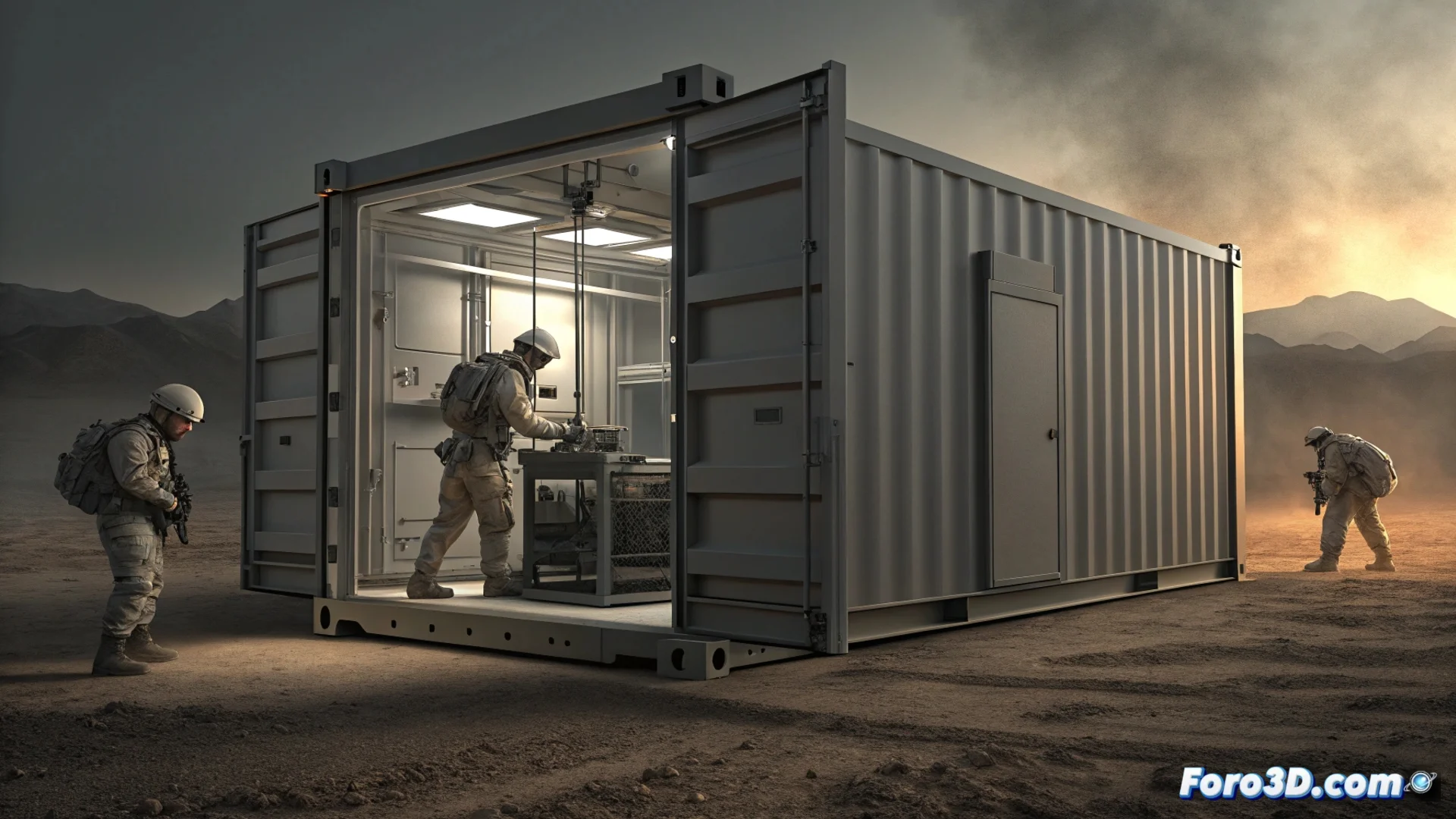
Forgex Deploys Additive Manufacturing in Remote Areas with Mobile Container
The company Forgex has devised a additive manufacturing solution designed to operate in isolated or hard-to-access locations. This approach aims to minimize waiting times to obtain tools and spare parts, a decisive factor in areas such as disaster response, infrastructure construction, or military applications. 🚚
An Autonomous and Transportable Production Unit
The core of the system is a mobile container that integrates all the required technology. This portable unit contains industrial-grade 3D printers, a three-dimensional scanning device, computing equipment to process models, and the necessary filament or material. The concept allows deploying this complete workshop near the place where a part is needed, whether in a disaster zone, a civil construction site, or a remote operational base.
The in-situ workflow:- The process begins by scanning a damaged part to generate a digital three-dimensional model.
- Alternatively, a design can be selected from an internal system file library.
- Subsequently, the file is sent to the industrial 3D printers to produce the component.
Manufacturing directly where the component is needed mitigates logistical problems and long delivery times associated with conventional spare parts.
Shortening the Supply Chain is the Main Objective
By producing in situ, Forgex aims to solve the challenges of traditional logistics and long waiting times. This not only accelerates the repair of vital equipment but also reduces the need to store a large physical inventory at each location. The technology enables on-demand creation of custom tools, adapters, or spare parts, providing significant operational flexibility. ⚙️
Key Operational Advantages:- Reduce delivery times for critical components.
- Decrease dependence on centralized warehouses and complex transportation.
- Enable rapid customization of tools and adapters.
The Challenge of Autonomy in Extreme Environments
The promised autonomy of the solution faces the practical reality of operating in the field. The system's viability may depend on factors such as the reliability of the network connection for transferring design files, where a slow or unstable connection could jeopardize the process. The idea of a dial-up modem as the only link metaphorically underscores the technical challenges that persist when implementing advanced technology in remote and hostile environments. 🏔️