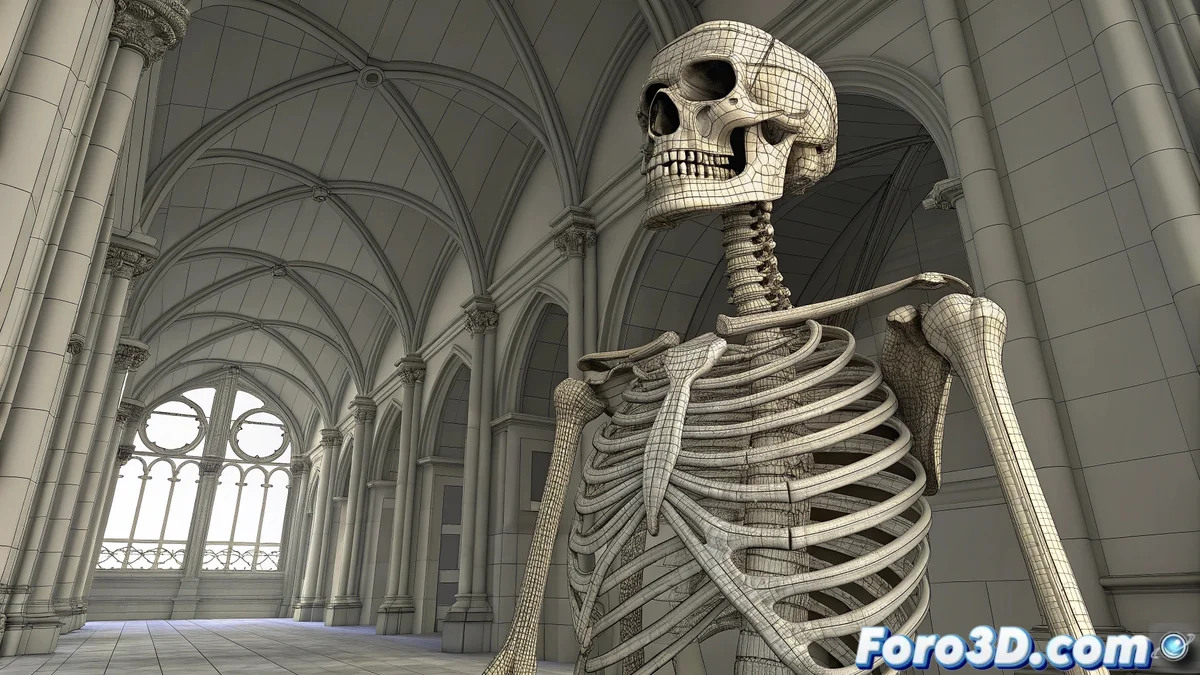
Uncovering Royal Secrets through 3D Modeling 👑
A new forensic study on the skeleton of an ancient European monarch has revealed genetic anomalies that could rewrite his family history. This finding, which analyzes chromosomal differences and mutations challenging established historical versions, finds in Autodesk Maya the perfect tool for its visualization. The software allows reconstructing the skeleton with anatomical precision, lighting it like in a forensic laboratory, and presenting the anomalies in a clear and impactful way, bridging archaeology, genetics, and digital technology.
Precise Anatomical Modeling in Maya
The process begins by modeling each bone of the skeleton separately, using archaeological references and historical radiographs to ensure accuracy. Employing techniques of box modeling and extrusions, the skull, spine, ribs, and limbs are built with attention to details like cranial sutures, vertebral holes, and joints. Modifiers like Smooth and Bevel refine the edges, while Deformers allow adjusting proportions to reflect the monarch's unique characteristics—perhaps an unusual stature or documented malformations. 💀
Forensic Laboratory Lighting
To emulate a forensic laboratory environment, a lighting setup is configured with cold and directional Area Lights that bathe the skeleton from clinical angles. Side lights accentuate bone textures and anomalies, creating defined shadows that highlight fractures or asymmetries. The use of Light Linking ensures that certain lights illuminate only specific bones, guiding the viewer's gaze toward the most significant findings. A neutral and minimalist background keeps the focus on the model.
Lighting a skeleton is like revealing a story; every shadow tells a life, every highlight a secret.
Rigging and Subtle Rotation Animation
Although the focus is static, a basic rig is applied to the skeleton to allow smooth and controlled rotation. Bones are grouped into logical hierarchies—spine as a kinematic chain, limbs with rotation controls—and constrained to a main controller that rotates the entire assembly. This setup allows animating a slow 360-degree rotation, as if the skeleton were in an examination display case, revealing every angle without distractions.
Visually Highlighting Genetic Anomalies
The anomalies reported in the study are emphasized through visual resources:
- Subtle emissive materials on bones with key mutations
- Wireframe overlays in areas of genetic interest
- Normal map textures that exaggerate surface irregularities
- Animated measurement lines that indicate unusual proportions
These elements transform the anatomical model into an educational tool on historical genetics.
Composition and Final Rendering
The scene is rendered with Arnold to maximize the realism of bone materials—adjusting SSS to simulate calcium and phosphate, and reflection for slightly porous surfaces. Close-up planes on the skull or pelvis—where genetic anomalies often manifest osseo—complement general views. Basic post-production adjusts contrasts and saturation for a raw and documentary aesthetic.
The Irony of the Technical Process
While historians decipher genetic anomalies from centuries past, we decipher why the rig's bones go crazy when rotating. In the end, our digital monarch may have misaligned ribs, but at least we won't blame royal inbreeding... just the weight maps. 😅