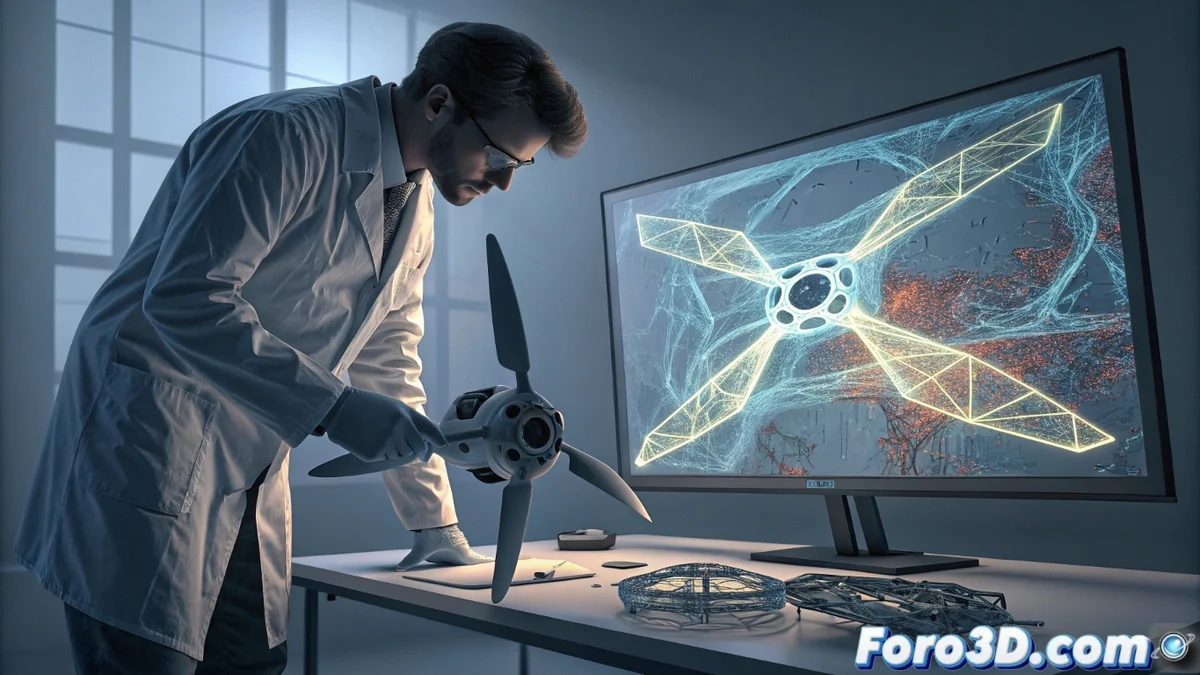
Forensic Analysis of Drone Collisions: Reconstructing the Accident
When a drone collides with a light aircraft or another drone, clarifying what happened requires a rigorous scientific method. Experts follow a technical protocol that transforms the wreckage remains into conclusive digital evidence. 🛩️💥
Digitalizing the physical evidence is the first step
The investigation begins by collecting all recovered fragments. To document them, high-precision 3D scanners such as the Artec Micro or the Space Spider are used. These devices capture the geometry and textures of each damaged piece, creating an exact three-dimensional digital model that serves as the main evidence.
Initial documentation process:- Recover and catalog all impact wreckage.
- Scan each fragment with 3D technology to capture its shape and surface.
- Generate a digital model that faithfully represents the physical evidence.
The 3D models obtained from scanning become the objective basis for all subsequent forensic investigation.
Process the scanning data in the virtual environment
With the models already digitized, the analysis moves to the computer. In software like Geomagic Control X, the scanned wreckage is aligned and compared with the original blueprints of the devices. This phase allows precise measurement of how the material deformed and classification of each impact mark. Determining the direction of a dent or the depth of a cut is key to deducing the contact angle and the energy of the collision.
Key actions in virtual analysis:- Align the 3D models of the wreckage with the original technical blueprints.
- Measure and catalog all deformations and visible marks.
- Deduce critical parameters such as the impact angle and energy from the marks.
Simulate the collision to find the truth
The final stage integrates all the information into a multibody dynamics simulator. Tools such as an adapted version of PC-Crash for drones, or even Blender for previewing the sequence, can be used. Here, the collision is recreated by testing different hypotheses of speed and trajectory. The goal is to find the only scenario that reproduces exactly the damages documented in the 3D models, which determines the relative speed and impact point that caused the accident. This technical report serves to establish responsibilities objectively. Often, the drone that caused the problem leaves the least wreckage, turning the investigation into a complex puzzle where each fragment tells part of the story. 🔍🧩