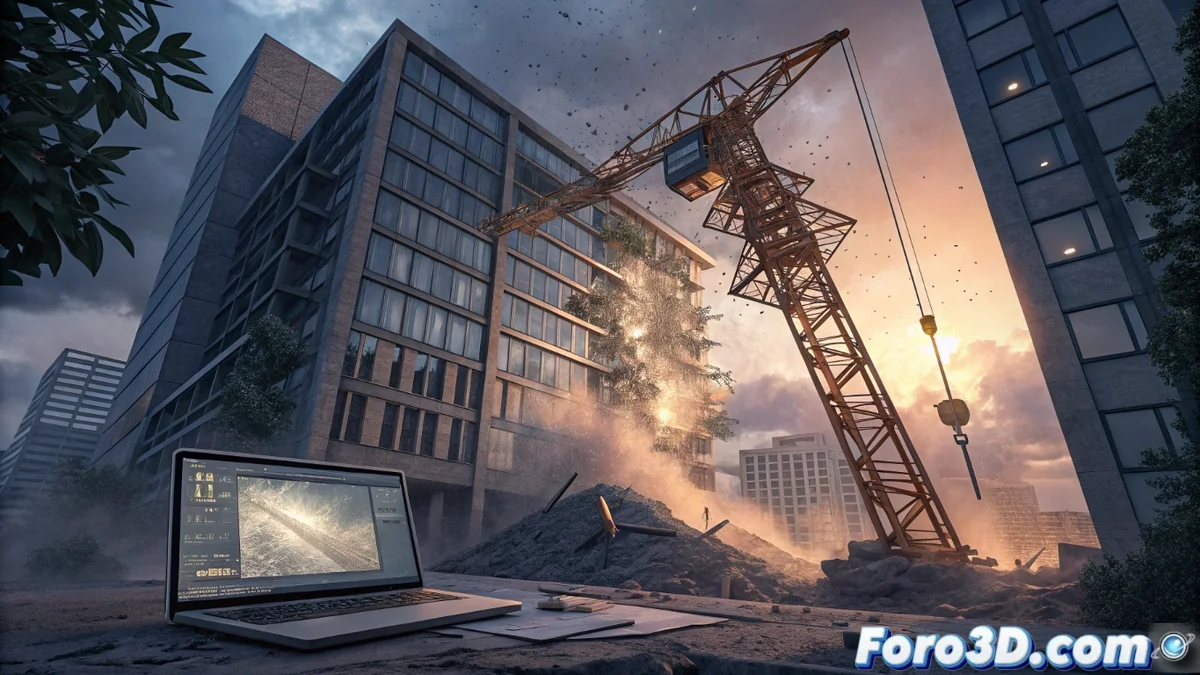
Forensic Analysis of a Structural Collapse Using CFD and FEA Simulation
The collapse of a tower crane onto a construction site is a critical event that triggers a meticulous technical investigation. To uncover the truth behind the accident, experts turn to reverse engineering and powerful digital simulations. The goal is to build a 3D forensic pipeline that accurately reconstructs the equipment's state at the moment of the incident, integrating various computational disciplines to test failure hypotheses independently. 🏗️🔍
Digital Scenario Reconstruction
The first phase is the creation of a high-fidelity parametric CAD model. Using tools like SolidWorks or AutoCAD, the manufacturer's original plans are combined with photogrammetry techniques applied to the recovered debris. This model becomes the master reference geometry. In parallel, all contextual data from the event is gathered and digitized: wind profiles from weather stations, records of the handled loads, and testimonies detailing the collapse sequence. This information sets up the realistic boundary conditions that will feed the subsequent analyses.
Key data for simulation:- Accurate 3D geometry: CAD model generated from plans and scanning of the debris.
- Environmental conditions: Wind profiles, temperature, and other meteorological variables at the time.
- Operational conditions: Hoisted load, jib configuration, and rotation angle recorded.
"The accuracy of the simulation critically depends on the quality and truthfulness of the input data. An error here invalidates the entire subsequent analysis."
Parallel Simulation of Loads and Stresses
The analysis process branches into two parallel simulation lines for a comprehensive evaluation. In one stream, using software like Ansys Fluent, a CFD simulation (Computational Fluid Dynamics) is run to calculate the wind effect around the crane's complex structure, determining the aerodynamic forces and overturning moments generated. In the other stream, with finite element analysis (FEA) tools like Abaqus, the structural model undergoes a nonlinear study, applying both the working load and the wind forces extracted from the CFD simulation.
Computational investigation lines:- Aerodynamic Analysis (CFD): Simulates wind flow and calculates pressures and forces on the structure.
- Structural Analysis (FEA): Evaluates stresses, deformations, and failure modes under combined loads.
- Results correlation: Compares simulated stresses with design limits and observed field damage.
Root Cause Determination and Conclusion
Cross-comparison is the final and most crucial step. The simulated maximum stresses are confronted with the strength limits specified by the manufacturer. Simultaneously, the failure mode predicted by the FEA software is contrasted with the collapse pattern observed in the physical debris. This process allows isolating the probable cause: whether it was an operational overload, an unconsidered extreme wind event, a material defect, or a failure due to accumulated fatigue. The definitive answer often lies in the data from a results file, a digital testimony that outweighs any assumption. 📊💡