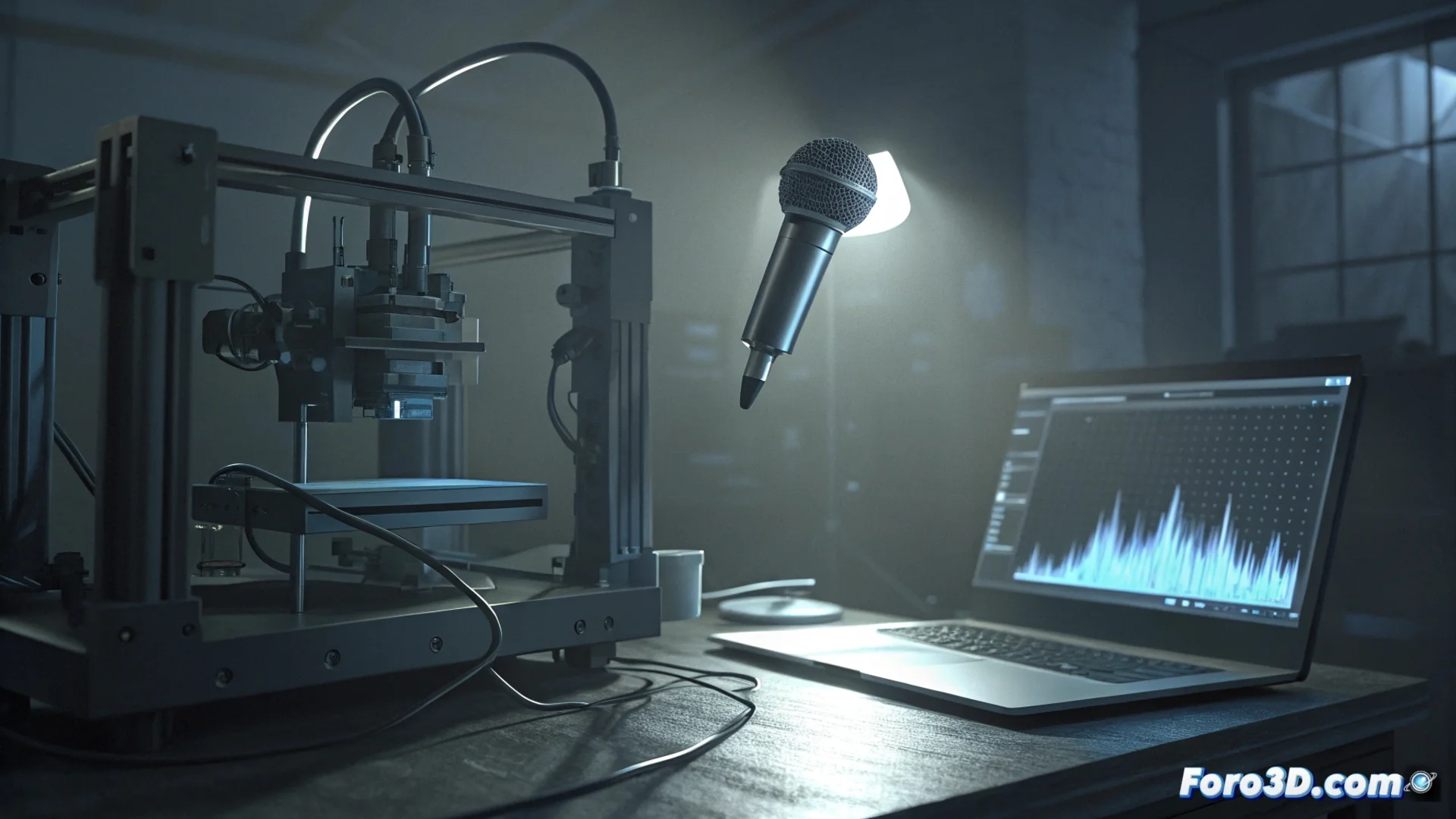
Forensic Acoustics Detects 3D Model Thefts Through Printing Sounds
A new investigation technique, forensic acoustics, is applied to protect intellectual property in the 3D printing field. When a company suspects that a competitor is illegally copying one of its patented designs, it can analyze the sound produced by the suspicious 3D printer. This method turns background noise into key digital evidence. 🔍
From Noise to Motion Data
The discreetly recorded sound contains the unique acoustic signature of the stepper motors. By processing this audio signal with FFT analysis (Fast Fourier Transform), the dominant frequencies are isolated. These frequencies directly correspond to the electrical pulses that control each axis of the machine. Specialized software translates these frequencies back into the sequence of steps and micro-steps executed by the motors, accurately reconstructing the movements on the X, Y, and Z axes. This sequence is finally converted into G-Code commands, the universal language that tells 3D printers what to do.
Key steps in the analysis process:- Record the acoustic signature: Covertly capture the sound of the 3D printer during operation.
- Isolate motor frequencies: Use FFT analysis to filter and identify stepper motor frequencies.
- Translate to motion: Convert the isolated frequencies into the exact step sequence for each axis.
The hum of innovation can be transformed into the evidence that exposes it, revealing that even the most common noise holds secrets.
Recreate the Design from Recovered Code
Once the G-Code is obtained from the sound, the next step is to simulate the path followed by the print nozzle. This path defines the precise contour of each layer of the object being fabricated. By digitally stacking these layers in 3D design software like Blender or Fusion 360, a geometric replica of the original model is regenerated. This digital evidence, obtained solely from an audio recording, can then be directly compared to the patented design to look for matches that confirm the infringement.
Model reconstruction process:- Simulate paths: Use the recovered G-Code to recreate the nozzle path layer by layer.
- Stack digital layers: Assemble the paths in 3D software to form the complete geometry.
- Compare and contrast: Compare the reconstructed model with the original patented design to validate similarities.
A New Frontier in Design Protection
This methodology demonstrates how forensic acoustics emerges as a powerful tool to investigate intellectual property thefts in the 3D design world. The process of converting sound into geometry highlights the vulnerability of manufacturing processes and, at the same time, offers an ingenious method to protect innovation. The paradox is evident: the sound that announces creation can, with the right analysis, betray its unauthorized copy. 🛡️