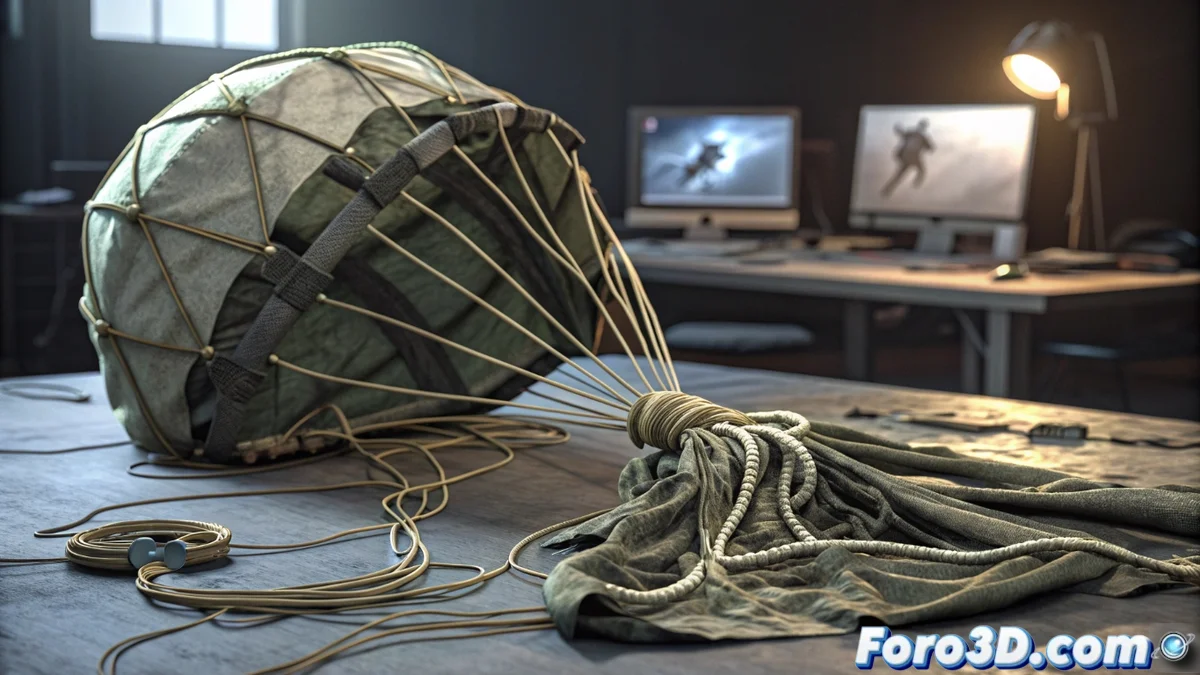
Forensic 3D: Unraveling Skydiving Accidents with Scanning and Simulation
When a fatal skydiving accident occurs, the physical evidence is fragile and critical. Manipulating tangled gear can destroy vital clues. To avoid this, experts turn to 3D scanning technology, creating an exact digital replica that preserves the scene forever. This is the first step in a modern forensic process that combines reality capture, physical simulation, and animation. 🕵️♂️
Capturing Intangible Evidence with 3D Scanning
The process begins with documenting the gear as it was found. Handheld 3D scanners, such as the Artec Leo, are used to record with millimeter precision the position of every element: lines, straps, rings, and knots. This three-dimensional model becomes the primary object of study, allowing investigators to examine, measure, and analyze without physical contact. Thus, an objective and unalterable foundation is established for all subsequent investigation.
Key Advantages of Forensic 3D Scanning:- Intact preservation of evidence in its original state.
- Creation of a digital archive for repetitive and risk-free analysis.
- Precise measurement of angles, tensions, and contact points.
The scanned 3D model is the perfect and measurable photograph of the moment of failure, a silent witness that does not deteriorate.
Physical Simulation to Reverse the Accident
With the digital model as a reference, the investigation advances to the simulation environment. Tools like Marvelous Designer or CLO 3D, specialized in the physics of fabrics and ropes, allow recreating the mechanical properties of the parachute. In this virtual space, experts can untangle the gear in a controlled manner, following the accident sequence in reverse. This methodology enables isolating critical events, identifying anomalous frictions or knots that precipitated the failure.
Stages of Simulation Analysis:- Import and preparation of the scanned 3D model in simulation software.
- Application of realistic physical properties to materials (fabrics, ropes).
- Execution of reverse simulations to decompose the entanglement sequence.
Validation through Forensic Animation
The final phase consists of reconstructing and validating the accident hypothesis. Using 3D animation software like Blender, an animated sequence is generated that visually narrates the events, from deployment to collapse. This animation is not only a powerful tool for presenting findings in legal contexts but also serves to contrast the theory. If the animation can reproduce the tangled state captured by the scanner, the hypothesis gains formidable technical solidity, pointing to the component or action that initiated the catastrophic failure. 🎬