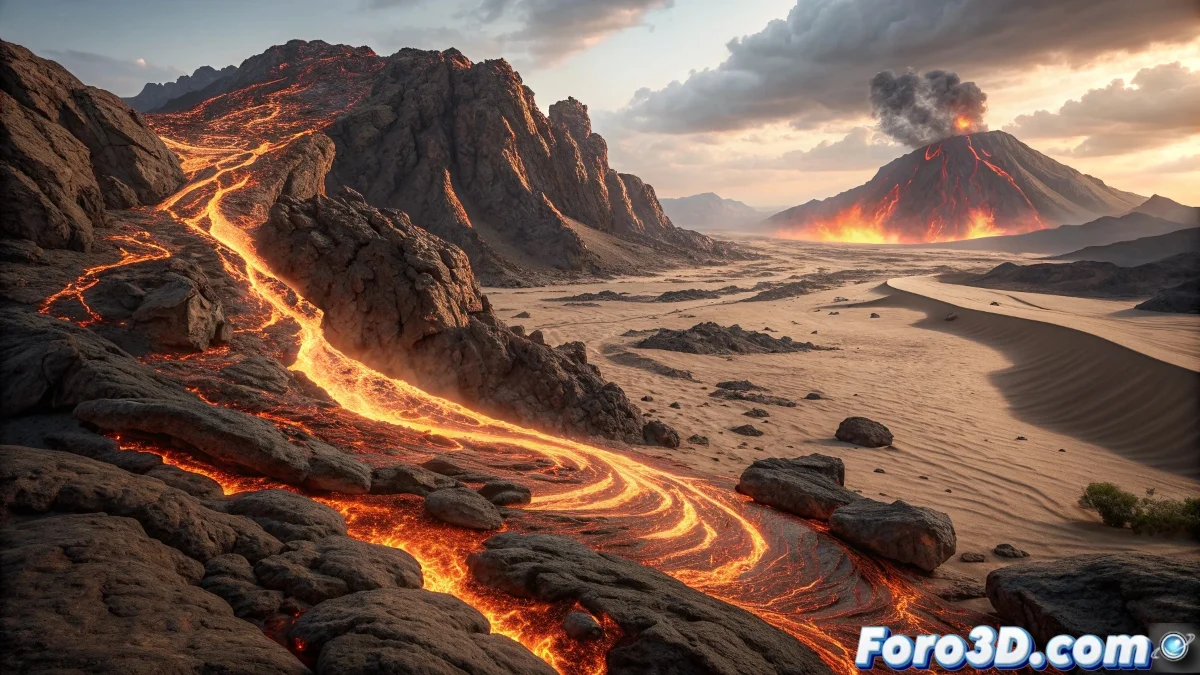
Fluid Flow for Blender: Tool for Painting Lava and Sand Directly in 3D Scenes
Fluid Flow emerges as a revolutionary tool within the Blender ecosystem, allowing artists to add and paint lava or sand directly in their 3D scenes. This innovative addon significantly simplifies the creation of realistic fluid effects without the need to resort to complex physical simulations, offering an intuitive and fast workflow for artists of all levels seeking to incorporate liquid and granular elements into their projects. 💧
Revolution in the Fluid Effects Workflow
Fluid Flow represents a paradigm shift in the creation of fluid effects in Blender. Traditionally, generating lava, sand, or other fluid materials required computationally intensive simulations and complex technical setups. This tool eliminates those barriers through a direct painting approach.
Advantages over traditional methods:- Elimination of baking and simulation times that slow down the workflow
- Direct artistic control over the fluid's appearance and behavior
- Ability to work in real-time with immediate visual feedback
- Compatibility with any existing geometry without special preparation
- Efficient resource usage that doesn't require specialized hardware
- Seamless integration with Blender's material and lighting system
Fluid Flow democratizes the creation of fluid effects, putting the power of advanced simulation in the hands of artists rather than technicians.
Lava Painting: Volcanic Effects Instantly
The lava painting system in Fluid Flow allows creating convincing volcanic effects with real-time adjustable parameters. Artists can define lava flows, control viscosity, and adjust thermal properties through an intuitive brush stroke approach.
Features for lava creation:- Specialized brushes for different lava flow behaviors
- Viscosity control that affects how lava spreads and accumulates
- Temperature parameters that influence color and light emission
- Erosion tools that simulate how lava modifies the terrain
- Integrated smoke and particle effects for greater realism
- Automatic flow animation with speed and direction control
Sand Painting: Simplified Granular Dynamics
The sand module offers equally impressive tools for granular materials, allowing to create dunes, accumulations, and collapses of sand with credible physical behavior without complex simulations. 🏜️
Capabilities for sand work:- Brushes that simulate different types of sand (fine, coarse, etc.)
- Angle of repose control for naturalistic accumulations
- Wind tools that create aeolian patterns on the surface
- Interaction with objects that leave footprints and modify the terrain
- Different moisture states that affect appearance and behavior
- Generation of stratified layers with color and texture variations
Intuitive Interface and Optimized Workflow
The Fluid Flow interface has been designed with a focus on usability, presenting logical and accessible controls even for users without prior experience in fluid dynamics. The learning curve is notably smooth.
User interface elements:- Unified panel with essential parameters organized by category
- Real-time preview that shows changes immediately
- Customizable brushes with size, strength, and behavior adjustments
- Painting modes for different phases (base, details, effects)
- Presets for common scenarios (volcano, desert, beach, etc.)
- Correction and fine-tuning tools to perfect results
Integration with the Blender Ecosystem
Fluid Flow integrates seamlessly with Blender's native tools, leveraging the Eevee/Cycles material system, lighting, and rendering for consistent results within the standard pipeline.
Compatibility and integration:- Use of the material node system for customizable appearance
- Compatibility with all Blender render engines
- Integration with the particle system for additional effects
- Works with any existing mesh without requiring specific geometry
- Support for keyframe animation of parameters and properties
- Preservation of work during Blender updates
Practical Applications and Use Cases
The versatility of Fluid Flow opens up numerous creative possibilities across different industries and project types. From cinematographic productions to video game development, the applications are extensive.
Highlighted use cases:- Concept art and previsualization for VFX productions
- Environment creation for video games and immersive experiences
- Scientific and educational visualization of geological phenomena
- Architecture and landscape design with natural elements
- Generative art and abstract visual experimentation
- Content production for motion graphics and broadcast
Performance Optimization and Efficiency
One of the greatest achievements of Fluid Flow is its computational efficiency. Unlike traditional fluid simulations that consume significant resources, this tool offers visually convincing results with minimal performance impact.
Performance advantages:- Real-time work even on modest hardware
- No prior baking required to see results
- Efficient use of memory and processing
- Scalability that maintains performance in complex scenes
- Compatibility with Blender's viewport for interactive work
- Efficient rendering without significant additional overhead
Conclusion: Democratizing Fluid Effects in 3D
Fluid Flow for Blender represents a significant advancement in the accessibility of complex visual effects. By transforming fluid creation from a complex technical process into an intuitive artistic experience, this tool not only accelerates workflows but empowers creators to explore possibilities that previously required advanced specialization. For 3D artists seeking to incorporate dynamic lava and sand elements into their projects without the burden of intensive simulations, Fluid Flow establishes itself as an indispensable solution that combines power with simplicity in Blender's ever-evolving ecosystem. 🌋