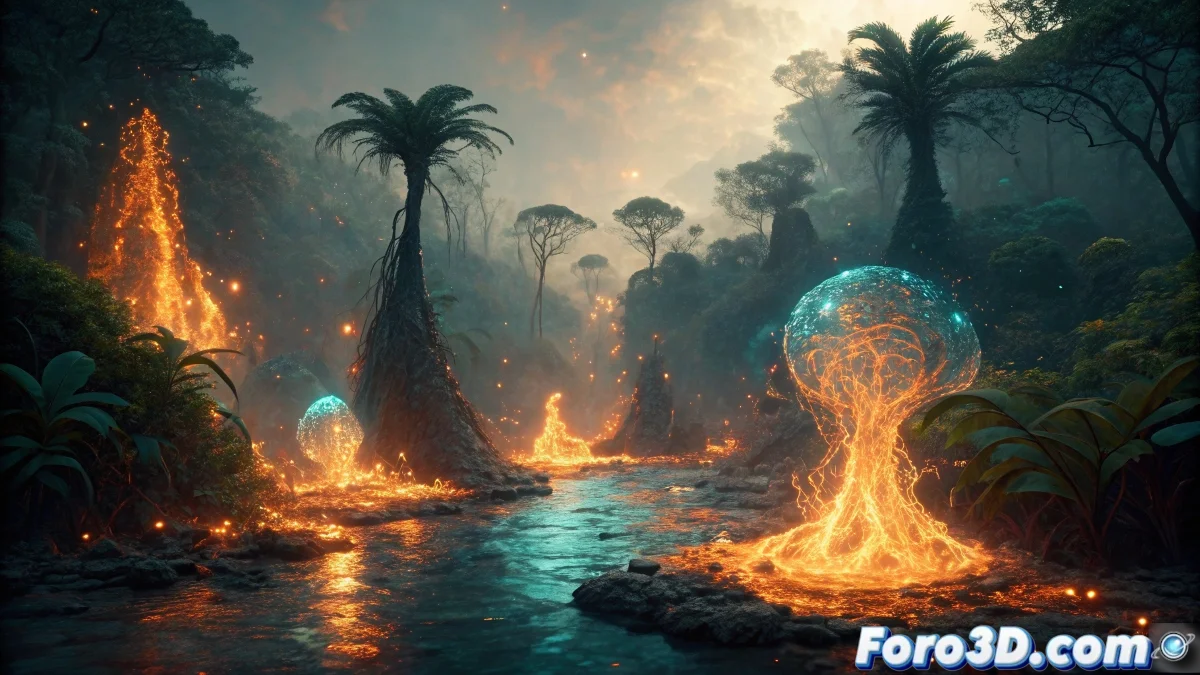
Fluid and Fire Simulation Techniques in the Avatar Movies
The creation of the world of Pandora in the Avatar movies represents one of the most ambitious technical challenges in the history of visual effects. Particularly, the simulation of natural elements like fire and water required revolutionary innovations from the Weta Digital teams. These elements are not mere decorative effects, but fundamental narrative components that interact organically with the characters and the environment. To achieve this level of realism, Weta developed proprietary simulation systems that combine advanced fluid dynamics with sophisticated volumetric lighting, setting new standards for the film industry. 🌊🔥
The Complexity of Simulating Pandora's Nature
What distinguishes the simulations in Avatar is their unprecedented scale and complexity. Unlike isolated effects, the elements in Pandora exist within a coherent ecosystem where fire interacts with bioluminescent vegetation, water flows through alien landscapes, and the atmosphere itself is a character. The Weta teams could not rely on pre-existing solutions; they had to create custom simulation engines capable of handling multi-physics interactions at scales ranging from dew drops to giant waterfalls and epic forest fires. Each simulation had to account for gravity, density, viscosity, and the specific optical properties of Pandora's world.
Natural Elements Simulated in Avatar:- Rivers, waterfalls, and moving bodies of water
- Fire and combustion at different scales
- Atmospheric effects and volumetric fog
- Fluid-solid interaction with characters and creatures
- Particle systems for foam, sparks, and ashes
Integration of Volumetric Lighting into Simulations
The most innovative aspect of Weta Digital's work is how they integrated volumetric lighting directly into the simulation process. Instead of being an effect applied afterwards, light is a fundamental component of the physical simulation. For fire, this means that the calculated heat and combustion directly affect how light scatters through the flames and smoke. For water, the simulation takes into account how light refracts, reflects, and absorbs at different depths and with different levels of turbidity. This unified approach allows Pandora's natural elements to possess an organic luminescent quality that makes them feel alive and an integral part of the world.
In Avatar, light does not illuminate the effects; the effects generate their own light.
Technical Challenges of Scale and Performance
The computational magnitude required for these simulations is difficult to exaggerate. A single complex shot could involve tens of millions of simulated elements interacting with each other. Fluid simulations use highly refined FLIP (Fluid-Implicit-Particle) methods that combine the precision of Eulerian grids with the flexibility of Lagrangian particles. For fire, the systems combine combustion simulation, gas dynamics, and heat transport. These simulations are so computationally intensive that they require render farms with thousands of nodes working in parallel for days or even weeks to complete particularly complex shots.
Required Technical Infrastructure:- Render farms with thousands of CPUs working in parallel
- High-speed storage systems for petabytes of data
- Proprietary simulation software optimized for massive scalability
- Production pipeline capable of handling complex iterative versions
- Real-time visualization tools for previsualization
Credible Interaction with Characters and Environment
The true magic of the simulations in Avatar lies in how they interact convincingly with the digital characters and the environment. When a Na'vi walks through a river, the water does not simply displace; it reacts to the character's weight, speed, and specific movement. When fire burns near vegetation, it blackens, chars, and eventually consumes it in a believable manner. Achieving this requires a deep integration between simulation and animation systems, where characters exert realistic forces on the fluids and these, in turn, affect the lighting and reflections on the characters. It is a physical feedback loop that creates a sense of world cohesion.
The Technical Legacy of Avatar in the Industry
The techniques developed for Avatar have had a profound impact on the entire visual effects industry. Many of the advances in fluid simulation and volumetric lighting have been adapted and refined for use in other productions. Weta Digital's approach of treating natural elements as integrated systems rather than isolated effects has influenced how digital world creation is approached in contemporary cinema. The tools and methodologies developed for Avatar continue to evolve, promising to take the realism of natural effects to new levels in future productions.
The fluid and fire simulation work in the Avatar movies represents the culmination of decades of visual effects advances, taken to their most advanced expression. It is not simply about creating impressive images, but about building a coherent and physically believable alternative reality where every element, no matter how ephemeral, obeys the laws of its world and contributes to the viewer's immersion. In Pandora, water flows, fire burns, and light dances not as special effects, but as essential components of a living and breathing ecosystem, a testament to the power of technical art when exercised at its highest expression.